NAICS Codes and Size Standards: How Eligibility Is Decided
Nov 18, 2026 · 11 min read

You certified as a small business on a services notice last quarter and nobody questioned it. This month a different agency posts a requirement in another industry, you check the same box, and a competitor files a size protest. Your revenue didn't move. Your headcount didn't move. The industry code on the notice did.
That gap between "I'm small" and "I'm small for this procurement" is where most firms get hurt in their first few years of federal work. There's no single small-business limit to memorize. There's a limit attached to each industry classification, and each procurement carries one classification chosen by the contracting officer. NAICS codes and size standards only mean something as a pair, and the pair changes from notice to notice.
Two contractors with identical revenue and identical staff can sit on opposite sides of the line on the same day, because they're bidding different work. Once you see the code as the thing that sets the test, the whole eligibility question gets simpler and a lot less scary.
Table of Contents
- How to Find the Size Standard for a Solicitation
- Receipts-Based and Employee-Based Standards Side by Side
- How Revenue, Headcount and Affiliates Are Counted
- Recent NAICS Revisions and Your Size Limit
- Eligibility Mistakes That Cost Bids and How to Avoid Them
- Confirm Your Size Before You Bid on the Next Notice
How to Find the Size Standard for a Solicitation
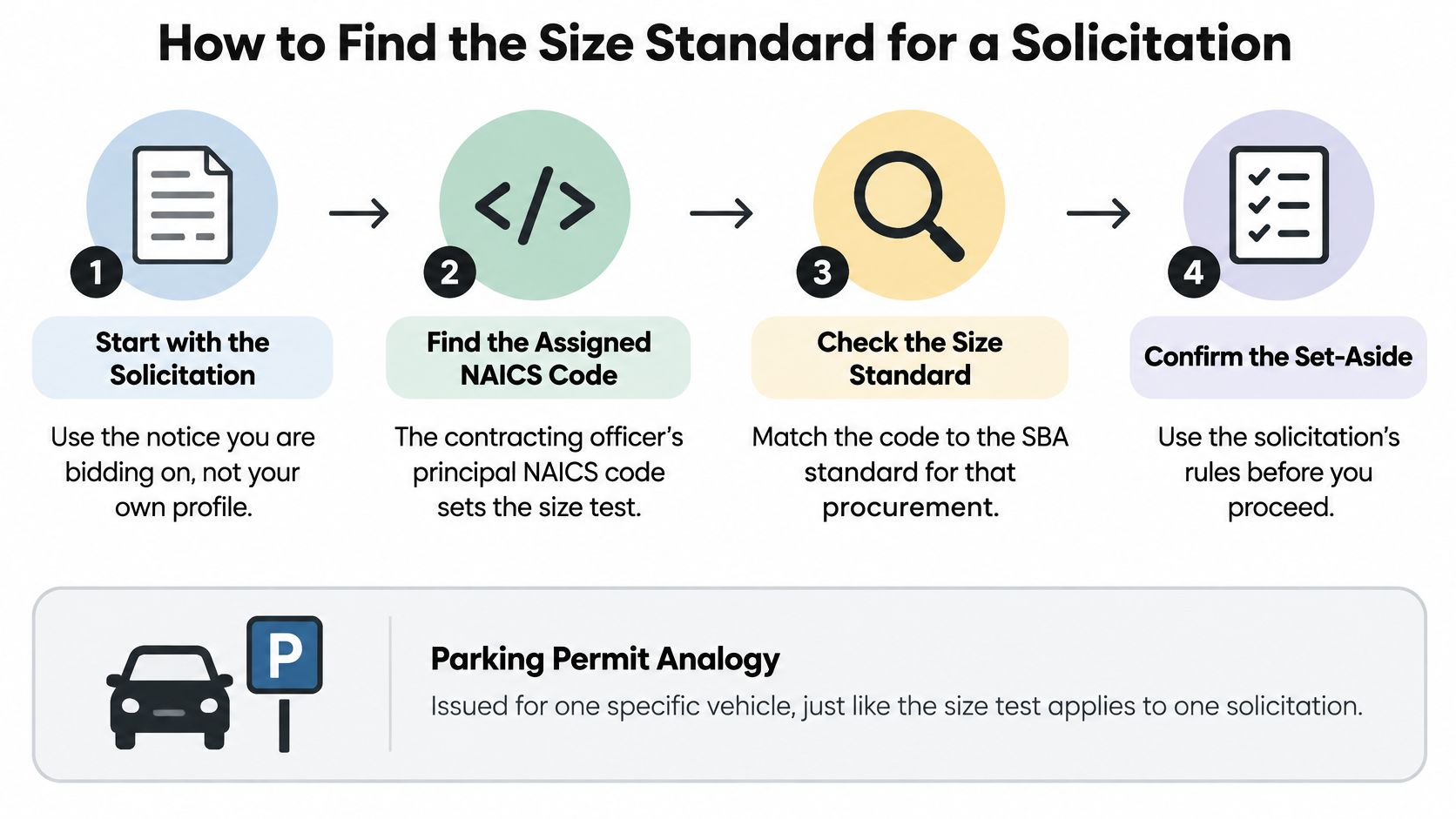
Every notice carries exactly one size test, and the buyer picks it. When the contracting officer assigns the solicitation's principal NAICS code, that code determines the applicable SBA small-business size standard for the procurement, which is why a company can qualify as small under one code and fail under another, as SBA's guidance on NAICS appeals and size standards explains.
Think of a parking permit. It's issued for one vehicle in one lot. The same car, driven to a different lot, has no permit at all. Your revenue is the car. The solicitation is the lot. Nothing about the vehicle has to change for the answer to flip.
Six steps from notice to answer
- Open the notice and read the assigned code. On SAM.gov the principal NAICS code sits in the notice data. Don't work from the codes you saved in your company profile, because the profile isn't what governs this bid.
- Confirm whether the notice is a set-aside. Size rules bind set-asides directly. If the notice is unrestricted, size may matter less for eligibility and more for teaming.
- Look the code up in SBA's current table of size standards. Write down two things: the threshold, and whether it's stated as an average annual receipts amount or an employee count. The unit matters as much as the number.
- Compute your own figure for the matching period. Receipts and headcount use different look-backs, so a number built for the wrong period is worse than no number.
- Add your affiliates. A parent, a sister company or a shared owner can push your combined figure past the threshold even when your own books look comfortable.
- Compare and get a second read if you're close. Within 10 percent of the limit either way, have someone else redo the arithmetic before you commit proposal hours.
Here's the sequence as a single picture.
Run one hypothetical. A firm averages $9 million in annual receipts with 40 employees. It bids a services code with a $12 million limit and passes easily. Same firm, same year, bids an industry code capped at $7 million and fails by $2 million. Nothing changed except which lot the car parked in.
Keep one line per notice. Assigned code, threshold and table version, your figure, the period you used, and the date you checked. Six fields, written before you draft a word.
Clearing size is only the first gate. The rest of the notice still has to be mapped requirement by requirement, and a compliance matrix for a government RFP keeps that work in one place once you've decided to bid.
Receipts-Based and Employee-Based Standards Side by Side
A size standard is always written in one of two currencies: average annual receipts or average employment, as SBA's guidance for businesses getting started in federal contracting sets out. The NAICS code chooses the currency. Your job is only to measure yourself in the one it picks.
| Standard type | How it is measured | Measurement period | Where the threshold is stated |
|---|---|---|---|
| Receipts-based | Total income, or gross income plus cost of goods sold | Averaged over the five most recently completed fiscal years | A dollar amount for each NAICS code |
| Employee-based | Average number of employees per pay period, counting every person on payroll | Average over the preceding 24 calendar months | An employee count for each NAICS code |
| Business operating under 24 months | Averaged over the pay periods it has operated | Months since the business started | The same threshold as its NAICS code |
The table works like a size chart. The NAICS code is the label on the garment, the threshold is the largest size that still fits, and you need to know which measurement the label asks for before you reach for a tape.
The defaults, and why they rarely decide anything
As a foundational rule, most manufacturing businesses with 500 or fewer employees and most nonmanufacturing businesses with average annual receipts below $7.5 million qualify as small, per SBA's size standards guidance for federal contracting. Industry-specific exceptions are substantial, though, and the row for your own code always overrides the default.
That gap between the default and the code is where firms trip. A contractor reads the $7.5 million figure once, remembers it forever, and applies it to every bid. Then a code with a $5 million limit ends the conversation. A firm averaging $6.2 million in receipts clears the general nonmanufacturing test with room to spare and still fails a code capped at $5 million. Same company, same books, different code, different answer.
Receipts, for measurement purposes, means total income, or gross income plus cost of goods sold. Profit, signed contract value and last quarter's invoice total each measure something else, and a figure built on any of them drifts from the number the table wants.
How to read one row of the table
Work left to right. Find the code in the current table. Identify the type, receipts or employees. Read the threshold in the stated unit. Apply the measurement period that belongs to that type, since a receipts figure averaged over the wrong years is a number nobody can defend.
Do that on paper once for your two or three most common codes and you have a reusable baseline. From there, each new notice is a lookup rather than a research project.
How Revenue, Headcount and Affiliates Are Counted
Most size errors happen in the arithmetic, not the lookup. A firm finds the right code, reads the right limit, then measures itself over the wrong window and lands on a number that's either falsely comforting or needlessly discouraging. The calculation is mechanical once you know which period applies.
The receipts path
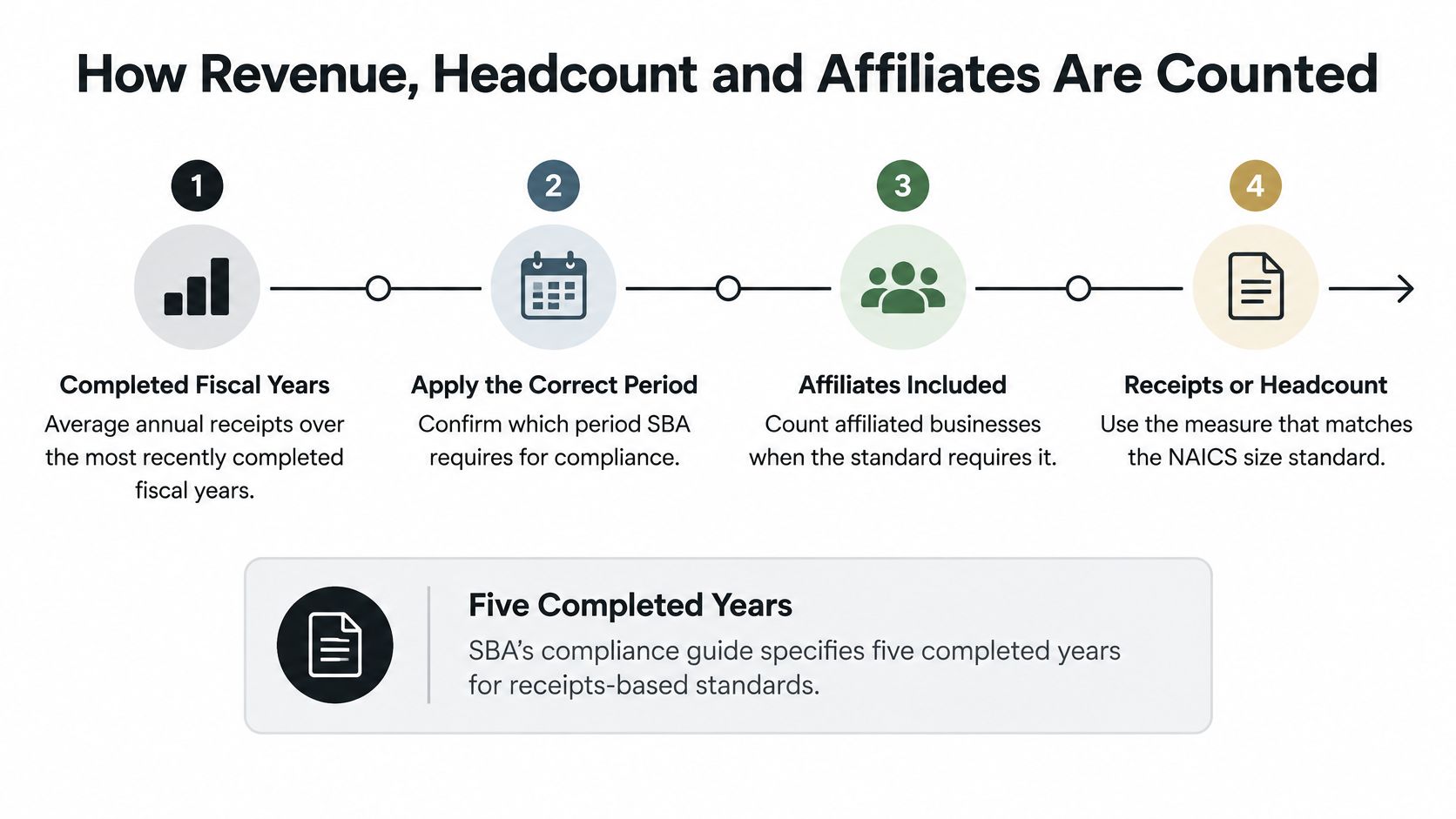
Pull your financial statements for the completed years, take total income or gross income plus cost of goods sold for each year, and average across the period. Then confirm which window the rule wants. SBA's guidance for contracting officials sets the look-back for both methods: the compliance guide specifies five completed fiscal years for its general affiliation-and-size methodology, while employee-based standards average each pay period across the preceding completed 24 calendar months, with every person on the payroll counting as one employee regardless of hours worked or temporary status, per SBA's small business size standards guidance for contracting officials.
Two different windows, two different kinds of number. Mixing them is the single most common self-inflicted error.
Averaging headcount over 24 months
Employee-based standards don't ask how many people work for you today. They ask what your average was across the period. Say a company grew from 80 employees to 140 over two years, hiring steadily. The average across those months lands near 110, not 140. A bidder who reports the current headcount overstates the firm and can talk itself out of work it was eligible to win.
Businesses that have been open less than 24 months average the pay periods they've operated. New firms aren't excluded from set-asides by their short history.
Payroll records beat memory. Run the average from pay-period data in your payroll system, not from a headcount you remember from December.
Affiliates count too
Size calculations generally include subsidiaries and affiliates, so a sister company's revenue or staff can push the combined figure over a limit your own books never approached. Common ownership, shared management and the power to control all feed into that analysis. Before you certify, list every entity connected to yours and decide, in writing, whether it should be counted.
Here's a short walkthrough of the compliance side of this work.
Keep the finished calculation in the bid file with the statements and payroll reports behind it. If an outside CPA prepares your financials, ask them to confirm the receipts figure you plan to certify. A second signature costs far less than a lost protest.
Recent NAICS Revisions and Your Size Limit
A firm can lose its small status without changing a thing. The classification system gets revised, SBA republishes its table against the new structure, and a threshold, a measurement method or the code itself shifts underneath a business that never stopped doing what it does.
The code works like the size tag on a garment. The item on the hanger is the same; the label that decides whether it fits is not. Your revenue and headcount are the garment. The NAICS code, and the revision it came from, is the tag.
The most recent cycle shows how this happens. SBA's size-standard table is now built on NAICS 2022, and the adoption reshuffled enough definitions that a code carried forward from an older bid may no longer map to the limit you remember. SBA's final rule adopting the NAICS 2022 size standards documented the scope of that reshuffle.
What the 2022 adoption changed
| Revision | New industries | Standards increased | Standards decreased | Measurement type changed |
|---|---|---|---|---|
| NAICS 2022 adoption (SBA final rule) | 111 | 22 industries and parts of 2 | 7 industries and parts of 2 | 2 industry categories |
Read that table as uneven ground. For most industries, nothing moved. For the firms inside the changed categories, the same revenue figure that passed a size test last year can fail it on the next solicitation, and a firm that was too large under the old definition can now qualify. Two notices, two different codes or two different table versions, and the same unchanged business gets two different answers.
The version check
Three habits cover almost all of this risk. Verify the code and the limit twice, once in the solicitation and once in the current SBA table. Record the table version and effective date in your bid file alongside your own figure. Never reuse a threshold from a past bid without checking it against the current table first.
That last habit is the one that bites. Past performance files get pulled out and reused because they're convenient, and a figure that was correct two table versions ago looks authoritative sitting in a folder. Run the short check on every notice: which code did the agency assign, which table version is current, and where does your number sit against that limit today. Recheck it before it goes into a certification.
Eligibility Mistakes That Cost Bids and How to Avoid Them
The costliest mistake isn't a miscalculation. It's building a bid around a code the firm chose for the size of its threshold rather than for the work. A convenient code can be challenged, and it can also not describe the requirement, which creates a second problem in the proposal itself.
Mistake one, shopping for the highest limit
The agency names the code in the notice, based on the principal purpose of the procurement, so a bidder's preferred code doesn't control anything unless the notice already uses it. If you're stretching to reach a favorable classification, expect a competitor to notice. Eligibility disputes over the assigned code run through SBA's appeals process, and they cost calendar time you won't get back before the deadline.
Set-aside status adds another layer. If you're relying on a certification like SDVOSB, the certification and the size test are separate gates, and how to find SDVOSB government contracts covers the certification side that many firms assume is already settled.
Mistake two, assuming growth is safe
Firms near the line often assume that crossing it later is a future problem. Check how the solicitation treats size changes between offer and award before you assume anything, and read the representations you're signing rather than the ones you signed last year. Long performance periods and option years create their own questions, and the answers live in the solicitation, not in a blog post.
Mistake three, treating borderline as a pass
A figure that clears the limit by $40,000 isn't a comfortable pass, it's a coin flip with a paperwork advantage for whoever challenges it. Document every input, keep the statements and payroll records together, and ask the contracting officer how the solicitation treats size when the answer is close.
The number is not the answer. A passing figure means something only when it's measured against the assigned code, for the period the rule requires, with every affiliate counted.
Confirm Your Size Before You Bid on the Next Notice
The same firm can qualify as small on one solicitation and fail the size test on the next, with no change in revenue, staff, or day-to-day operations. The variable is the assigned NAICS code, because the code printed on the notice selects the threshold you are measured against. Run the check before the proposal, and write only after the answer is yes.
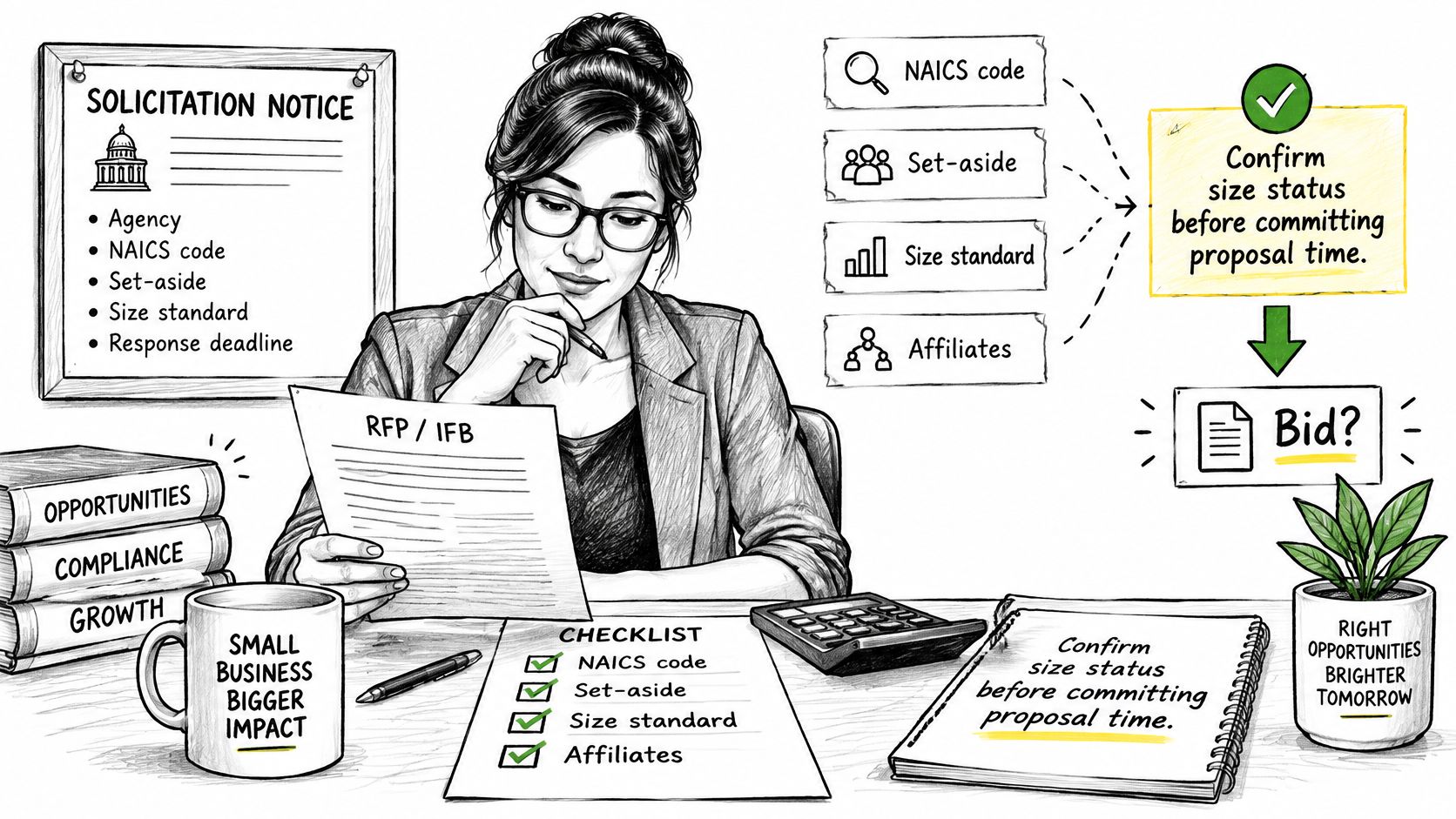
The five-minute size check
- Assigned code: the principal NAICS code exactly as written in the notice.
- Set-aside status: whether the notice is reserved for small business at all.
- Table version: the SBA table and effective date you compared against.
- Your figure: receipts or headcount for the correct period, with the period stated.
- Affiliates reviewed: who you counted, and who you decided not to count and why.
- Date checked: because thresholds and codes both move.
Five minutes per notice, six fields, one consistent file. Firms that run this check stop bidding on work they cannot be awarded, and they stop hesitating on work they are eligible to pursue.
BidFunnels runs the same early screen. Every federal and state opportunity gets a fit score from 0 to 100 and a verdict of Go, Maybe or Skip, with the reasons in plain words, based on your NAICS codes, set-asides, location and time left to respond. The score tells you where to look first; the size standard stated in the solicitation still gets the final word. Setup takes a UEI or a website, and BidFunnels fills in the company, codes and certifications from there.
If you're new to the market entirely, how to get government contracts for small business covers the groundwork that sits before any of this. Then run the check on your next notice and let the assigned code decide whether you're small.
BidFunnels pulls federal notices from SAM.gov and state opportunities into one list, then scores each one against your NAICS codes, set-asides, location and time left to respond, so the size question gets answered before you invest in a proposal. You can start with a seven-day Pro trial, no card required, and see how the fit score reads on the codes you bid. Visit BidFunnels to get started.