

How to Find HUBZone Government Contracts: Step by Step
Nov 24, 2026 · 10 min read

Typing HUBZone into SAM.gov and bidding on whatever appears is a poor search strategy. You can spend weeks preparing a response to a notice your company can read but can't pursue. Finding worthwhile opportunities starts with eligibility and procurement pathway, not a keyword match.
Table of Contents
- Why a Plain HUBZone Search Misses Good Notices
- The Seven-Step HUBZone Search Workflow
- SAM.gov Filters to Set Before You Search
- Qualify Each Notice by Procurement Pathway
- Confirm Eligibility and Map Your Designated Areas
- Track Deadlines, Amendments and Bid Decisions
- Pick Your First Three HUBZone Notices This Week
Why a Plain HUBZone Search Misses Good Notices
Certification isn't automatic eligibility for every notice. A requirement can match your services and still exclude your firm through its size standard, contract vehicle, security conditions, or performance requirements. The title is only a starting point.
The SBA's certification guidance sets the government-wide annual HUBZone award goal at at least 3% of federal contract dollars and describes eligibility conditions including a principal office in a HUBZone and at least 35% of employees living in a HUBZone for at least 180 days before applying. The spending goal establishes market context. It doesn't tell you your probability of winning, or whether a particular buying office purchases your services through this program.
Separate access from advantage
Relevant opportunities don't always say HUBZone in their titles. Look beyond competitive HUBZone set-asides to sole-source notices, unrestricted competitions with applicable evaluation preferences, and potential teaming routes.
Use these questions to separate a searchable notice from a realistic pursuit:
- Eligible to view? A public listing lets you research the requirement, but public access says nothing about your ability to compete.
- Eligible to bid? Check the solicitation's assigned NAICS code, size standard, certification requirements, vehicle access, and mandatory qualifications.
- Likely evaluation advantage? Identify the actual set-aside or evaluation provision that benefits your firm. Don't infer one from your certification.
Practical rule: A matching capability statement isn't enough. Identify the clause that permits your participation before assigning proposal work.
A useful search produces defensible decisions, not a large collection of notices containing the right word.
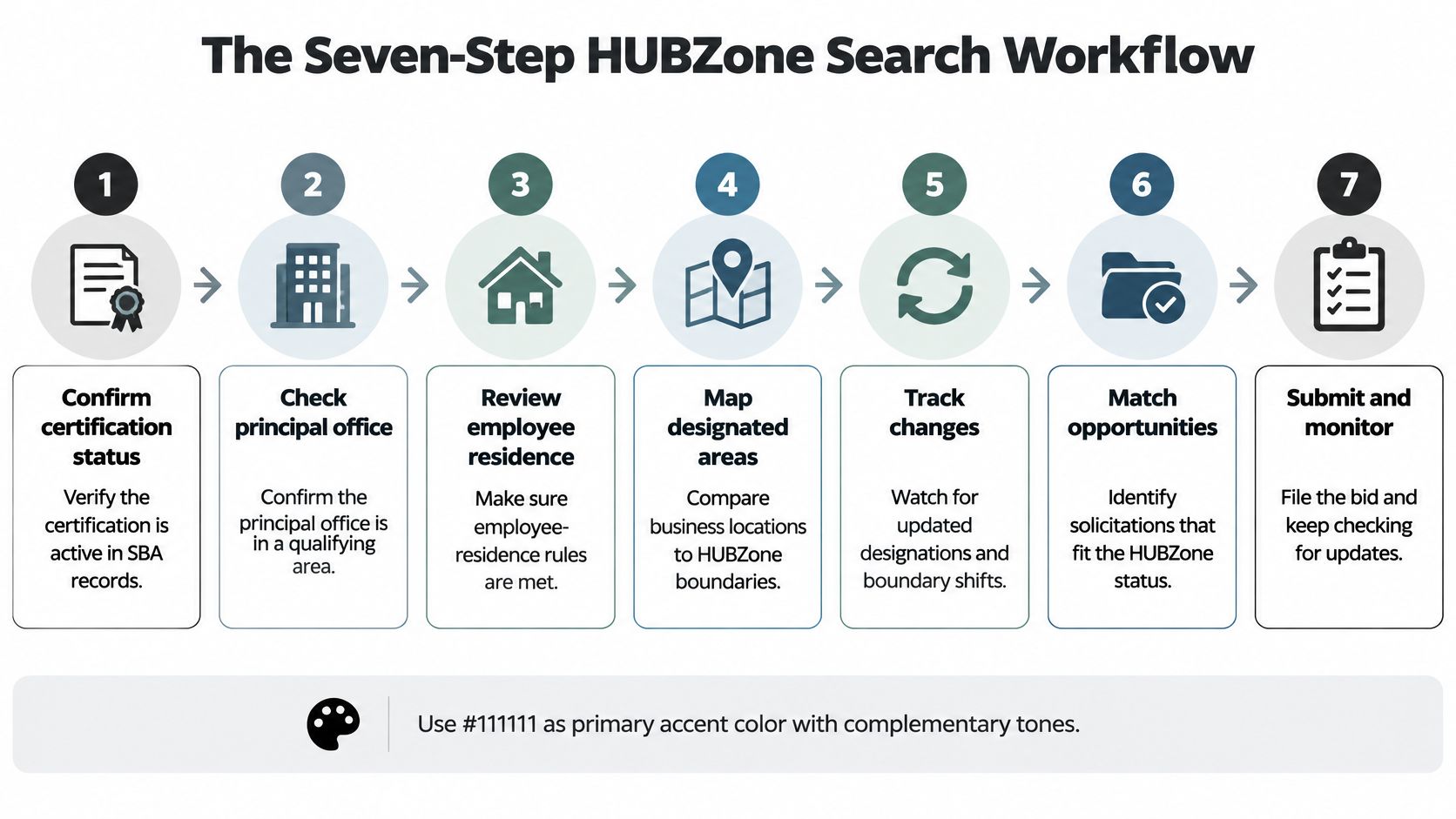
The Seven-Step HUBZone Search Workflow
Use a repeatable routine so that different reviewers reach comparable bid decisions. The SBA's federal contracting and certification guidance supports a qualification-first approach, with SAM.gov as the federal opportunity source and current certification as an input to participation.
Establish the match before drafting
Confirm active certification. Verify your status in SBA records and check that your principal-office and employee-residence evidence remains valid. An old approval letter isn't a substitute for checking current records.
Load an accurate company profile with your primary and supported secondary NAICS codes, size information, and certifications. Otherwise, you'll repeatedly review notices against capabilities or eligibility your company doesn't have.
Search SAM.gov using structured filters. Combine NAICS, set-aside designation, place of performance, and notice type. Use keywords to refine the scope, not to replace those filters.
Classify each candidate by access and advantage, then identify its procurement pathway. A public notice for an intended sole-source award requires a different response decision from an open competitive solicitation.
The visual below summarizes the eligibility checks that should accompany opportunity matching.
Turn a candidate into a decision
Download the complete solicitation package and amendments. Record the notice identifier and retain the documents you reviewed. Working from the summary page alone leaves you exposed to requirements buried in attachments or revised instructions.
Build a compliance matrix with a separate row for each mandatory requirement. Check representations, past performance, pricing instructions, submission format, security conditions, and the deadline's time zone; don't start writing around an unresolved disqualifier.
Record bid or no-bid with a reason and next action. Assign an owner and set amendment and deadline alerts. A saved notice without a decision owner is just another unattended bookmark.
Keep federal and state research separate. If you're also developing a state-market pipeline, State and Local Bid Reviews can help you compare state procurement tools, but state portal coverage doesn't establish access to federal HUBZone set-asides.
A finished review should leave you with a short list whose entries say something useful: eligible and ready for pricing, awaiting clarification about vehicle access, or no-bid because mandatory experience is missing. Track those reasons by agency and NAICS so future searches become more selective.
SAM.gov Filters to Set Before You Search
| Filter | Setting to use | Why it matters |
|---|---|---|
| Set-aside | HUBZone Set-Aside (HZC) | Finds competitive HUBZone set-asides for qualified firms |
| Set-aside | HUBZone Sole Source (HZS) | Identifies possible sole-source leads requiring review of the acquisition rationale |
| Set-aside | Small Business Set-Aside (SBA) | Broadens the pool; inspect the applicable clauses rather than assuming a HUBZone-specific advantage |
| NAICS | Primary code, then supported secondary codes | Connects the requirement's scope with its applicable size standard |
| Place of performance | State, county, or city where work is done | Tests delivery feasibility separately from your HUBZone location eligibility |
| Notice type | Solicitation, presolicitation, sources sought | Separates early market signals from requests requiring a formal offer |
| Posted date | A rolling weekly window | Keeps routine review focused on newly posted opportunities |
| Response deadline | Closing within the coming month | Creates an action list for near-term decisions |
Run separate searches for separate purposes
Set-aside filters do most of the initial sorting. Don't combine every procurement pathway into an indistinguishable results list. Maintain a focused HUBZone search and a broader small-business search, then review unrestricted opportunities separately when you can support the proposal effort.
A general small-business set-aside doesn't automatically provide a HUBZone price preference. Read the actual evaluation provisions, and distinguish subcontracting requirements from a prime contractor's eligibility to compete.
Use secondary NAICS codes only where you can credibly deliver the work. Adding unrelated codes increases review volume without improving your opportunity pool. If your firm holds another certification, maintain a distinct search for that route, using the same discipline described in this guide to finding WOSB government contracts.
Place of performance deserves a separate check. Your office's HUBZone designation doesn't mean you can staff a distant facility, meet an onsite response requirement, or absorb travel costs. Equally, don't assume the work must occur inside your own HUBZone unless the solicitation imposes that restriction.
Search by where you can perform, then verify where you qualify. Those are different questions.
Sources-sought and presolicitation notices belong in an early-engagement queue, not your proposal-writing queue. Save a search for each supported NAICS code, review it on a fixed weekday, and record when you ran it so missed review periods are visible.
Qualify Each Notice by Procurement Pathway
Read the set-aside designation, estimated value, and acquisition rationale together. No single field establishes whether a notice is worth pursuing.
| Pathway | Value filter | What to verify |
|---|---|---|
| Competitive HUBZone set-aside | Above the general small-business reservation range, examine the HUBZone competition determination; don't treat that range as a minimum | Set-aside code, NAICS, size standard, performance clauses, and expected competition |
| HUBZone sole-source award | The SBA's HUBZone administration guidance gives government-estimate limits of $7 million for manufacturing or $4.5 million for other requirements, and describes automatic small-business set-asides at or below $250,000 | Fair price, responsibility determination, and agency acquisition rationale |
| Small business set-aside | Within the automatic reservation range, inspect the actual designation; above it, review the expected competition | Applicable small-business eligibility and any specifically named socioeconomic category |
| Full and open with HUBZone price preference | No separate value screen in this triage | Evaluation factors and applicable preference provisions |
| Subcontracting or joint venture | Screen for a viable delivery role rather than a blanket value cutoff | Subcontracting language and the joint venture's compliance with SBA requirements |
Competition and sole source require different evidence
A competitive HUBZone set-aside requires the contracting officer reasonably to expect offers from at least two responsible HUBZone small businesses at a fair market price. Sole-source authority addresses a different situation, where that competitive expectation doesn't exist and the selected firm must still be responsible at a fair price.
For broader small-business set-asides above the automatic reservation range, the agency's expectation of adequate small-business competition matters. Don't assume that a low estimated value makes a requirement available to you, or that a sole-source notice invites ordinary competitive proposals.
Look beyond HUBZone-titled notices
The SBA's HUBZone program guidance describes a 10% price-evaluation preference in full-and-open competitions, subcontracting routes, and joint-venture participation subject to SBA requirements. A qualifying member's certification doesn't, by itself, make every joint-venture arrangement compliant.
Consider a hypothetical $3.2 million services requirement advertised as full and open. If its evaluation factors apply the HUBZone preference, assess your evaluated position, technical strength, and pricing rather than treating it as restricted competition.
Now consider a hypothetical $180,000 intended sole-source lead. Your immediate task is to read the agency's notice and any permitted capability-response instructions, not prepare a conventional competitive proposal. Being below a threshold doesn't create an entitlement to an award or require the agency to change its acquisition strategy.
Confirm Eligibility and Map Your Designated Areas
Geographic eligibility needs recurring review. In 2025, SBA authorized 10 new Governor-Designated Covered Areas in Kansas, and its HUBZone expansion announcement reports governor-petition approvals across multiple states since January 2025. An address result saved during certification isn't permanent evidence of the designation you should use for a later pursuit.
Treat the map check as a documented qualification task.
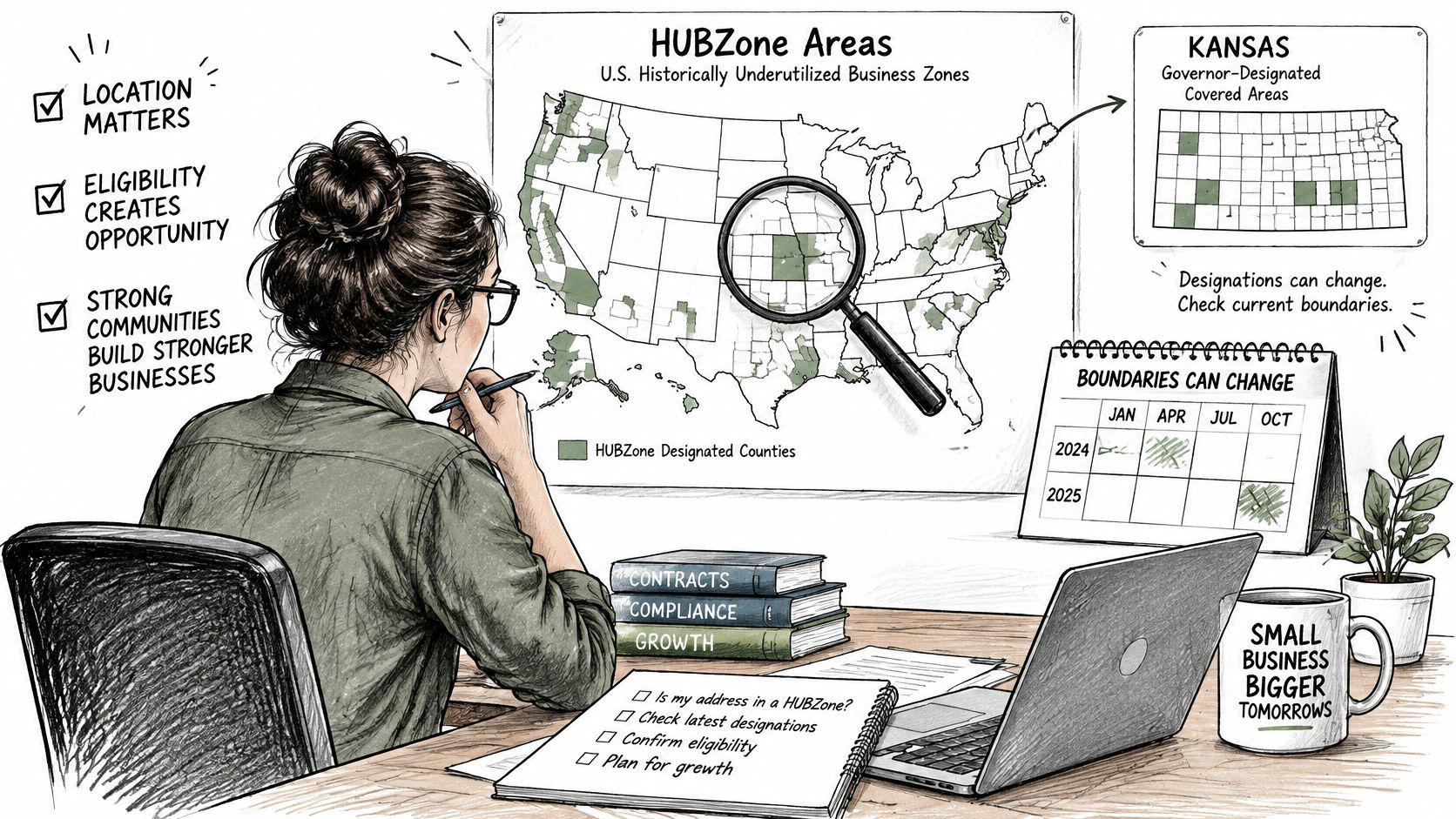
Keep a dated geographic eligibility record
Verify the principal office. Check its address against the current SBA HUBZone map and retain the lookup date. Investigate a changed result rather than assuming it automatically ends or preserves eligibility.
Reconcile employee addresses with your current employment records and applicable residency rules. A map screenshot doesn't establish who counts as an employee or whether the supporting residence history is adequate.
Review before committing proposal resources. Repeat the map check before bidding, especially after an office move, hiring changes, or a designation update. Confirm which continuing-eligibility provisions apply to your circumstances.
When newly designated areas include your region or a neighboring area, investigate demand. Look for agency facilities, planned requirements, comparable awards, and delivery needs rather than assuming designation alone creates contracts.
Keep geography and procurement size separate. This explanation of NAICS codes and size standards helps distinguish the solicitation's size test from the location evidence needed for HUBZone eligibility.
Use the accompanying video as background while maintaining your own address and employment documentation.
Connect the map to actual demand
New designations can justify expanding your research area, but they don't establish a predictable flow of set-asides from a particular agency. Compare potential work with staffing capacity, performance location, incumbent scope, and procurement access.
End each review with a dated eligibility note recording the principal-office address, map result, employee count used, supporting records, and unresolved questions. That gives the proposal decision-maker something more reliable than a remembered address lookup.
Track Deadlines, Amendments and Bid Decisions
Start with a pipeline record that another person can audit. Certification status mismatches between systems deserve attention, so compare SAM.gov with SBA's Small Business Search rather than assuming every profile reflects the same current information.
Copy these fields into your tracker
- Identity: Notice ID, buying office, procurement pathway, set-aside type, NAICS, and size standard.
- Evidence: Certification verification, eligibility note, document versions, and incumbent if known.
- Decision: Bid or no-bid rationale, owner, unresolved questions, and next action.
- Timing: Closing date, exact time, agency time zone, and amendment history.
- Outcome: Submitted, withdrawn, unsuccessful, or awarded, with the reason where available.
Build your evidence file around the SBA's HUBZone supporting-document checklist, including ownership, principal-office location, employee residency, payroll or employment records, and tax documentation. Recheck eligibility before submission and before award.
Use a government RFP compliance matrix to connect mandatory requirements to response locations and supporting evidence. Keep it separate from the pipeline tracker: one controls proposal compliance, while the other controls pursuit decisions.
Review the actual documents, not just the listing summary.
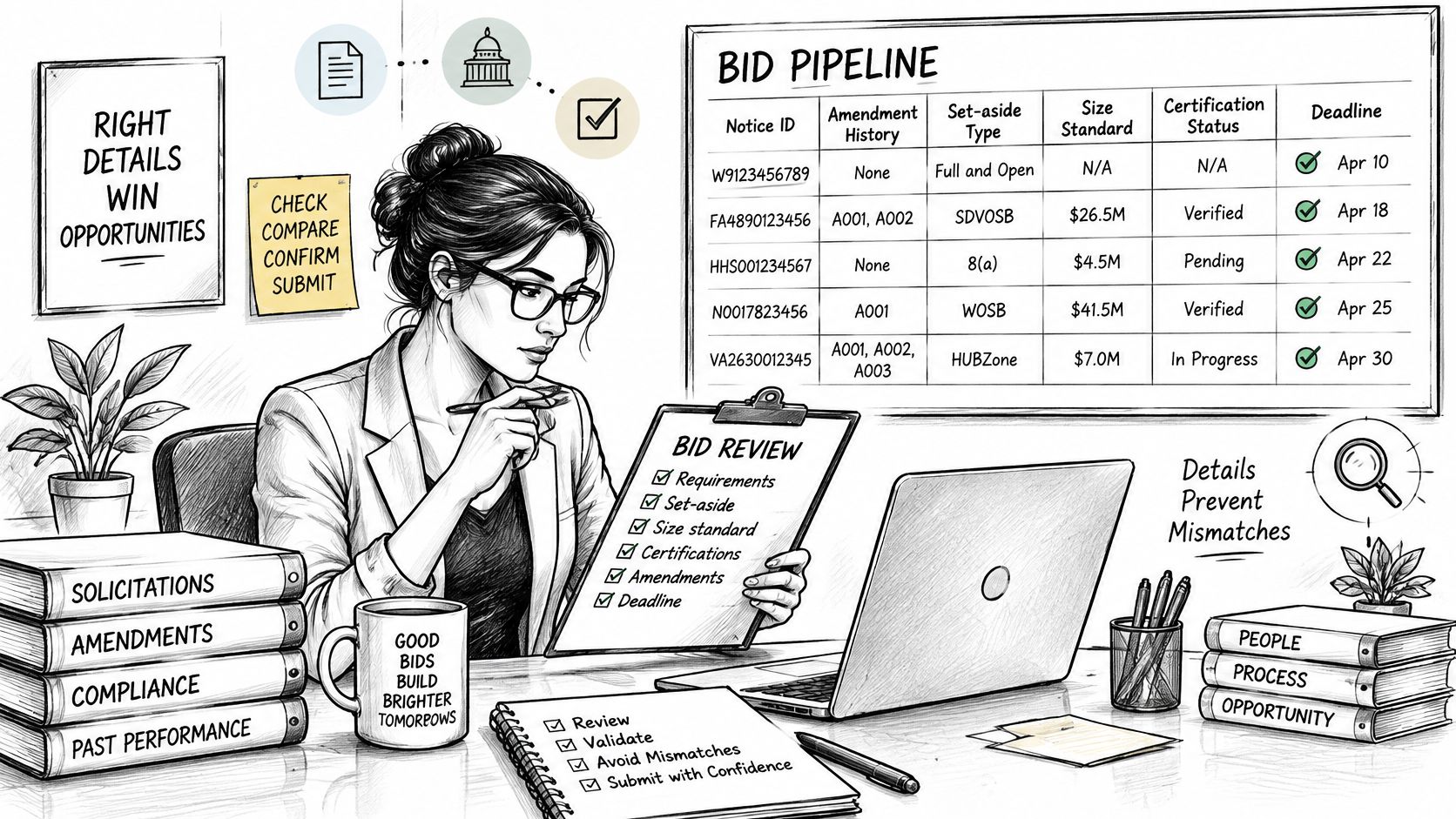
Make reminders actionable
Set reminders a week before closing and again two days before closing as an internal operating practice. After an amendment, recheck the deadline, set-aside, attachments, and affected response instructions.
An amendment alert isn't complete until someone records what changed and decides whether it affects the bid.
Forecasts call for monitoring; sources-sought notices call for a capability-response decision; solicitations call for bid qualification; awards call for historical analysis. Keep the evidence file current, log amendments when they post, and review unsuccessful pursuits for missed eligibility or timing signals.
Pick Your First Three HUBZone Notices This Week
The practical answer to how to find HUBZone government contracts is to qualify a manageable shortlist. Run your saved NAICS searches and choose three recently posted, open notices whose scope, set-aside, and performance requirements fit your company.
Give every candidate a next action
- Remove disqualified pursuits: Drop notices that fail mandatory eligibility, even when the work looks attractive.
- Write the decision: State why you'll bid, decline, or seek clarification.
- Assign follow-through: Name the owner and record the next deadline or monitoring event.
BidFunnels scores public federal notices against your company profile using inspectable rules based on NAICS, set-asides, location, and response time, while highlighting conditions such as intended sole-source notices and short deadlines. Our Go / Maybe / Skip Fit score is a quick read, not a promise, so read the solicitation before deciding. Our free RFP checker lets you check one RFP without signing up.
We're a research and drafting tool, not your submitting representative. Drafts use your own files, and we don't submit bids or proposals or act as your agent before a government body.
Visit BidFunnels to compare public notices with your company profile and identify which HUBZone opportunities deserve a closer read. Start with the free RFP checker on a real candidate, then document your eligibility, procurement pathway, and bid decision before committing to a proposal.