

How to Build a Compliance Matrix for a Government RFP
Nov 17, 2026 · 12 min read

You're checking a nearly finished proposal when someone asks where the required certification went. The technical narrative is polished, the pricing workbook is ready, and nobody owns the missing form. Now you're searching attachments instead of checking the final files.
That's the problem a compliance matrix should prevent. Learning how to build a compliance matrix for a government RFP means building a traceable record of obligations, evidence, decisions, and changes, not just coloring a checklist green.
Table of Contents
- What a Compliance Matrix Is and Why It Starts Early
- Columns Every Government RFP Matrix Needs
- How to Extract Every Obligation From the Solicitation
- Mapping Requirements to Factors, Owners and Evidence
- Tracking Amendments Without Losing Traceability
- Quality Gates and Failures to Catch Before Review
- Logging Ambiguities and Question Deadlines
- Build Your First Matrix From One Live RFP
What a Compliance Matrix Is and Why It Starts Early
Say your team writes a convincing technical approach but misses a certification buried in an attachment. A reviewer can admire the approach and still find that you haven't satisfied the solicitation. Good writing doesn't replace a required submission item.
A compliance matrix turns each obligation into a traceable row with its source, accountable owner, planned proposal location, and proof of completion. Its scope includes instructions, evaluation criteria, provisions, clauses, deliverables, and submission constraints, not merely technical requirements.
Start with the full obligation inventory
The FAR Part 52 provisions-and-clauses matrix distinguishes six categories: required solicitation provisions, required-when-applicable provisions, optional provisions, required contract clauses, required-when-applicable clauses, and optional clauses. That classification provides a useful starting model, although your internal proposal matrix needs response locations and ownership as well.
Conditional requirements deserve particular attention. Don't discard a clause because it looks irrelevant. Record the applicability decision and who approved it. An unresolved applicability question belongs in the matrix before anyone drafts around an assumption.
Practical rule: Reuse the spreadsheet structure, not the previous solicitation's compliance decisions.
The government-wide FAR matrix is maintained separately from the Code of Federal Regulations. Verify the current solicitation and applicable agency supplements rather than treating an old template as authoritative.
Before drafting begins, inventory:
- Solicitation sections: Instructions, evaluation criteria, technical requirements, contract terms, and deliverables.
- Supporting documents: Attachments, exhibits, forms, representations, and certifications.
- Changes and mechanics: Amendments, submission instructions, file constraints, and delivery requirements.
Keep the requirement's actual wording beside its source reference. A summary helps writers work quickly, but the original language lets the verifier check whether the team answered the obligation rather than a simplified interpretation of it.
Columns Every Government RFP Matrix Needs
One worked row tells the story better than a template tour. A mandatory past-performance instruction in Section L looks simple until someone has to close it. These fields are what closure takes.
Matrix columns, what each holds and a sample entry
This hypothetical row concerns a mandatory past-performance instruction.
| Column | What to record | Example entry |
|---|---|---|
| Requirement ID | Unique number for each obligation | L-PP-001 |
| Source | Section, page and attachment where the requirement appears | Section L, page 22, past-performance instructions |
| Requirement type | Shall or must, should, or submission instruction | Shall (mandatory) |
| Proposal location | Volume and section where the answer goes | Volume II, Tab 3 |
| Owner | One named person accountable for the response | Alex Rivera, Proposal Manager |
| Evidence source | Document that proves the claim | CPARS record for prior contract |
| Response coverage | Covered, Partly covered, Not found or Not applicable | Partly covered |
| Proof of compliance | Specific document, page or test result that supports the response | CPARS rating, page 4 |
| Final verifier | Person who checks the row before submission | Jordan Lee, Second Reviewer |
L-PP-001 stays stable even when the proposal outline shifts. The source points back to the solicitation; the proposal location points forward to the answer. Combining them into one citation field breaks traceability in both directions.
Pair each name with a title. Alex Rivera coordinates the response and closes gaps; Jordan Lee checks the row independently. A role label alone lets accountability slide, so the person stays visible alongside the function.
Treat the matrix as a working record rather than a form to fill once. When an amendment revises the instruction or the team argues over what a clause demands, the row should absorb that history instead of leaving it buried in email threads.
Separate coverage from proof
Here the narrative describes relevant experience and the CPARS record exists, but no one has connected the rating to the performance characteristic the instruction asks about. Partly covered is the honest status. Holding a document is weaker than using it to substantiate the response.
Keep completion controls separate:
- Response coverage: Does the proposal answer the instruction?
- Proof of compliance: Can the verifier locate the supporting document, page or result?
A Not applicable status needs a written reason and an approving reviewer. Otherwise it becomes a quiet way to clear difficult work out of the open-items filter. A fully green matrix deserves a second look for the same reason: rows can reach Covered while the evidence column stays thin.
For teams designing assignments and review queues, Wisely's monday.com productivity use cases offer workflow ideas. Keep the source references and evidence decisions in the matrix even if you manage tasks elsewhere.
Excel or Google Sheets is a practical starting point because reviewers can filter by owner, status and volume. Avoid merged cells and free-form status labels. Controlled dropdowns make it harder for an unresolved row to disappear under a reassuring label such as almost finished. Add one free-text column for interpretation notes, since a dropdown can hold a verdict but not the reasoning behind it.
How to Extract Every Obligation From the Solicitation
Extract against the actual files, not a notice summary. The Army's request-for-proposals development guidance supports correlating solicitation requirements, preparation instructions, evaluation factors, clauses, and data requirements. It also emphasizes explaining how requirements will be met rather than merely promising performance.
Work through the package in order
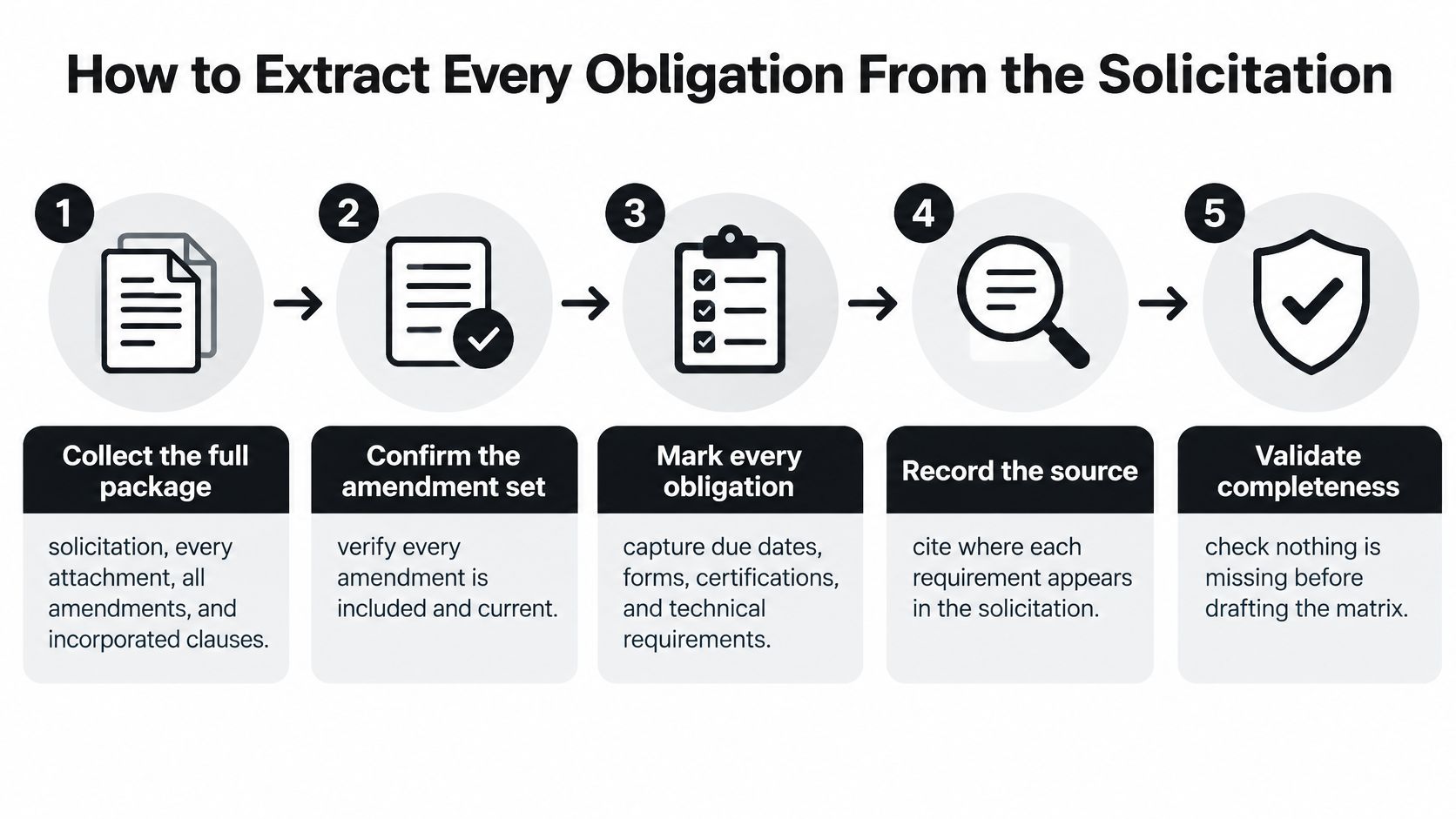
Collect the complete package. Save the solicitation, attachments, amendments, incorporated clauses, and forms. Check the SAM.gov notice history against your local files and record when you checked it. Continue monitoring until submission.
Extract instructions before technical prose. Capture delivery requirements, volume boundaries, forms, and formatting constraints. Read evaluation criteria next, then technical requirements. This order keeps administrative obligations from becoming an afterthought.
Assign IDs while reading. Record the source section, paragraph, and page immediately. Split a paragraph into separate rows when it contains obligations with different owners or evidence.
Classify the language. Preserve shall, must, and should distinctions, and identify submission instructions separately. Don't assume an instruction is optional because it lacks shall.
Connect instructions to evaluation. Map Section L instructions to Section M factors or their equivalents. Flag unmatched items for review rather than inventing an evaluation relationship.
Assign the planned response location. Give writers a volume and section before drafting. Add final page references after pagination stabilizes.
Build the attachment register. Record title, revision date, page count, source file, destination volume, inclusion status, and citation status.
Validate extraction completeness. Have another reader compare the rows with the solicitation's checklist and source documents. Counting rows alone won't reveal an obligation that nobody extracted.
Use this flow as a reminder while assembling the source package.
Treat attachments as source documents
The FAR overhaul Part 15 deviation guide identifies attachment titles, dates, and page counts as elements of the Section J attachment list. Use those identifiers to distinguish the current exhibit from a similarly named older file.
For a service example, apply the extraction process to a janitorial-services RFP: separate staffing instructions, cleaning schedules, inspection obligations, and pricing attachments.
In technical procurements, document control also extends beyond narrative claims. Ryshe's guide to AI in regulated aerospace manufacturing provides related context for teams considering AI within regulated workflows. Regardless of the tool, verify extracted obligations against the source.
Extraction is ready for drafting when every captured obligation has an ID, source, type, and planned location, and the independent reader has resolved missing-file questions.
Mapping Requirements to Factors, Owners and Evidence
A row marked Covered without supporting evidence can hide unfinished work. Classify requirements by consequence so the team spends its limited review time on the right problems.
Use the matrix to inspect those relationships, not just completion colors.
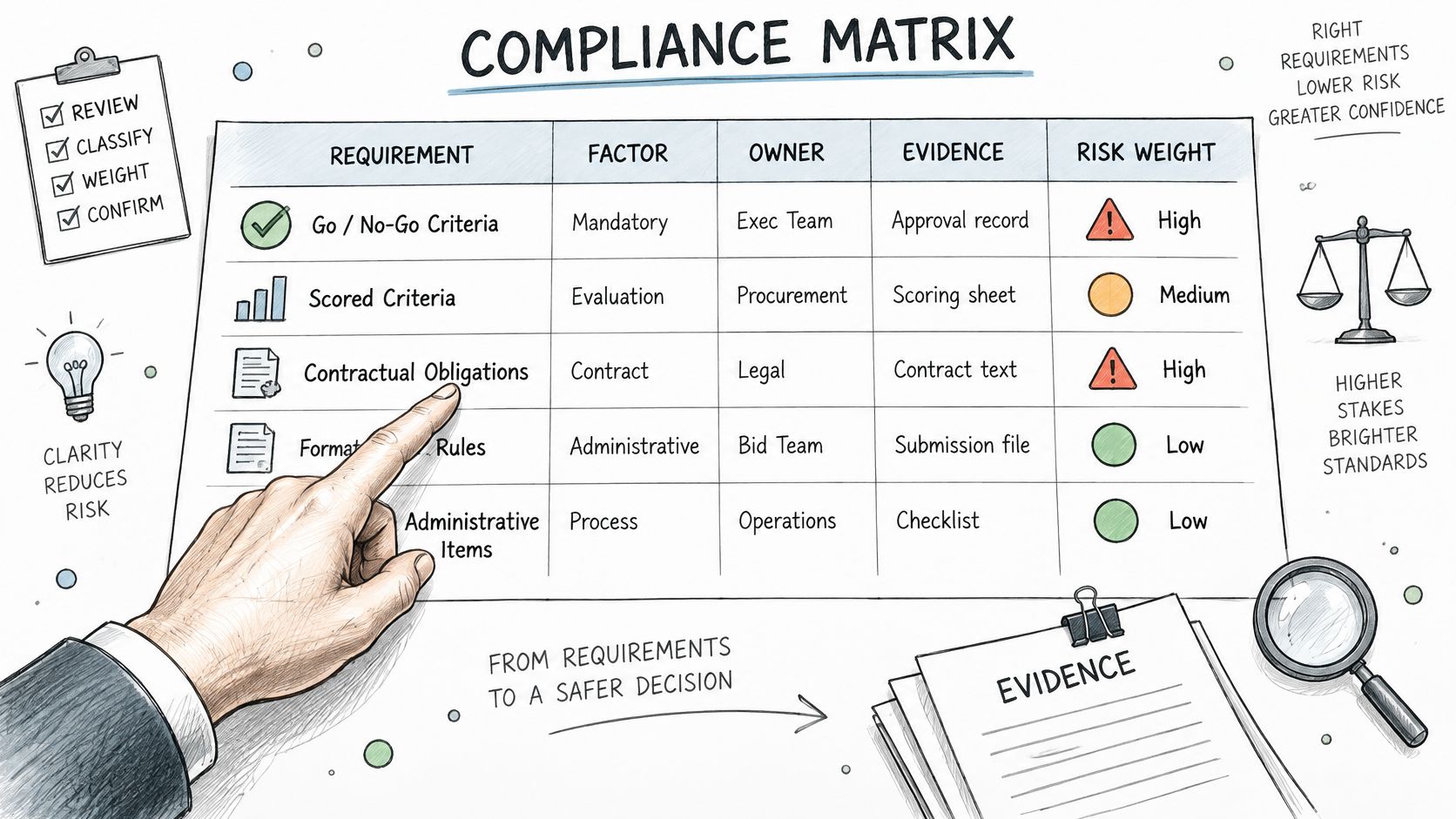
Requirement types, typical examples and how to treat each
| Requirement type | Typical examples | How to treat it |
|---|---|---|
| Go or no-go prerequisite | Registration, required certification, set-aside eligibility | Pass or fail; resolve before drafting starts |
| Scored evaluation criterion | Section M factors and subfactors | Map to a page-specific response and a proof point |
| Contractual obligation | Contract clauses, representations and certifications, performance terms | Assign an owner and confirm the acceptance step |
| Format rule | Page limits, font, margins, file naming | Check in the late-stage format audit |
| Administrative submission item | Forms, signatures, delivery method, volume labels | Confirm on a submission checklist before upload |
The FAR source-selection rules require competitive proposals to be evaluated solely against the specified factors and subfactors. Don't spend scarce pages on persuasive material that has no clear connection to what the evaluator will assess.
Assign severity based on disqualification potential, evaluation impact, ambiguity, and evidence difficulty. A certification dependent on an outside party may need attention before an unfinished paragraph, even if the paragraph is more visible.
Make the evidence gap explicit
Suppose an IT consulting-services RFP asks for migration experience. The response says the team has extensive experience, but the cited project describes help-desk support. Record an evidence gap, identify the missing migration example, and assign a corrective action. Adding more confident adjectives won't close it.
Projectify's discussion of traceability for release reviews offers a useful parallel: reviewers need a connection between the requirement and the artifact they can inspect.
The embedded video provides an additional viewing resource alongside the working matrix.
In our company workflow, members share the company's bids, files, drafts, saved answers, and AI credits. Shared access still doesn't establish accountability: each row needs a named owner.
The target is precise. Every scored factor points to an answer and an evidence item, and no obligation sits unowned in a shared folder.
Tracking Amendments Without Losing Traceability
Editing the matrix in place feels efficient until a reviewer asks why a requirement vanished between versions. Treat each amendment as a controlled change set: preserve the baseline, record what changed, and trace the consequences forward.
Under FAR 15.206, changes to solicitation requirements or terms require an amendment carrying identifying information: the amendment number, date, page count, description, and any revised closing date. Record those details in your amendment log the day the amendment posts.
Preserve the change and its consequences
Copy the baseline into a new version and map affected rows. For each change, retain:
- Source history: document revision, original language, and amended language.
- Response impact: affected volumes, evidence, pricing assumptions, and cross-references.
- Closure controls: owner, required action, acknowledgment status, and verification date.
Flag deleted requirements instead of removing them. A writer working from an overwritten matrix can keep answering an obligation that no longer applies while the replacement clause goes unanswered.
Suppose an amendment cuts the technical volume's page allowance. Mark every row assigned to that volume for impact review. The owner decides what to condense without losing scored evidence, then pagination and formatting checks run again against the new limit.
Amendment log
The following is a hypothetical working entry.
| Amendment | Change | Affected rows | Owner | Acknowledged on |
|---|---|---|---|---|
| Amendment A | Technical volume page allowance reduced | All technical-volume rows | Maria Alvarez | Aug. 14 |
Don't close an amendment because you downloaded it. Close it when its effects and acknowledgment are verified.
Check the acknowledgment deadline and method stated in the solicitation and the amendment itself. FAR 52.215-1 requires offerors to acknowledge amendments, and the offeror stays responsible for timely delivery of the proposal and any revisions. A missed acknowledgment can sink an otherwise compliant offer.
BidFunnels checks SAM.gov for new and changed notices several times a day, while state opportunities load from each portal's own list. Open the amendment from the notice itself, update the matrix the same day, and preserve the source file. Monitoring tells you a change exists. The log is what proves your response incorporates it.
Quality Gates and Failures to Catch Before Review
Set the compliance-review benchmark at zero Not found rows and zero unowned rows. Any Partly covered row needs an owner, corrective action, and closure deadline before final production.
The Army's evaluation-activities guidance describes initial screening against submission instructions, including required information, electronic media, quantities, and format. A technically strong response still needs a compliant package.
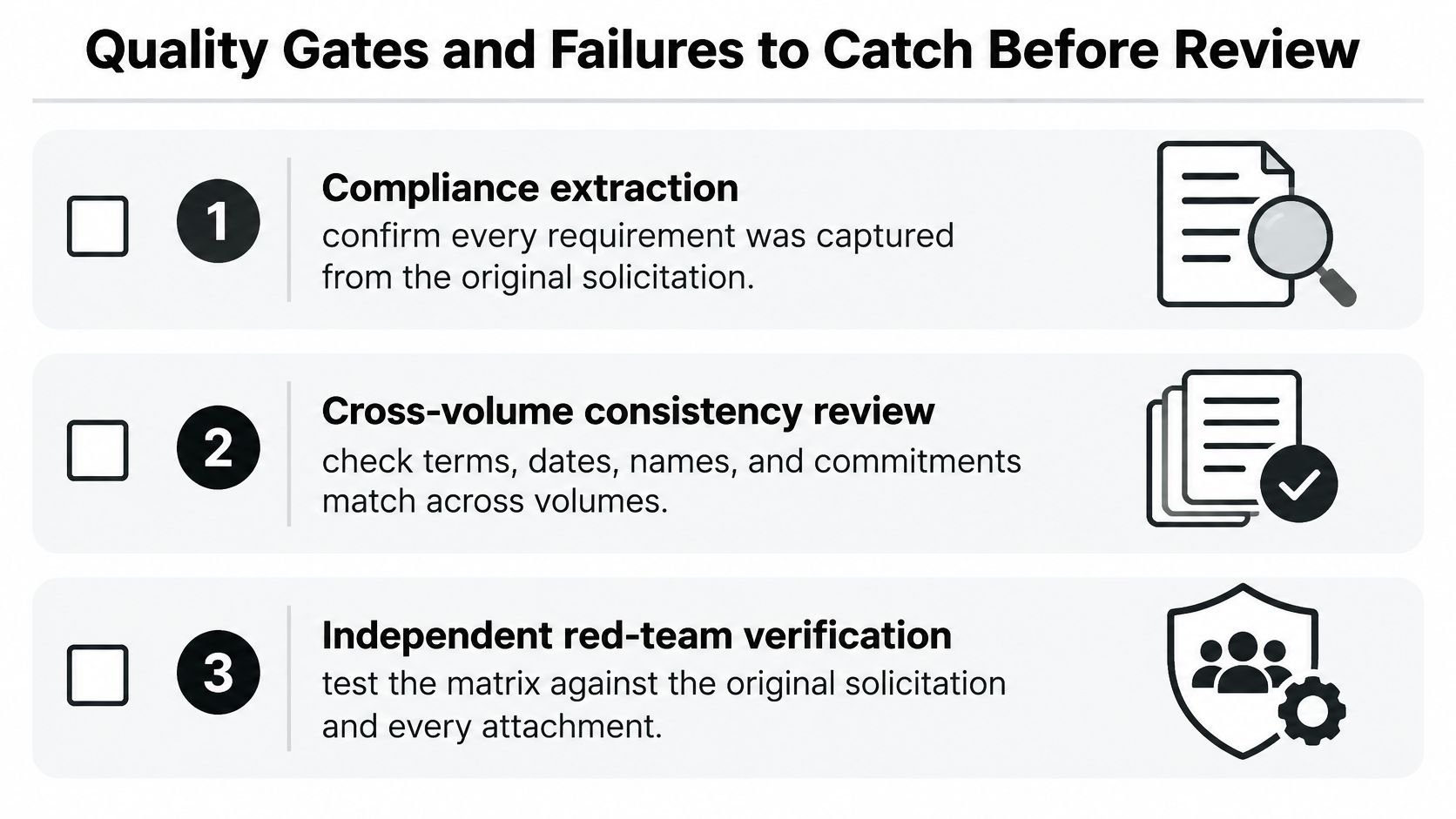
Run distinct review passes
- Compliance extraction: Reconcile captured obligations with the original solicitation and current amendments.
- Cross-volume consistency: Compare names, dates, staffing, quantities, assumptions, and commitments across technical, management, past-performance, and pricing content.
- Independent red-team verification: Have a reviewer test the actual response and evidence against the source package, not just accept the owner's status.
Use the review sequence to separate completeness from consistency and independent verification.
Common matrix failures, their causes and fixes
| Failure | Likely cause | Fix |
|---|---|---|
| Scored factor has no page-specific answer | Section M factor never mapped to a Section L instruction | Add a mapping row and name the proof point |
| Row marked Covered with no document | Response coverage confused with proof of compliance | Change status to Partly covered and log the evidence gap |
| Attachment is an outdated version | Old exhibit reused after an amendment | Check the register against the Section J attachment list |
| Page limit or font violated | Format audit skipped or done too early | Rerun the late-stage format audit after the last edit |
| Row has no owner at review | Shared folder with no single accountable person | Assign one named owner per row before the gate |
Audit the rendered submission files, not only editable drafts. Check page limits, fonts, spacing, margins, file names, signatures, required forms, volume labels, cross-references, attachments, and amendment acknowledgments.
The Commerce proposal-preparation provision illustrates the importance of organization, indexing or cross-indexing, page identification, and coverage of technical subfactors. Follow the actual solicitation's rules rather than importing another agency's formatting requirements.
A government contract proposal template can help organize the response, but it can't establish that the final files satisfy this procurement. Test the files you intend to deliver.
A green spreadsheet isn't the acceptance artifact. The proposal, supporting documents, and verified submission package are.
The gate passes when every row is owned, scored factors have page-specific answers, and format rules have been checked after the last substantive edit. Preserve the approved matrix version with the reviewed proposal files.
Logging Ambiguities and Question Deadlines
A fully green matrix can conceal a risky interpretation. Keep an interpretation register for conflicting instructions, undefined terms, apparent defects, and clauses whose applicability remains uncertain.
This register is an input to approval, not a collection of notes somebody reads after production. Link each entry to its requirement ID so the proposal lead can see which compliance decisions depend on unresolved assumptions.
Record the decision, not just the concern
| Register field | What the reviewer needs |
|---|---|
| Requirement and type | The affected obligation and its classification |
| Consequence | Potential disqualification, lost evaluation credit, or contract risk |
| Interpretation confidence | High, medium, or low, with a reason |
| Assumption | The interpretation used in planning the response |
| Question deadline | Solicitation deadline, including time zone |
| Action | Written question, clarification request, or legal review |
| Agency answer | Response reference and amendment location, if applicable |
| Decision and approval | Proposal lead's disposition and any counsel advice |
Under the GAO bid protest regulations, challenges to apparent solicitation improprieties generally must be filed before the deadline for initial proposals. Don't assume an issue can be saved for a post-award challenge. Obtain qualified legal advice promptly when a defect may warrant protest.
Resolve conflicting instructions before production
Suppose Section M calls for a staffing plan, but Section L provides no clear location or page allowance. Log the interpretation as low confidence, identify the potential evaluation consequence, and submit a written question before the question deadline.
Keep the response row Partly covered while the team lacks an approved approach. Record the agency's answer and check whether it is reflected in an amendment when it changes the solicitation.
If no answer arrives, the proposal lead must document the chosen interpretation and residual risk. Don't let a writer decide where the staffing plan belongs during final assembly.
The production rule is straightforward: no Not found row and no low-confidence interpretation proceeds without a documented disposition. An approval records the decision; it doesn't make an unresolved legal or compliance risk disappear.
Build Your First Matrix From One Live RFP
Pick a live RFP you're considering this week. Start with its source package, not a previous proposal, and build the obligation inventory before assigning narrative sections.
Our free RFP checker lets you check an RFP without signing up. For the full workflow, the seven-day Pro trial requires no card; when you start a bid on Pro, BidFunnels reads the solicitation and attachments and places requirements in a compliance matrix with their source section and page. Check those rows line by line rather than treating extraction as verification.
Define what finished means
- Establish ownership: Populate the matrix fields and replace role placeholders with names.
- Control supporting files: Complete the attachment register and open the amendment and ambiguity logs, even if they're empty.
- Schedule verification: Set a dated review gate before the response deadline and record the time zone.
- Close deliberately: Resolve gaps or document approved dispositions before final production.
The matrix and any drafts are research and drafting aids. Drafts come from your own files, you must review and edit them, and you remain responsible for what you submit. BidFunnels doesn't submit bids or proposals and doesn't act as your agent before a government body.
Treat a Go / Maybe / Skip Fit score as a quick read from rules, not a promise. The solicitation remains the source of truth.
Your first finished matrix should have stable IDs, traceable source references, named owners, controlled statuses, supporting evidence, an assigned verifier, and a dated gate. That's a usable control record, not merely a table you completed at kickoff.
Bring a live solicitation to BidFunnels and use the free RFP checker, or start the seven-day Pro trial with no card required to build a source-linked compliance matrix. Assign owners, verify the evidence, and use the spreadsheet to run your review gate before you submit through the agency's required channel.