

RFP for IT Consulting Services: How to Respond Well
Nov 7, 2026 · 12 min read

The most popular advice on an RFP for IT consulting services is also the most damaging. It tells you to write a polished narrative, lead with your methodology, and show enthusiasm for the mission. That's backwards.
Evaluators don't award points for polish they can't verify. They score evidence they can trace to a requirement, a deliverable, and a person who'll do the work. I would treat every solicitation as a scoring system first and a writing project second.
Table of Contents
- Why IT Consulting RFPs Are Built Differently
- Standard Sections of an IT Consulting Services RFP
- Decide Whether to Bid Before You Start
- Build a Requirements Compliance Matrix
- How Evaluators Score Your Proposal
- Security, AI and Exit Clauses That Change Your Bid
- Common Proposal Mistakes and How to Fix Them
- Assemble and Submit a Compliant Response
Why IT Consulting RFPs Are Built Differently
Start with the money, because it explains the workload. In fiscal year 2024, U.S. federal agencies spent $126 billion on IT contracts, up from $120 billion in fiscal year 2023, according to Washington Technology reporting on federal IT contract spending. This isn't a niche market where a generic capability statement carries you.
A separate view shows where that demand sits. For fiscal year 2024, 26 federal agencies reported approximately $95 billion in planned IT spending across about 6,700 investments, and approximately $74 billion, about 78%, was designated for operations and maintenance of existing systems, according to the U.S. Government Accountability Office report on federal IT spending. Only the remainder targeted development, modernization, and enhancement.
That split changes your bid. Many consulting RFPs ask for sustainment, integration, cybersecurity, service management, and transition support for systems already in service. A response that offers only development capacity misses most of the work.
An RFP is a job specification and a scorecard combined. Read only the job description and you'll miss how points are calculated.
This market also has mature, competitive structure. The U.S. Government Accountability Office report on federal IT services spending from 1997 to 2001 reported federal spending on IT services rising from approximately $9 billion to more than $17 billion, with small businesses receiving 14% of FY2001 IT-services spending, medium-sized businesses 21%, and large businesses 62%.
That's why eligibility, size status, subcontracting, and contract vehicles matter alongside technical skill. What follows covers the standard sections, the compliance matrix, evaluator scoring, security and AI clauses, common mistakes, the bid or pass test, and final assembly.
Standard Sections of an IT Consulting Services RFP
Most agencies use a lettered or numbered structure, even when names differ. Learn to find the same eight parts and you can read a new solicitation in hours instead of days.
Two parts drive almost everything you write. The statement of work states required outcomes, scope, and performance standards. The evaluation criteria show which factors earn points and how they rank against each other.
The Parts That Can Disqualify You
Instructions to offerors look administrative, but they're pass or fail. Page limits, font rules, file types, and volume structure aren't suggestions. Exceed a limit or submit the wrong format and a compliant technical approach may never get read.
The cover page holds the submission deadline and time zone, plus the question cutoff. Miss the question window and you're guessing at ambiguous requirements for the rest of the pursuit.
| RFP section | What it tells you | What your response must include |
|---|---|---|
| Cover and key dates | Issuing office, solicitation number, question and submission deadlines | Receipt confirmation, amendment acknowledgments, questions sent before the cutoff |
| Statement of work or performance work statement | Required outcomes, scope, deliverables and performance standards | Approach mapped to each task, deliverable plan, stated assumptions |
| Instructions to offerors | Format, page limits, file types and volume structure | Volumes arranged as specified, page and font compliance, correct file types |
| Evaluation criteria | Scored factors and their relative importance | Evidence for each factor, organized in the order it is scored |
| Pricing schedule | Labor categories, units of measure and pricing structure | Completed price forms, rate build-up, labor mix and pricing assumptions |
| Past performance and references | Which contracts count and how references are contacted | Relevant contract summaries, reference contacts and scope comparisons |
| Representations and certifications | Eligibility, small-business status and conflict rules | Signed forms, size and set-aside status, subcontracting plan if required |
| Attachments and forms | Security questionnaires, SLA templates and sample contract terms | Completed questionnaires, exceptions list, signed acknowledgments |
Use that table as a checklist against the actual document. Section names vary, and attachments often hide requirements that never appear in the main body.
How I Would Read It
Don't read front to back. Start with instructions, evaluation criteria, and the statement of work, in that order.
- Instructions first: You learn the rules for volumes, pages, and files before anyone writes a word.
- Evaluation second: You learn where points live, so effort follows weight.
- Statement of work third: You learn what outcomes you must prove you can deliver.
Everything else supports those three. Pricing, past performance, and certifications confirm whether your technical story is credible and eligible.
Decide Whether to Bid Before You Start
Run a bid or pass test before drafting. Three questions decide it.
First, can you meet every mandatory requirement? Check each pass or fail item in the instructions and statement of work. One unmet mandatory item ends the evaluation, no matter how strong the rest reads.
Second, do you qualify? Confirm eligibility, size, and set-aside rules in the representations section. If you're checking work under computer systems design, start from the NAICS 541512 government contracts page and match the code on the notice to your profile.
Third, can you produce checkable evidence in time? You need contract summaries, résumés, certifications, and references that evaluators can verify before the deadline. Strong capability without documents scores like no capability.
Practical rule: Any no means pass, or find a qualified partner who closes that specific gap. Don't hope evaluators overlook it.
Red flags justify walking away. Watch for a sole-source notice, a contract already awarded, a deadline too short for a compliant response, or scored factors built on credentials you can't document.
If all three answers are yes, confirm you've read and acknowledged every amendment. Record the official cutoff with its time zone, and set internal deadlines at least one day earlier.
Tools can help you screen faster. Our RFP checker is free and can be used to check one RFP without signing up. We're a research and drafting tool, though. We don't submit bids for you and we don't act as your agent before any government body. Drafts must be reviewed and edited by you, because you're responsible for what's submitted.
Build a Requirements Compliance Matrix
A compliance matrix turns a solicitation into rows you can assign, prove, and check. Build it before writing. Retrofitting one after drafting is how requirements get missed.
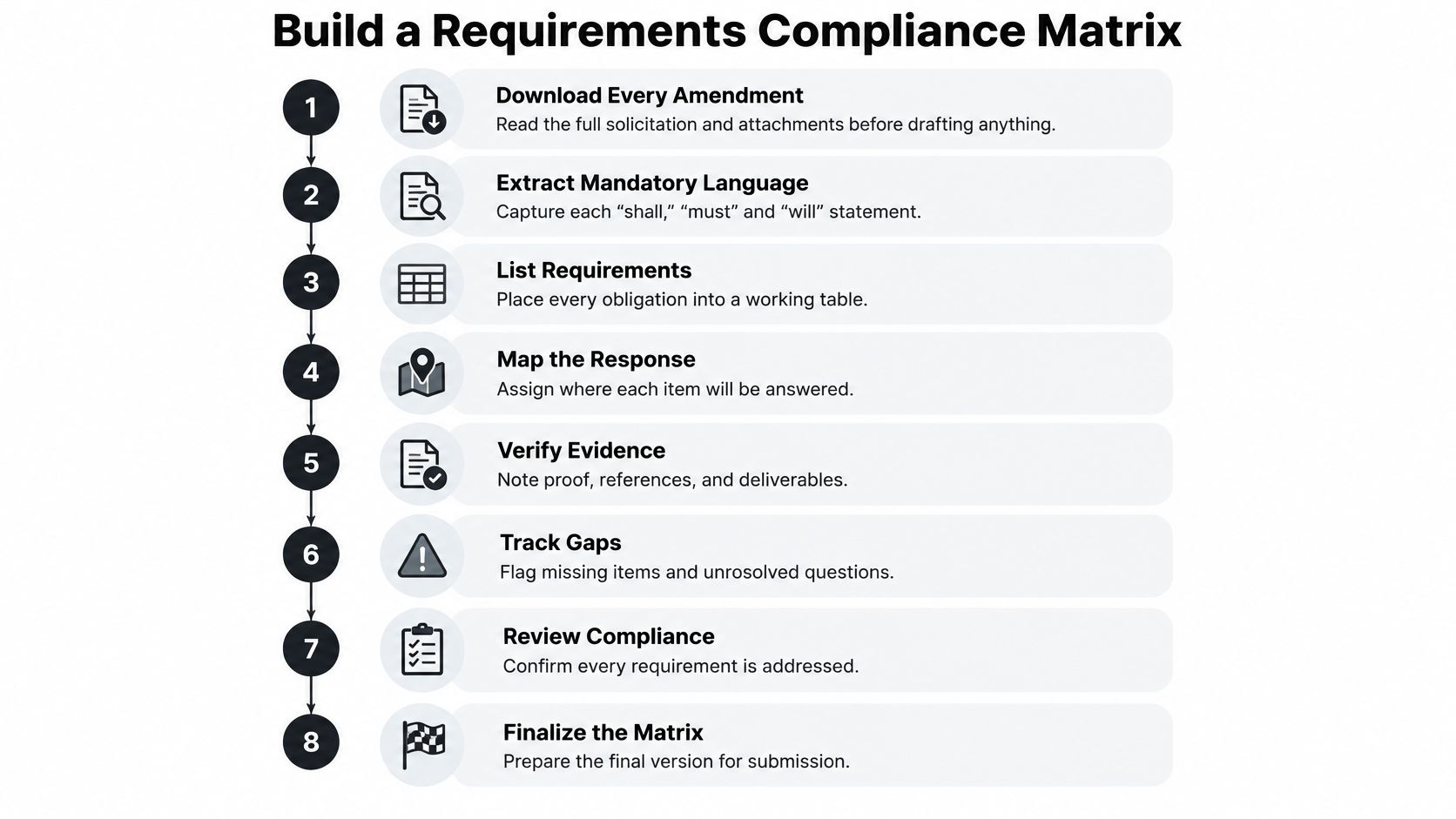
The eight-step sequence below shows the build order.
The Eight Steps
- Download every amendment. Read the full solicitation and attachments before drafting anything, including pricing templates and security questionnaires.
- Extract mandatory language. Pull each "shall," "must," and "will" statement into a spreadsheet with its section and page reference.
- Tag each row. Mark it mandatory or scored, and note which evaluation factor it feeds.
- Make it measurable. Convert each performance objective into a baseline, target, measurement method, and reporting frequency.
- Assign an owner and proof. Attach a past project, certification, résumé, reference, or sample deliverable to every row.
- Map the response location. Note the proposal section and page where each row will be answered.
- Flag gaps early. Send questions before the cutoff instead of assuming what the buyer meant.
- Recheck after amendments. Changed requirements often sit in attachments, not in the amendment summary.
On the Pro plan, when you start a bid, we read its documents and put every requirement into one table with the section and page it came from. You still verify each row against the solicitation yourself.
Why Measurable Beats Persuasive
Step four is where most matrices fail. Replace "provide expert support" with "application availability of 99.5 percent, measured monthly" in a worked example, and an evaluator finally has something to score.
The U.S. Government Accountability Office report on performance-based service contracting found that performance-based service contracts varied considerably in how completely they applied measurable outcomes. That finding supports explicit standards and a quality-assurance surveillance plan instead of broad support language.
Adapt measures the work as needed. Useful candidates include incident-response time, defect escape rate, migration accuracy, backlog throughput, security-remediation time, and customer-satisfaction scores.
Each metric needs more than a target. Define the baseline, measurement method, reporting frequency, corrective-action threshold, and acceptance authority. Without a threshold, nobody knows when a miss triggers a service credit or a corrective action plan.
A vague claim gives evaluators nothing to score. A measurable target with a named owner gives them evidence.
How Evaluators Score Your Proposal
Evaluators score against factors and weights published in the solicitation, usually in a dedicated evaluation section. Those weights are your best guide to where effort belongs. If technical capability outweighs price, don't spend half your pages defending rates.
Virginia's guidance makes the mechanism explicit. Virginia's 2025 IT procurement manual says agencies should define objective, observable criteria and their weighting before drafting the RFP. It identifies technical capability, management maturity, past performance, price reasonableness, lifecycle cost, and small-business compliance as distinct evaluation dimensions.
That timing matters to you. The scoring model existed before you saw the RFP, so your job is to map evidence to it, not to persuade evaluators to use a different one.
Evidence Evaluators Can Score
| Criterion | What evaluators check | Evidence to include |
|---|---|---|
| Technical capability | Methods fit the SOW tasks and identified risks | Task-by-task approach, tools used, sample artifacts |
| Management maturity | Governance, quality control and reporting discipline | Quality assurance plan, escalation path, reporting cadence |
| Key personnel | Named experts with credentials that match the tasks | Résumés, certifications, availability commitments |
| Past performance | Similar scope, scale and measured outcomes | Contract summaries with results, verifiable reference contacts |
| Price reasonableness | Rates and totals fit the scope and labor mix | Rate build-up, staffing mix, stated assumptions |
| Lifecycle cost | Ongoing operation, maintenance, transition and exit costs | Multi-year cost view, transition plan, exit obligations |
| Small-business compliance | Eligibility, subcontracting goals and size status | Subcontracting plan, certifications, size status documentation |
Build a traceability link for each factor. Connect the requirement to a deliverable, an acceptance measure, a responsible person, and proof from past performance. That chain is what separates a responsive proposal from a persuasive one.
Small consultancies feel this most. You may have strong technical ability and almost no proposal staff. A short, auditable evidence chain beats a long narrative you can't finish well.
Watch lifecycle cost in particular. Buyers can count security, maintenance, operation, and disposal obligations, which small firms often leave out of their price story. Leaving them out doesn't make you cheaper. It makes your cost look incomplete.
Copy factor names and weights from your solicitation, not from the table above. Exact weights vary by agency, and using the buyer's own terms helps evaluators find your evidence fast.
Security, AI and Exit Clauses That Change Your Bid
The easiest place to overpromise is security. Firms write "we take security seriously" and move on. When consulting work touches client systems or sensitive data, that sentence earns nothing.
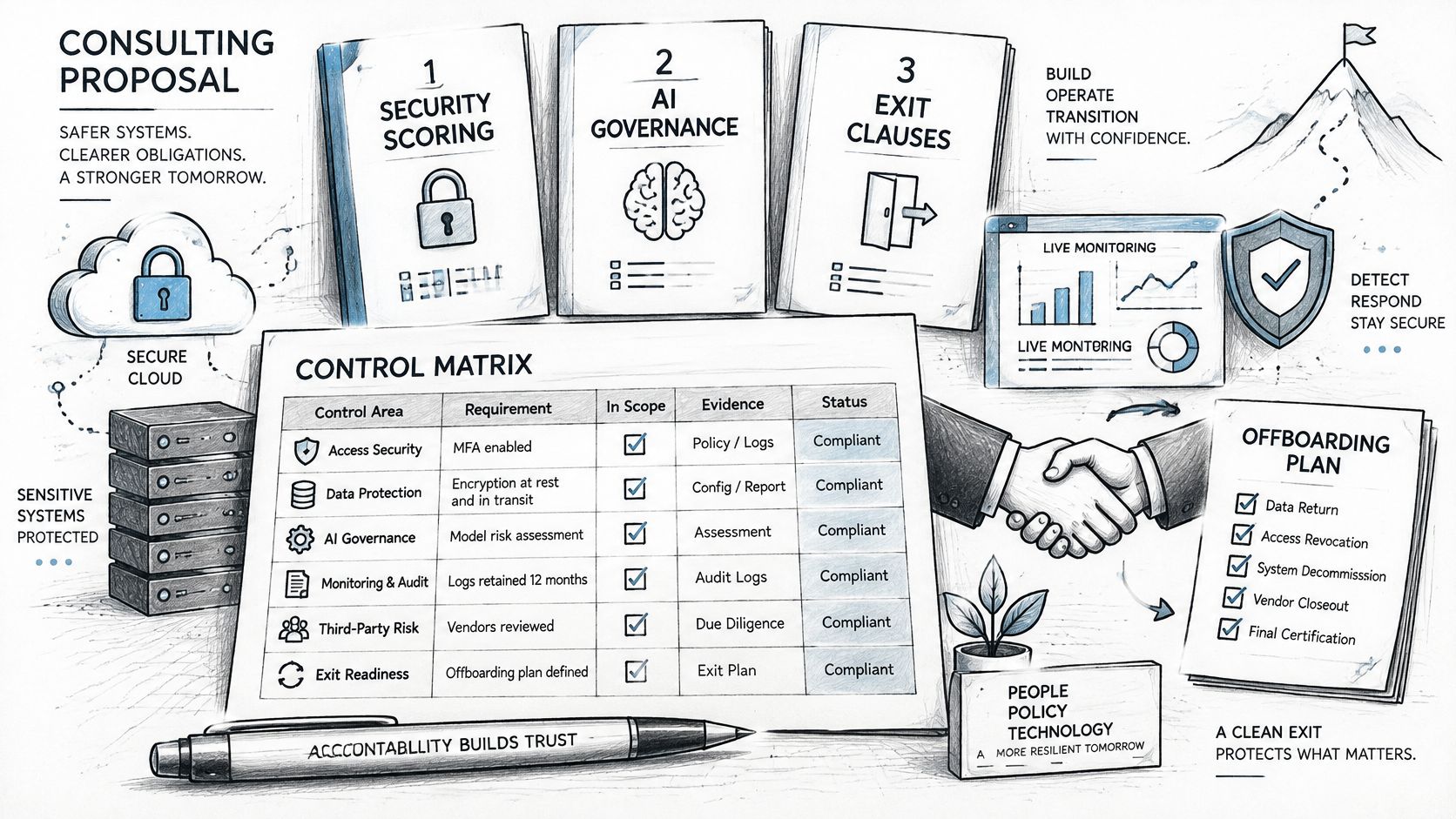
Treat cybersecurity as a scored requirement and a monitored contract obligation. The visual below frames the controls a credible response has to address together, not as separate boilerplate.
Build a Control Matrix
Map each obligation to an owner, evidence artifact, verification interval, and remediation deadline. That structure follows the direction in NIST guidance on cybersecurity supply chain risk management, which recommends supplier requirements proportionate to the service's criticality and potential impact, with contractual mechanisms for verification and evidence such as attestations, certifications, or inspections.
Reviewers look for practical minimums:
- Encryption: Cover data in transit and at rest, and name where each applies.
- Incident handling: State notification and response procedures with owners.
- Access control: Describe privileged-access controls and personnel vetting.
- Subcontractors: Show how requirements flow down to every sub with system access.
- Ongoing proof: Include vulnerability-management reporting and periodic independent assessment.
Before you promise any of it, review how your own tools handle client material on our security practices page. Evaluators award points for demonstrable controls, not unsupported claims.
The short video below walks through why these clauses affect price and staffing, not just compliance language.
AI, Cloud, and Exit Risk
AI and platform work adds a second risk layer. Under federal guidance on efficient acquisition of artificial intelligence in government, solicitations may require vendors to disclose AI use, address transparency and accessibility, and reduce vendor lock-in through knowledge transfer and data or model portability.
Answer five questions before you bid:
- Which tools: Name every AI or platform tool your team will use.
- What data: State what client data enters each tool and retention limits.
- How validated: Describe human review of outputs before delivery.
- What transfers: List reusable artifacts, documentation, and data the agency receives.
- What changes: Explain transition assistance, audit rights, and what happens if the technology changes.
AI can lower delivery cost while raising governance cost. If the buyer can't verify outputs or leave your platform, your low price stops looking low.
Common Proposal Mistakes and How to Fix Them
The most common symptom evaluators flag is a generic methodology. It reads smoothly, mentions proven frameworks, and never touches a numbered task in the statement of work. Evaluators notice within two pages.
Use the table as a diagnostic. Each row starts with what a reviewer sees, traces it to the likely cause, and gives the fix to apply before the deadline.
| Symptom in review | Likely cause | Fix before submitting |
|---|---|---|
| Generic methodology with no task mapping | Template reused without reading the SOW | Rewrite each approach section against a numbered SOW task |
| Claims without evidence | Past results stated but no proof attached | Attach a contract summary, metric or artifact for each claim |
| Narrative and price sheet disagree | Staffing changed late and only one document updated | Reconcile hours, labor mix and assumptions across all volumes |
| Resumes do not match labor categories | Staff listed without checking credentials against the category | Map each named person to a category and required qualification |
| Past performance judged not comparable | Examples chosen by size, not by scope | Select examples that match scope, complexity and outcomes |
| Assumptions appear after award | Risks left unstated in the proposal | State assumptions, dependencies and client responsibilities in writing |
The Mistakes Behind the Symptoms
Template reuse causes the first two rows. Say your firm bids a cloud migration and pastes in an ERP implementation methodology. The tasks won't map, the sample artifacts won't fit, and evaluators score what you submitted, not what you meant.
Page limits make this worse. Firms cut evidence to fit, then keep the claims. Cut the claim instead, or find shorter proof. A one-line contract result with a reference contact beats a paragraph of adjectives.
Hidden assumptions are the quietest failure. If you assume the client provides test data, licenses, or security approvals, write it down with a date or dependency. Unstated assumptions become disputes and change orders after award.
Fix against the matrix, not against memory. Memory tells you what you intended to write. The matrix shows what you actually answered.
A requirement-by-requirement check speeds up that review. Our proposal check rates each requirement as Covered, Partly or Not found, so gaps surface while you still have time to close them.
Run the check after every major rewrite, not once at the end. Late edits routinely delete the only paragraph that answered a scored requirement.
Assemble and Submit a Compliant Response
Build the response in the order the solicitation specifies, not in the order ideas occur to you. Sequence discipline prevents most last-day compliance failures.
Work Backward From the Deadline
- Outline each volume. List every required section, its page limit, and the scored factor it answers.
- Assign owners and reviewers. Give each volume one owner and one reviewer who didn't write it.
- Set backward milestones. Complete the draft 14 days before the cutoff, run a red-team review against evaluation weights 7 days before, and lock content 2 days before in your internal plan.
- Reconcile in one pass. After the last staffing change, align narrative, labor mix, hours, and price sheet together.
- Check people and proof. Verify every résumé against its labor category and every past-performance example against the stated scope.
- Open files as the buyer will. Confirm formats, naming rules, fonts, and page limits in the final files.
- Keep the receipt. Save portal confirmation and confirm no amendment arrived after your last check.
If your team needs the broader drafting workflow behind step one, our guide on how to write a government contract proposal covers volume structure in detail.
Do the final check against the compliance matrix. Read each row, find the answer location, and confirm the proof artifact is attached. A response to an RFP for IT consulting services wins on that traceability, not on last-minute prose.
Ready to stop guessing what evaluators will score on your next IT consulting bid? BidFunnels helps you find matched federal and state opportunities, turn solicitations into source-linked compliance matrices, and draft proposal sections from your own past performance files. Visit us, check one RFP free, and build your next response around evidence evaluators can verify.