

Janitorial Services RFP: What Bidders Need to Know
Nov 9, 2026 · 10 min read

Seven firms priced one federal janitorial contract between $11,314,202 and $29,135,350, and the buyer still canceled it. The GAO decision on the NASA Moffett Field solicitation shows why. Specs were too ambiguous for bidders to price the same work. A janitorial services RFP is judged as an evidence chain. Each scope line, staffing assumption, and dollar has to be provable. Pass/fail conditions sit apart from scored factors. A missing form can sink a strong cleaning plan, while a thinner narrative usually only costs points.
Table of Contents
- Mandatory and Scored Requirements Every Janitorial RFP Lists
- Pricing Structures and Contract Value in Janitorial RFPs
- How to Show Past Performance That Evaluators Accept
- Quality Control Plans Evaluators Can Audit
- How to Prove Staffing and Price Are Credible
- How to Build a Responsive Bid Package
- Make Your Bid or No-Bid Decision
Mandatory and Scored Requirements Every Janitorial RFP Lists
Every janitorial services RFP mixes two lists. Pass/fail conditions decide whether the bid is read at all. Scored factors decide who wins among the bids that survive. A missing signature, bond, or mandatory walkthrough can make a strong technical story nonresponsive. A weaker narrative usually only lowers the score.
The award model changes how hard you work each factor. Under best value, past performance, technical approach, and price are weighed against each other, so a tighter quality plan can beat a lower price. Under lowest price technically acceptable, the bid only has to clear the technical bar. Once it does, the lowest compliant price wins, and extra narrative polish buys little.
Build your own split from this map before you estimate a single hour.
| Requirement | Typical Category | Consequence if Missed |
|---|---|---|
| Signed forms, certifications and affidavits | Pass/fail | Proposal can be rejected as nonresponsive |
| Bid or performance bond | Pass/fail when required | Missing bond can disqualify the bid |
| Mandatory site visit attendance | Pass/fail | Absence can remove the bidder from consideration |
| Table of contents with section and page numbers | Format rule | Non-compliant format can be rejected or penalised |
| Page limits and required formats | Format rule | Pages beyond the limit may be ignored |
| Exact delivery deadline and time zone | Pass/fail | Late proposals are generally not considered |
| Insurance, licenses and registrations | Pass/fail or scored | Missing proof can disqualify or delay award |
| Past performance references | Scored, sometimes with a minimum | Weak or non-comparable references lower the score |
| Technical approach and quality control plan | Scored | Generic plans lose points |
| Price proposal | Scored | Unrealistic pricing creates performance risk |
| Post-award reporting and inspection | Contract obligation | Non-performance leads to penalties |
What actually knocks a bid out
Delaware's janitorial solicitation warns that bid and performance bonds may be required and that vendors must know the procurement rules that apply. A Shreveport solicitation in the same class of local rules demands a table of contents with section and page numbers, five prior-project contacts, and a felony-conviction and e-Verify affidavit. FEMA has treated a mandatory site visit as part of the technical evaluation, so skipping the walkthrough is not a small omission.
Scored past performance is just as specific. A 2019 GAO protest decision describes a GSA janitorial solicitation for Blue Water Bridge, Ambassador Bridge, and Detroit Metro Airport. It was a HUBZone set-aside under FAR Part 15, a fixed-price award with one base year and four 12-month options, and it required three recent, relevant references plus management, supervision, labor, equipment, and supplies. Earlier GAO rulings treated contracts of about $200,000 and $100,000 a year as too small for a requirement near $600,000 annually. Another defined relevant work as janitorial service in a commercial or government facility lasting at least two consecutive years and finished within five years of closing.
Practical rule: Split the RFP into a pass/fail list and a scored list before you price anything. If you are still learning how sealed bids differ from negotiated proposals, start with an invitation for bids and mark which path this solicitation uses.
Pricing Structures and Contract Value in Janitorial RFPs
A janitorial services RFP is rarely a one-time buy. The Moffett Field case is the pattern. The 1996 NASA solicitation contemplated one base year plus four option years. Recurring cleaning sat beside indefinite-quantity work ordered as needed, including floor stripping, rewaxing, and related grounds tasks. Seven bids arrived in January 1997. The second-lowest was $11,748,108. Janitorial services were the largest category in the government estimate and more than half of the fixed-price work. The solicitation was canceled because the specifications were inadequate or ambiguous, so offerors could not bid on a common basis.
Option years multiply total value. Bundled grounds or floor-care work changes the crew and the chemicals. Undefined indefinite-quantity lines are where prices spread, because each bidder invents a different quantity.
Price forms and the check that belongs to each
| Pricing Structure | How It Is Priced | What to Verify Before Bidding |
|---|---|---|
| Fixed monthly price | Single monthly amount covering the defined scope | Service frequencies and scope boundaries are fully defined |
| Per-square-foot rate | Rate multiplied by facility area | Area figures and excluded spaces such as restricted rooms |
| Labor-hour rate | Hourly labor rate multiplied by estimated hours | Hour estimates and supervision hours are realistic |
| Base year plus option years | Price set for each 12-month period | Escalation terms and conditions for exercising options |
| Indefinite-quantity work | Unit prices for work ordered as needed | Estimated quantities and any minimum guarantee |
| Supplies and equipment | Included in the price or billed separately | Who buys consumables, equipment and replacements |
Before a bid or no-bid call, price every option year, not only the base. Confirm that frequencies, square footage, and restricted rooms match the basis in the price schedule. If the buyer supplies routine chemicals but not strip-and-wax materials, those costs stay in your unit price. An eight-figure spread between the low and high Moffett bids is what vague quantities produce.
I would not submit a monthly price until the indefinite-quantity minimum, if any, is written down. Without it you are guessing the year's real workload.
How to Show Past Performance That Evaluators Accept
Evaluators do not accept "we clean offices." They test whether the work is recent, similar in size, and the same kind of building.

Match the contract, not the trade
Run your history through four filters the solicitation wrote down.
- Annual value. List each contract's yearly dollars next to this requirement's estimated value. A much smaller job will not carry a larger facility.
- Duration and recency. Note start, end, and whether the work ran in consecutive years inside the window the RFP sets.
- Facility type and scope. Mark commercial or government sites, and whether you did supervision, equipment, supplies, and any floor care, not only nightly trash and restrooms.
- A live contact. Pair each chosen reference with a name, role, and phone number. Evaluators call. A reference who cannot describe your crew size will hurt you.
If nothing fits, do not invent a match. Present the closest contract, say what is different, and label any subcontracted portion so the evaluator can see what your firm performed.
What the reference should be able to confirm
The GSA national custodial specification treats inspection forms, service-call logs, tenant reports, satisfaction surveys, and corrective-action timeliness as proof that work was done. Ask each reference whether those records exist before you name them. A promise of "high quality" is not a record.
Offer three references only when you can defend all three on value, years, building type, and scope. Two strong matches beat three generic office cleanings.
Quality Control Plans Evaluators Can Audit
Evaluators score quality through two plans that touch the same work and belong to different people. Your Quality Control Plan is the internal system. It names inspection steps, the person who inspects, the forms, how a defect is found, and the fix you make before the space is unacceptable. The customer's Quality Assurance Surveillance Plan turns the performance work statement into standards someone can see, then ties those results to payment and contract administration.
Defined tasks and acceptance standards make inspections repeatable. Written results force a correction. A correction made on time cuts repeat defects and arguments about whether the work happened.
Where the two plans differ
| Element | Contractor Quality Control Plan | Customer Quality Assurance Surveillance Plan |
|---|---|---|
| Owner | Contractor | Customer or government inspector |
| Purpose | Detect and correct defects before they become unacceptable | Verify the contractor meets the performance work statement |
| Inspection method | Scheduled internal inspections with named personnel | Surveillance and inspection of observable results |
| Records kept | Inspection forms, service-call logs, corrective-action logs | Surveillance findings, tenant reports, satisfaction surveys |
| Link to payment | Indirect, through performance and corrections | Direct, through acceptance and contract administration |
| Question the evaluator asks | Are the controls auditable and mapped to each requirement? | Are the standards observable and linked to payment? |
What the draft you submit has to contain
Write inspection frequency, who escalates, and the hours you have to respond. Map each control to a performance requirement. "We deliver high quality" scores as a slogan.
If your supervisors do not already follow a written routine, build one before you describe it. Documind's guide to creating SOPs is a practical way to turn a checklist into steps a new lead can run on night one. The plan evaluators can audit is that routine, with a named owner and a clock on every correction, not a brochure paragraph.
How to Prove Staffing and Price Are Credible
A polished narrative fails when the evaluator cannot verify capacity, continuity, or past performance. A price can meet the form and still be too low to keep the labor and service levels the scope requires.
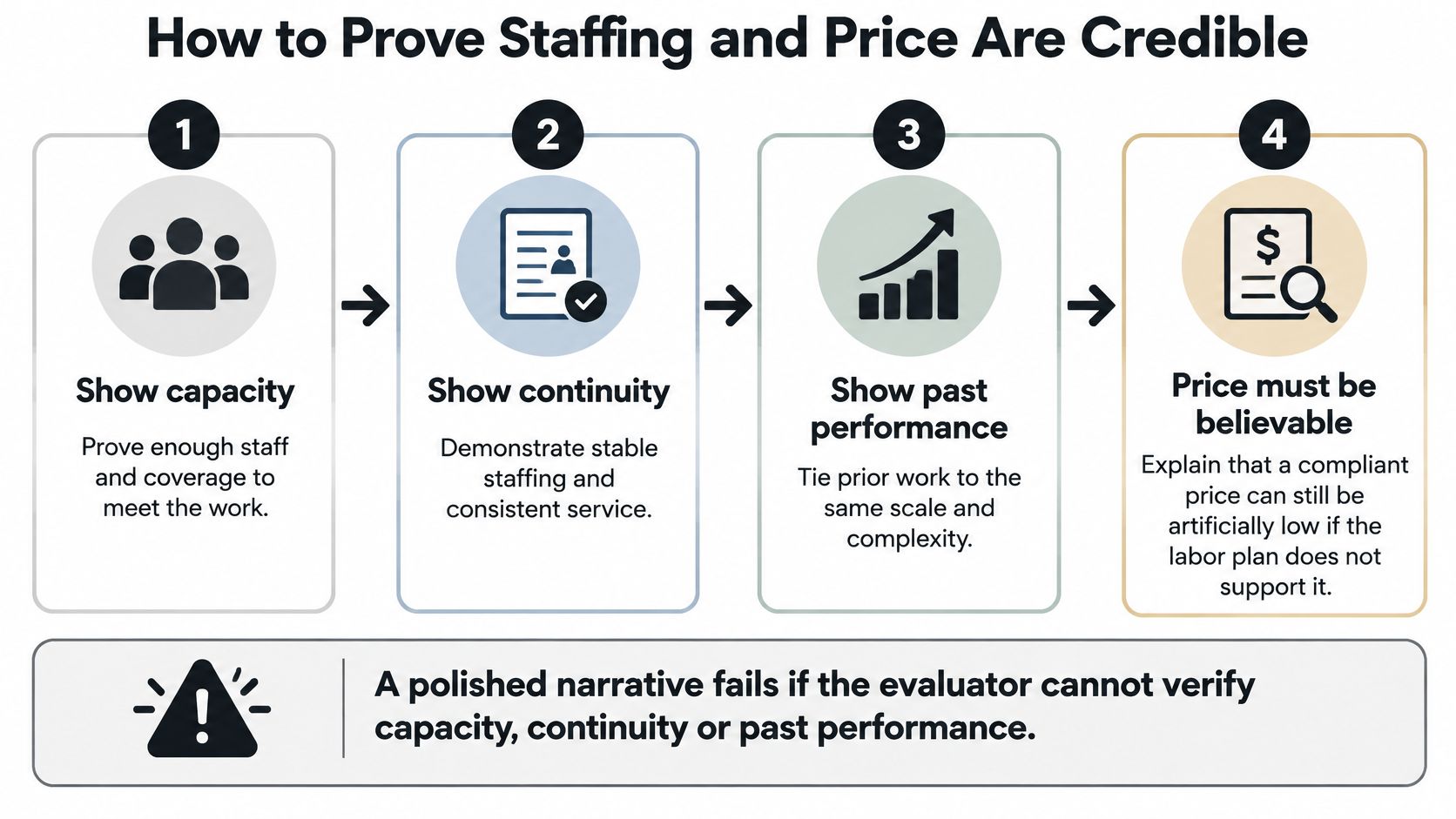
FEMA's janitorial solicitation on SAM.gov scores price, technical approach or management plan, and past performance together. A U.S. Embassy solicitation asks offerors to name the types and quantities of equipment and supplies, say whether they already own them, and explain how missing items will be obtained. Local solicitations add labor, supervision, licenses, insurance, personnel qualifications, and a detailed cost proposal. Treat those as one chain, not a checklist.
Six proofs, in order
- Turn scope into hours. List every performance line with its frequency, such as nightly restrooms or weekly floor stripping, and convert each frequency into labor hours. The evaluator looks for hours that match the schedule, not a single blended rate.
- Staff the shifts. Show headcount per shift, the supervisor ratio, and who covers holidays and absences. A plan with no relief is a continuity gap.
- Inventory equipment and supplies. List type and quantity, mark what you own, and name the supplier and delivery time for anything you still need to buy.
- Build the labor rate from the wage determination. On federal work, check whether the solicitation attaches Service Contract Act wage determinations. Price from the listed occupations and the minimum wage and fringe rates, then add insurance, licenses, and supervision. A market guess that sits under those floors is not credible.
- Attach the proof. Map each assumption to a résumé, equipment list, supplier letter, license, or reference. If a file does not exist, say so.
- Stress-test one absence. Ask what happens if one worker is out for a week and whether the margin still pays a replacement. If it does not, the price is artificially low.
Credibility is simple to spot. Every assumption traces to an evidence item the evaluator can open.
How to Build a Responsive Bid Package
Assemble the package in the order an evaluator will check it. Skipping ahead to prose is how signed forms get left out.
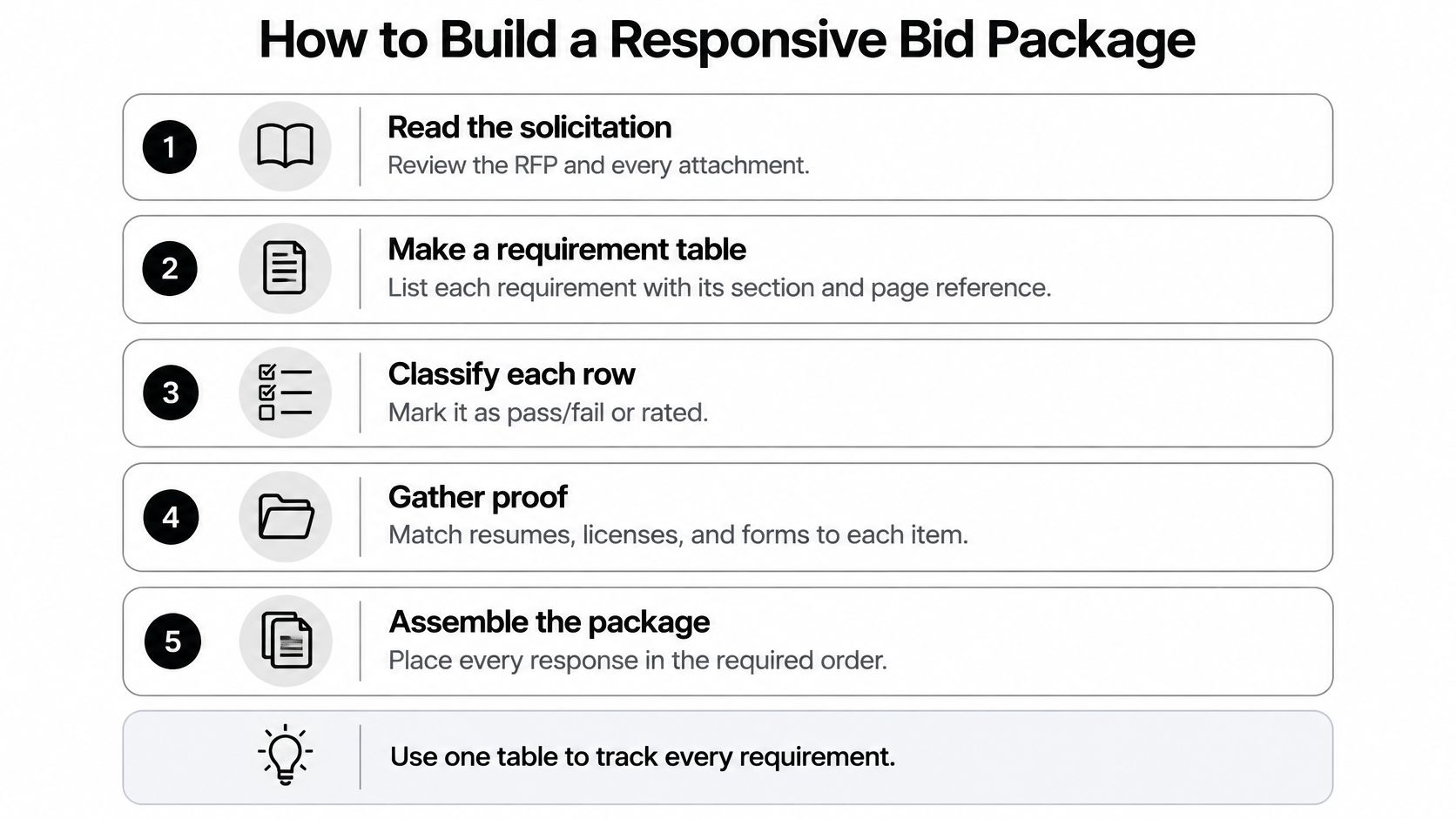
- Read the solicitation and every attachment. Put each requirement in one table with its section and page. On the Pro plan, when you start a bid, BidFunnels reads its documents and puts every requirement into one table (a compliance matrix) with the section and page it came from.
- Classify each row as pass/fail, scored, a clarification, or a post-award duty. That label tells you what can reject the bid and what only costs points.
- Build the table of contents with section and page numbers that match the format rules before you draft. Writers then fill a skeleton instead of inventing headings.
- Stack the forms. Certifications, bond, and insurance go on a checklist. Check signatures, dates, and expiry. A current certificate with the wrong additional-insured wording still fails.
- Draft each narrative against the requirement it answers. Reuse an old proposal or capability statement only where it fits. Mark the gap instead of inventing a contract you did not perform. BidFunnels lists every requirement in the RFP and checks your proposal against those requirements, which is useful when a section looks finished but skips a line.
- Check limits, file names, fonts, and the portal deadline with its time zone. Submit at least one day early. After each addendum, rerun the matrix. An amendment that changes square footage or a bond amount invalidates the price you already built.
Choosing which jobs deserve that much assembly is its own decision. Choosing which facility contracts to pursue is worth reading before you open a second solicitation in the same week. For the writing itself, how to write a government contract proposal covers the narrative shape once the matrix exists.
A finished package passes one test. Every requirement row points to a page, no pass/fail row is blank, and each claim traces to a file.
Make Your Bid or No-Bid Decision

Apply three tests, and decline the solicitation if any one fails.
- Pass/fail proof is already on file before the deadline. That means signed forms, bonds, insurance, and any mandatory site visit you can still attend.
- References match the written thresholds for contract value, duration, facility type, and recency.
- The price covers staffing, equipment, and supplies with margin in every option year, including a one-week absence.
No-bid signals are plain. A sole-source notice, a walkthrough you cannot attend, a bond you cannot get, or a deadline shorter than the time you need for the matrix and the draft. Walking away from a poor fit leaves the week for a better janitorial services RFP. Janitorial services sit under NAICS 561720, and you can scan open notices in that code instead of forcing this one.
The RFP checker is free and can be used to check one RFP without signing up. It will not file the offer for you. BidFunnels is a research and drafting tool that does not submit bids or proposals for the customer and does not act as the customer's agent before any government body. Drafts from BidFunnels must be reviewed and edited by the user, who is responsible for what is submitted.
This week, send questions before the question deadline or book the mandatory site visit. Put a compliance-matrix review on the calendar with the person who will sign. Set your own submission cutoff a day ahead of the portal's.
BidFunnels helps you find federal and state janitorial opportunities, score which ones fit your NAICS codes and set-asides, and turn the solicitation into a requirements table before you price a single shift. You still review and submit the offer yourself. Start with one solicitation at BidFunnels.