

Invitation for Bids Explained: Sealed Bidding vs. RFP
Nov 8, 2026 · 13 min read

You've found a notice that looks perfect. The work is clear, you can do it well, and your price feels competitive, so you start pricing right away. That order is exactly where many first-time bidders lose. In sealed bidding, the agency checks whether your bid complies before it cares how low your price is.
Table of Contents
- What an Invitation for Bids Is and Why Price Alone Loses
- How an Invitation for Bids Differs from an RFP
- Finding IFB Notices and Setting Up to Bid
- How Sealed Bidding Works from Notice to Award
- Responsiveness Rules That Disqualify the Lowest Bid
- When an IFB Is the Right Route for Your Bid
- Confirm Your Pre-Bid Checks Before the Deadline
- Cancellation Risk After Bids Are Opened
What an Invitation for Bids Is and Why Price Alone Loses
Say six contractors bid on a city or federal job. Your bid is the lowest by a comfortable margin, so you expect a call. Instead, the award goes to the second-lowest bidder because one signature page was missing from your package. That's not bad luck. That's how an invitation for bids is designed to work.
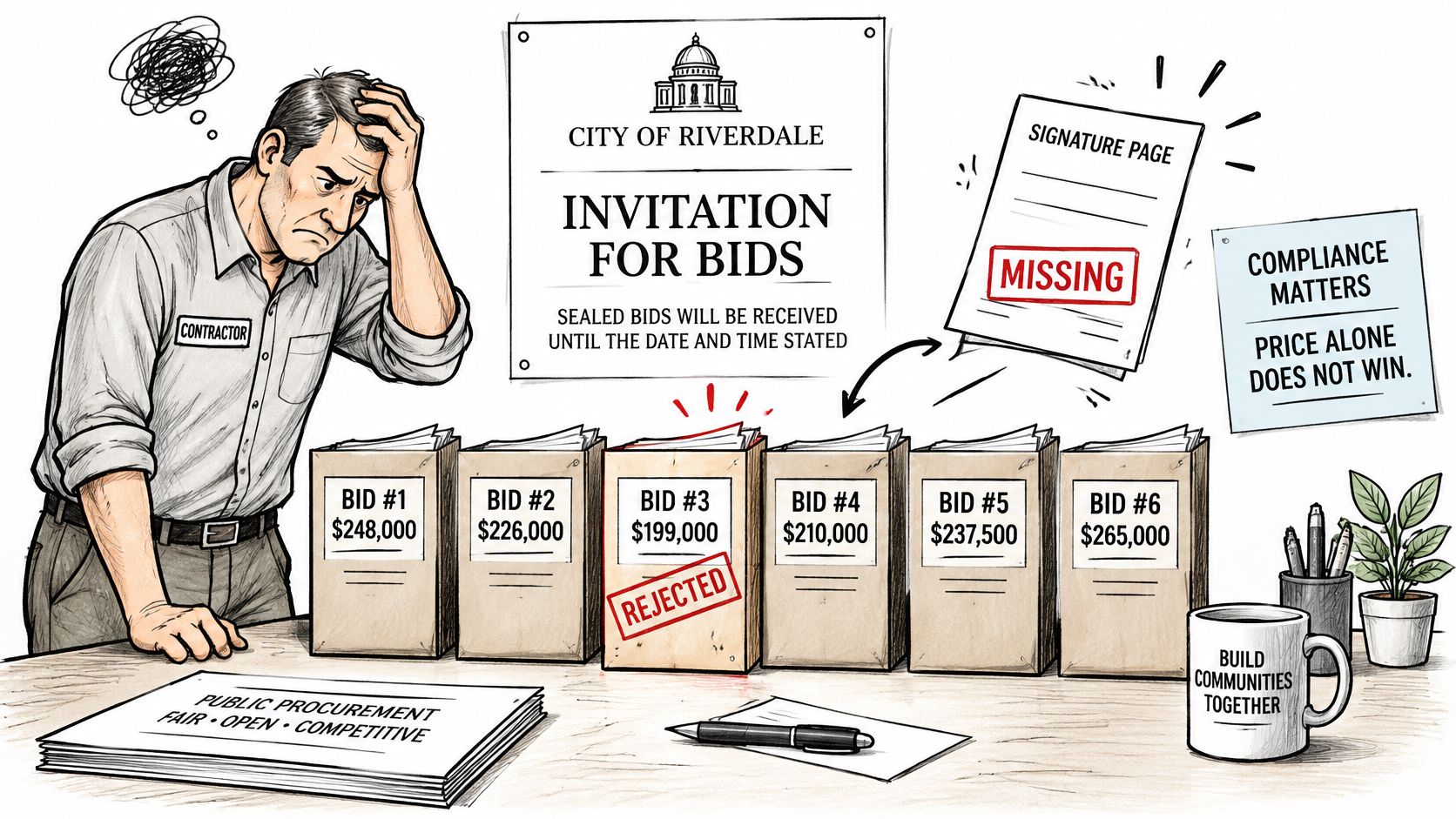
An invitation for bids, or IFB, is the government's solicitation for sealed bidding. The agency uses it when it can describe what it needs precisely enough that bidders can calculate a firm price, and award will rest mainly on price. Think of it as a sealed auction with a pass or fail entry form. Your price only counts after your form passes.
The formal rule has two parts. First, your bid must be responsive, which means it complies with all the material terms in the solicitation. Second, you must be responsible, which means you're able to perform the work. The agency awards to the lowest bid that clears both tests, using price and any stated price-related factors. A lower price that fails the first test doesn't beat a higher price that passes it.
Why Precision in the Solicitation Matters
Because bidders get no chance to negotiate later, the document has to carry the whole deal up front. Under FAR Subpart 14.1 on sealed bidding, the solicitation should include the specifications, delivery or performance requirements, contract clauses, bid forms, and all incorporated documents needed to calculate a firm price and submit a compliant offer. The same rules prohibit requirements that are unnecessarily restrictive, because they choke off competition.
That precision isn't bureaucratic decoration. If requirements are vague, each bidder guesses differently, prices aren't comparable, and the agency can't defend the award. If requirements are complete, everyone prices the same work and competes on an equal basis. Sealed bidding fits when the need can be judged objectively, there's time to solicit and evaluate bids, discussions aren't necessary, and more than one sealed bid is reasonably expected.
Practical rule: Read an IFB as a list of conditions to satisfy, not as a price sheet to fill in. Pricing comes second.
So before you touch numbers, pull out every mandatory specification, delivery term, form, certification, and clause. That list, not your price, is what the next steps are built on.
How an Invitation for Bids Differs from an RFP
The fastest way to see the difference is side by side.
IFB versus RFP at a glance
| Factor | Invitation for Bids (IFB) | Request for Proposals (RFP) |
|---|---|---|
| Basis of award | Lowest responsive, responsible bid using price and stated price-related factors | Best value trade-off using price and non-price factors |
| Discussions with offerors | Not permitted in sealed bidding | Permitted, including negotiations and revised submissions |
| What you submit | Fixed sealed bid by the exact deadline | Proposal, often with separate technical and price volumes |
| Effect of a missing or non-conforming item | Can make the bid ineligible regardless of price | Handled through evaluation of the proposal as a whole, depending on the solicitation |
| Best used when | Requirement is well defined and price is the main decision | Government needs a method, design or trade-off between cost and quality |
Two rows should change how you prepare. The first is the basis of award. In an IFB, once your bid passes the compliance test, price decides. You don't win extra credit for an elegant technical approach, strong past performance, or a clever staffing plan. In an RFP, those non-price factors can outweigh a lower price, because the agency is buying best value, not just the cheapest acceptable offer. If you're used to RFP work like an RFP for IT consulting services, it's worth setting that proposal mindset aside here.
The second row is discussions. Sealed bids are evaluated without them. There's no round where the agency asks what you meant by that delivery date, invites a revision, or lets you fix a weak section. What you submit is what gets judged. An RFP, by contrast, often includes negotiations and revised proposals, so a fixable gap in an early draft isn't always fatal.
A Quick Test You Can Run on Any Notice
Ask what the notice is really requesting. If it asks you to price a defined item or service and deliver it to specification, you're likely looking at an IFB. If it asks how you would perform the work, why your method is sound, and who will do it, you're likely looking at an RFP. The work itself can look similar. The evaluation logic is completely different.
Don't trust the label in the title. Agencies sometimes use loose wording, and a notice can carry one name while running under the other's rules. Go straight to the evaluation section and read how the winner will be chosen. That section tells you whether to spend your hours on pricing discipline or on writing a persuasive proposal.
Finding IFB Notices and Setting Up to Bid
Federal solicitations are published in the federal contract opportunity listings, and state and local agencies post through their own procurement portals. Before a federal award can land in your name, your business also needs registration in the System for Award Management, often called SAM.gov. Sorting that registration out after you've found a perfect notice is a poor use of a short deadline.
Five Setup Items to Finish First
- Confirm NAICS codes and size status: Your North American Industry Classification System codes and small-business size status determine which set-asides you're eligible for.
- Confirm state licensing: For construction work, hold the state license the solicitation requires before you bid, not after.
- Confirm bonding capacity: Talk to a surety about both the bid bond at submission and a later performance bond, so you know your ceiling.
- Set alert filters: Filter for IFB and sealed-bid notices in your codes so new notices and amendments reach you fast. Browsing current government contract listings with those filters set beats scrolling everything.
- Create one folder per notice: Store the solicitation, every attachment, and the full amendment history together from day one.
That last habit sounds minor and isn't. Amendments land while you're pricing, and a bidder working from an outdated copy in a downloads folder can price work that no longer matches the requirement.
One caution before you invest time. A notice can carry an IFB title and still be run under different rules, so check the procurement method and evaluation section before you price anything. Then make your first real decision about that notice. Are the requirements specific enough that you could price them confidently without ever talking to the agency? If the answer is no, sealed bidding may not suit this opportunity, however attractive the work looks.
How Sealed Bidding Works from Notice to Award
The flow below shows the sequence at a glance before the detailed steps.
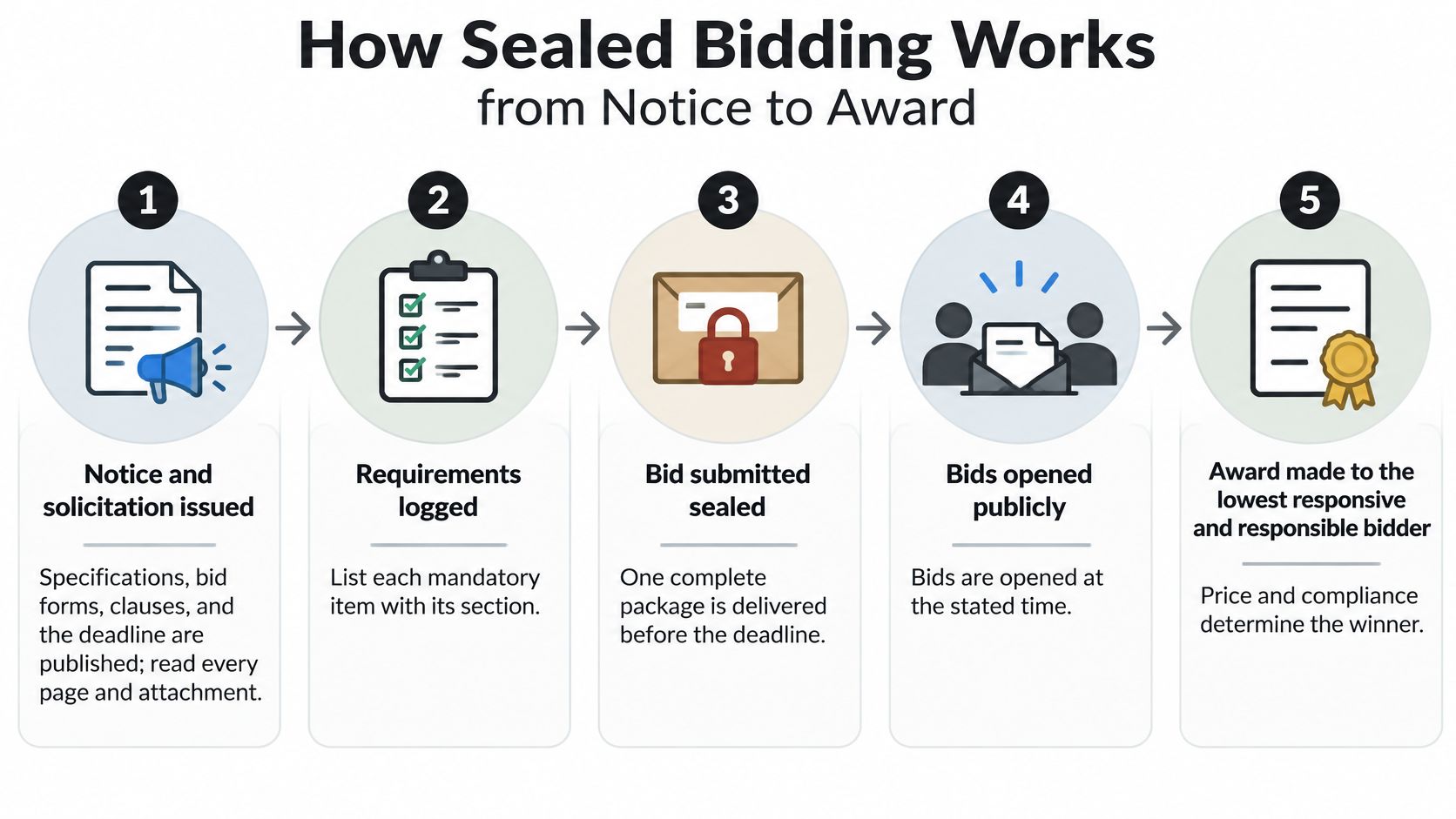
The Eight Steps in Order
- Notice and solicitation issued. The agency publishes specifications, bid forms, clauses, and the deadline. Read every page and attachment, because requirements hide in appendices. The common slip is skimming the main document and skipping the exhibits.
- Requirements logged. List each mandatory item with its section and page, then track every amendment against that list. An amendment can change price, scope, forms, or the deadline. The common slip is logging requirements once and never updating them.
- Firm price calculated. Price the work against the specifications exactly as written, since no discussions follow where you could clarify assumptions. The common slip is pricing what you think the agency meant instead of what it wrote.
- Bid package assembled. Include the bid bond or guarantee, signed forms and certifications, and every required attachment. The common slip is treating a certification page as paperwork you'll add at the end.
- Submission. Send the bid through the method the solicitation permits, early enough to hit the exact deadline, and keep your timestamp or delivery confirmation. The common slip is uploading in the final minutes and discovering a portal problem you can't fix.
- Public opening. Bids are opened and read at the stated time. Late or incomplete submissions are normally rejected rather than held for repair. The common slip is assuming a small omission will be overlooked because your price is strong.
- Responsiveness and responsibility review. The agency first checks whether each bid complies with the material terms, then checks whether the lowest responsive bidder can perform. The common slip on your side is confusing the two and assuming proof of capability can rescue a noncompliant bid.
- Award or cancellation. The contract goes to the lowest responsive, responsible bidder. If prices or competition are inadequate, the agency can cancel instead. The common slip is treating low bid at opening as a guaranteed win.
The short video below walks through the same sequence visually.
Notice where your control sits. Steps one through five are entirely yours, and step six onward is entirely the agency's. Everything you can do to protect your bid happens before the deadline, which is why the steps in the middle matter more than most bidders expect.
Responsiveness Rules That Disqualify the Lowest Bid
In a 1987 Army procurement for replacement compressed-air systems, bids were opened on September 3, 1987, and the apparent low bidder was rejected because its offer lacked the required bid bond, as the GAO decision in B-228393 records. The price was never the problem. The paper was.
Responsiveness is the gate before scoring. Under FAR 14.301 on responsiveness of bids, a bid must comply in all material respects with the IFB, be completed and executed as instructed, and reach the designated government office by the exact deadline. Electronic submission counts only when the solicitation specifically permits it. Your own form is acceptable only if you accept every term and the award would form a binding contract without changing the IFB's terms.
The logic is strict because sealed bidding is strict. In a fixed-price competition opened in public, letting one bidder add a material commitment after opening would punish every bidder that complied on time. A missing bond, signature, certification, or amendment acknowledgment is therefore treated as a defective bid, even when the price is attractive. Bidders arriving from negotiated work, including anyone using guidance on how to write a government contract proposal, often expect a cure period that sealed bidding does not provide.
Use the defect table as a pre-deadline checklist. Each row describes a failure that can remove the lowest price before price comparison matters.
| Defect | Why the bid fails | How to prevent it |
|---|---|---|
| Missing bid bond or required guarantee | Required security is absent, so the bid is nonresponsive | Confirm the amount and surety form before pricing |
| Unsigned certificate or form | Required signature or certification is missing | Name a signature authority and verify every form is executed |
| Unacknowledged amendment | Amendment changes price, scope or deadline but is ignored | Log each amendment and attach its acknowledgment |
| Altered or conditional commercial terms | Exception changes the IFB terms and is not an acceptable alternative | Accept every term unless the solicitation permits an alternative |
| Late or wrong-channel submission | Deadline missed, or an electronic method is used that the solicitation does not permit | Confirm the permitted method and submit early with a verified timestamp |
| Missing attachment or specification sheet | Required document absent from the package | Map each attachment to its requirement in the matrix |
The Control That Catches These
Keep a requirements matrix with six fields for every item: source section and page, mandatory or informational status, responsible reviewer, evidence or attachment, signature authority, and final verification timestamp. Recheck it after every amendment, then review submission logistics separately from technical content. The person verifying the package should know the delivery channel, the deadline, and the exact forms already signed.
When an IFB Is the Right Route for Your Bid
Not every notice deserves your pricing hours. The checklist below gives you the conditions that make sealed bidding a sensible bet.
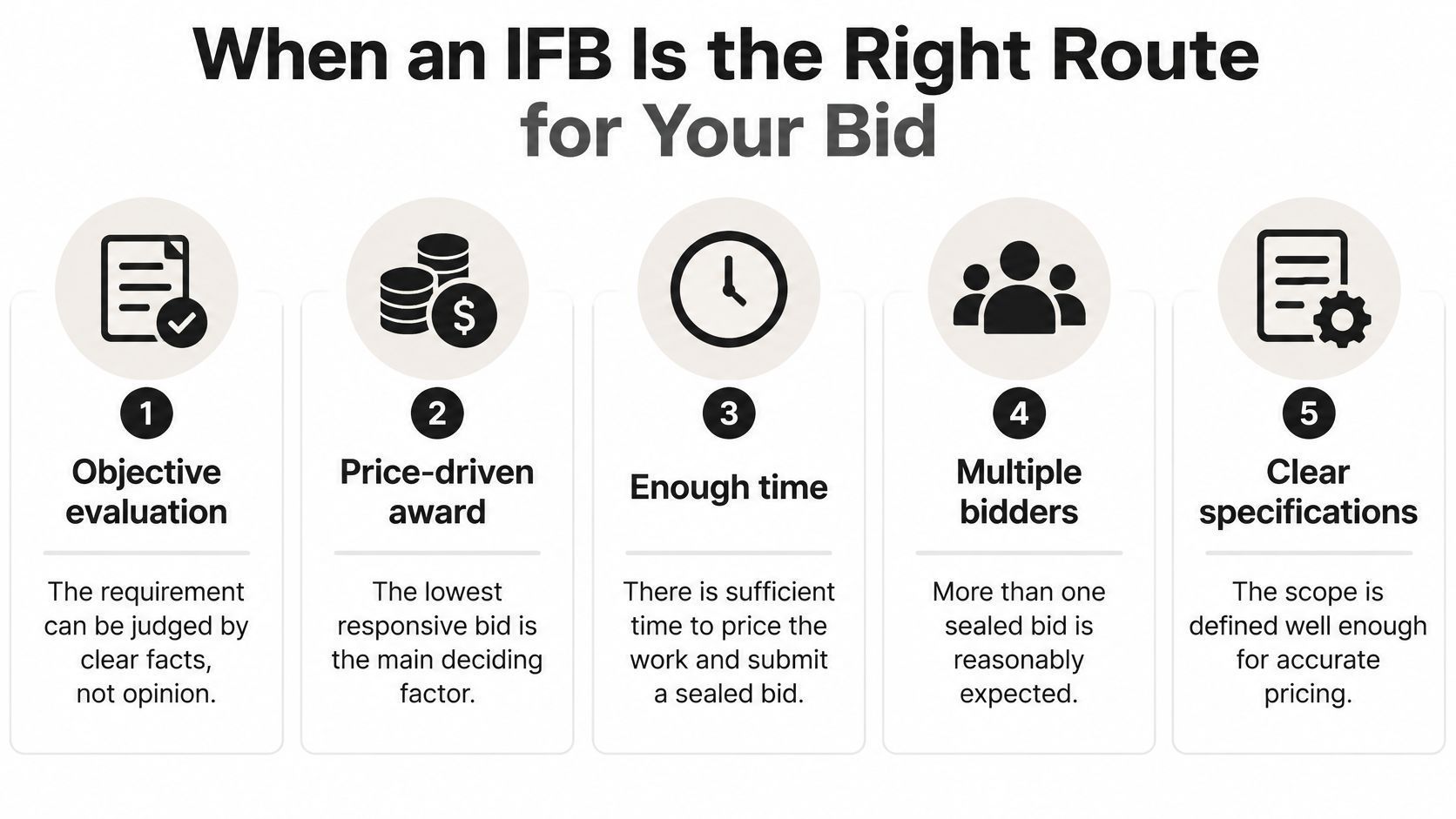
An IFB works well for you when the requirement can be evaluated objectively, the award is price-driven, you have enough time to price and submit carefully, clear specifications let you calculate costs without guessing, and more than one sealed bid is reasonably expected. When those conditions hold, sealed bidding is refreshingly straightforward. You know what's wanted, you know how the winner is picked, and discipline beats polish.
Red Flags That Should Slow You Down
- Ambiguous specifications: If two reasonable readers would price different work, your low bid may just mean you guessed wrong.
- Frequent amendments: A shifting requirement signals the agency hasn't settled its own needs.
- Heavy bonding exposure: If the required bond stretches your surety capacity, one win could block other work.
- Uncertain delivery or performance risk: Tight schedules or vague site conditions turn a firm price into a gamble.
- Price volatility: When material or labor costs swing between bid and performance, your margin carries the risk.
The stakes behind careful screening are real. According to the GAO report on bid protest trends, GAO resolves more than 1,000 bid protests annually, protesters obtain some form of relief in approximately 50% of cases, and overall protest filings have declined about 32% over the past decade. Fewer filings don't mean fewer defects. They mean the defects that remain still matter a great deal to the firms affected.
Score each criterion from one to five before you open the price sheet, and set your threshold in advance. Log every ambiguity you find rather than pricing around it. Then pick one of four options, in this order: bid as written, seek clarification, protest a defective term before the deadline, or walk away. Walking away from a flawed solicitation isn't failure. It's protecting your bonding, your cash, and your reputation for notices you can win.
Confirm Your Pre-Bid Checks Before the Deadline
Once your bid or no-bid score says go, run a responsiveness audit. For a small contractor without a proposal team, this is the most valuable hour in the whole process. Competition doesn't reduce the need for it. In one 2025 VA construction IFB that received six bids, the dispute still turned on procedural details rather than price, as the GAO decision document shows.
The Six-Step Audit
- List every mandatory instruction from the solicitation and all its amendments, including delivery terms and certifications.
- Match each item in your matrix to its evidence, attachment, and named signer.
- Confirm every amendment is acknowledged in the exact way the solicitation requires.
- Separate fixable from fatal. Responsibility questions like licensing or bonding capacity may be clarified. A missing signature, bond, or acknowledgment in the bid itself usually can't be cured after opening.
- Raise problems before the deadline. A challenge to defective solicitation terms generally must be filed before bids are due, not after you lose.
- Submit early and keep the timestamp as proof of when your bid arrived.
If a defect would make the lowest bid unacceptable before prices are even compared, the audit is where you catch it, while catching it still helps.
One optional way to support this work is BidFunnels. We help small government contractors find public contract opportunities, judge which are worth bidding on, organize solicitation requirements, and draft proposal sections from their own files and saved answers. On Pro, AI reads the solicitation and its attachments and places every requirement in one table with the section and page it came from. We don't submit bids for you or act as your agent, and you stay responsible for what you send. Finish the audit, then make the call: bid, clarify, or walk away.
Cancellation Risk After Bids Are Opened
A low bid can clear every responsiveness check and still never become a contract. The agency holds an escape hatch: it can cancel the entire solicitation, even after bids are open and prices are public.
That hatch is narrow. As the GAO decision in B-229947 explains, FAR section 14.404-1 permits cancellation after opening only for a cogent and compelling reason, a standard that includes cases where all otherwise acceptable bids are unreasonably priced.
GAO decisions show what clears that bar. In one Navy construction procurement, the agency canceled after opening because it considered the bid prices unreasonable, and GAO has upheld rejections where the low bid exceeded the government estimate even by modest margins. Inadequate competition can carry the same weight: in an Air Force two-step sealed-bidding procurement for battery carts and chargers, an amended solicitation went out to a wide vendor list yet drew very few proposals, and GAO upheld the cancellation once the agency concluded that restrictive specifications had limited competition.
Three Grounds and Your Move on Each
- Unreasonable prices. Compare your price with what the government likely estimated and keep records showing it's defensible. A bid far above the field and the estimate invites scrutiny.
- Inadequate competition. Watch participation signals, such as pre-bid meeting attendance and published questions. If competition looks thin for a reason you can name, raise it in writing before the deadline.
- Restrictive specifications. Request clarification of any term that appears to exclude capable firms without a real need behind it, and get the request in before bids are due.
Price reasonableness, adequate competition, and accurate specifications keep controlling the outcome after opening. Keep monitoring amendments and agency notices after you submit. A procurement you'd written off as finished can be revised, canceled, or resolicited, and the resolicited version may fit you better than the first.
Your next invitation for bids will reward the bidder who treats responsiveness as the first competition and price as the second, and that's exactly the order we built BidFunnels to support. We score notices against your company profile, put every solicitation requirement in one source-linked table, and check your proposal against those requirements so a missing form doesn't undo a winning price. Set up your profile and run your pre-bid checks with the full requirement list in front of you.