

Government Contract Proposal Template: Sections and Checks
Nov 12, 2026 · 14 min read

In fiscal year 2024, the U.S. government committed approximately $755 billion in contracts, about $22.5 billion below fiscal year 2023 after inflation adjustment, according to the Government Accountability Office's government-wide contracting dashboard. Money on that scale doesn't go to the best-written narrative. It goes to the offeror whose evidence an evaluator can find, score, and defend in a source selection record.
Most templates sitting in small contractors' shared drives are writing outlines: a technical approach heading, a staffing heading, a price heading, and nothing that connects a sentence to a requirement. A government contract proposal template that earns its keep works the other way around. Every row records what the solicitation asked for, where the answer lives, who owns it, and what proves it.
Table of Contents
- Reusable Template Sections and Required Fields
- Build the Solicitation Crosswalk Before You Draft
- Evidence Limits to Configure in Your Template
- Writing Each Volume Against Its Evaluation Factor
- Adding an AI Compliance Module When Solicitations Require It
- Accessibility Evidence Matrix for Section 508
- Pre-Submission Compliance Checks and Where to Fix Them
- Confirm the Template Fits Your Next Solicitation
Reusable Template Sections and Required Fields
The core of a reusable government contract proposal template is one table with nine rows. Each row carries the content a writer produces and the field that proves the content exists.
Core template sections and the fields each must hold
| Template section | Content to include | Evidence or field to track |
|---|---|---|
| Solicitation crosswalk | Requirement text, section number, volume, page limit | Requirement ID, owner, status |
| Compliance matrix | Every shall, must and should statement | Response location, Covered, Partly or Not found status |
| Technical approach | Method tied to each evaluation factor | Test results, reference documents, page reference |
| Management and staffing | Organization, key personnel, transition approach | Resumes, org chart, staffing assumptions |
| Past performance | Relevant contracts within the allowed window and count | Contract number, point of contact, CPARS or reference letter |
| Price volume | Cost worksheets, annual pricing, subcontractor budgets | Source spreadsheet, rate assumptions |
| Cover letter and volume index | Signature block, identification, page limits and format from Section L | Signatory, date, volume and page check |
| Forms and certifications | Section K representations and signed forms | Form register with signatory and date |
| Assumptions and clarifications log | Open questions and government answers | Amendment number, date received |
Solicitation-specific instructions, not a generic layout, control every row in that table. The template has to be adaptable, since each solicitation resets volume names, page limits and forms, and traceable, since every field points back to the instruction that created it.
Where the rows earn their place
Solicitations often ask for separate volumes covering technical approach, business, pricing, past performance and contract documentation, and some require a cross-reference matrix linking each contract reference to a technical element. That matrix is the argument for a template in miniature: an evaluator wants a link between a claim and a contract, and the template should have built the link already. When a solicitation demands that cross-reference, the past performance row and the technical approach row stop being separate documents and become two ends of the same citation.
The cover letter row and the forms register look like clerical clutter until they are not. Document-control errors, such as a missing signature or a stale page limit, can cost a bid as readily as weak writing. A register with a signatory, a date and a blocking check catches the gap before the signature rather than after. The same logic applies to the assumptions log: a government answer that arrives in amendment 4 and never reaches the compliance matrix is a requirement your draft skips.
Keep one master file and copy it per bid
Build the nine rows once as a spreadsheet with the solicitation number in the first column. Freeze the header, use the same three status values on every bid, and copy the file into a new bid folder instead of editing the master in place. A template that only ever gets edited in place eventually submits last quarter's page limits. Tools that automate the first row earn their cost quickly: BidFunnels, for example, reads a solicitation and its attachments on the Pro plan and places every requirement in one table with the section and page it came from, which removes the manual pass often skipped under deadline pressure.
If you need the one-page version of this discipline first, the part that gets a small firm in front of a buyer before a solicitation exists, this capability statement template guide covers it.
Build the Solicitation Crosswalk Before You Draft
Under FAR 15.204-1, solicitations using the Uniform Contract Format come in four parts, as set out in the Federal Acquisition Regulation text on the uniform contract format: Part I is the Schedule, Part II holds the contract clauses, Part III lists documents, exhibits and attachments, and Part IV carries representations and instructions. For proposal work, Part IV does nearly all the heavy lifting. Section K holds representations, certifications and other offeror statements. Section L holds instructions, conditions and notices. Section M defines the evaluation factors for award.
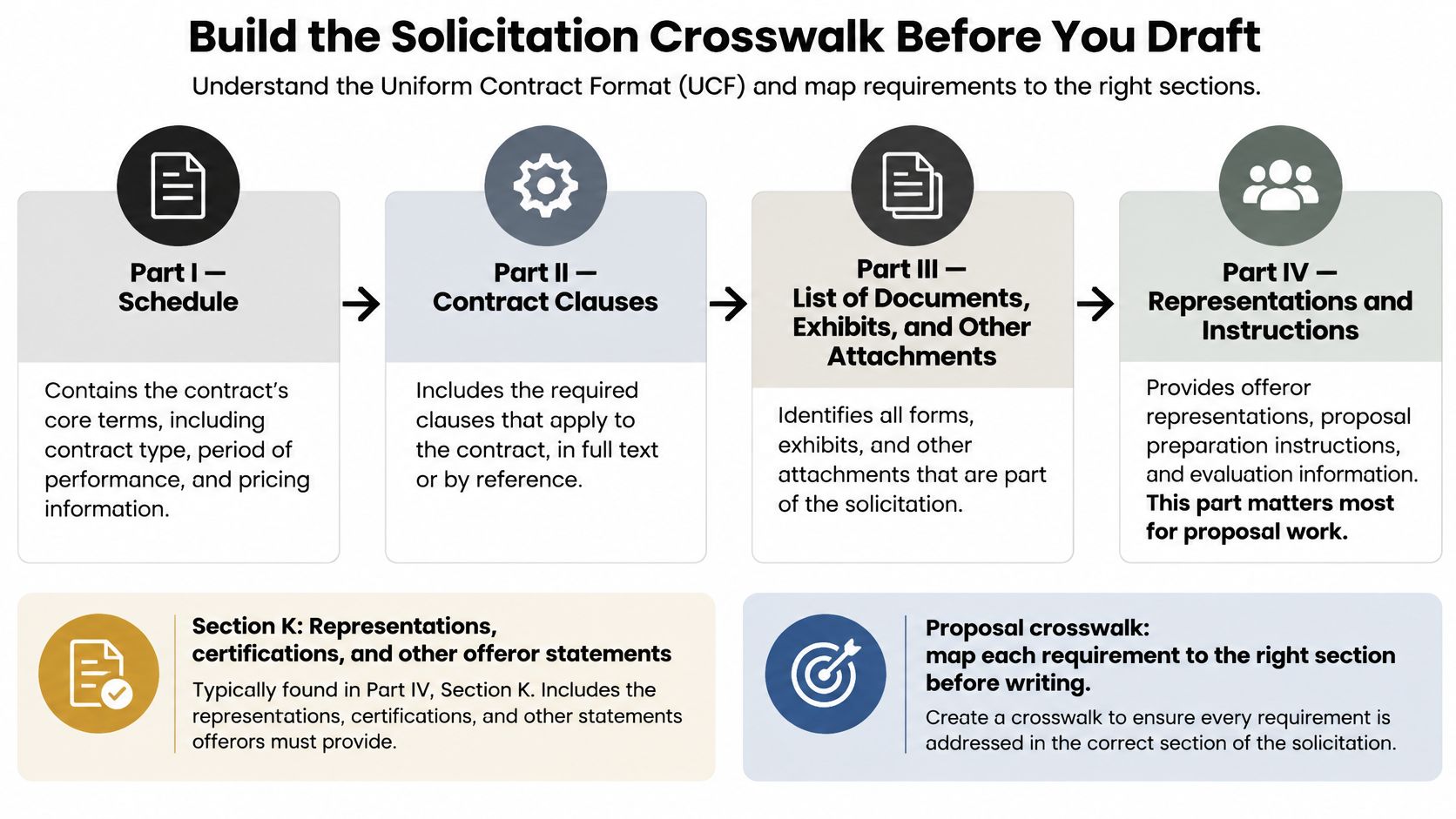
The regulation is blunt about what gets scored. Competitive proposals are evaluated solely against the factors and subfactors named in the solicitation, which means persuasive content with no matching requirement earns nothing no matter how well it reads. Keep the solicitation's own terminology and numbering as you map, because an evaluator hunting for requirement 3.2.1 will not appreciate your improved phrasing.
Seven steps, in this order
- Download everything, amendments included. Record each amendment number and the date you received it. A crosswalk built on the original document is the most common version-control failure in a bid folder.
- Pull every Section L instruction and Section M factor into one row. Use the exact requirement text rather than a summary, and keep the section number so you can find the clause again when a reviewer challenges it.
- Add the volume, response location and page limit. This turns a list of requirements into a plan, because every requirement now has a physical home in the submission.
- Flag the attachment or form each row depends on. A pricing requirement that lives inside a government spreadsheet is a different task from a paragraph you write, and the flag tells you which one you're doing that afternoon.
- Name one owner per row. One. Shared ownership of a compliance row means nobody checks it on the last day.
- Log questions and assumptions with dates. Anything you'd otherwise resolve by guessing goes into the log with the date you submitted the question and the amendment number that answered it.
- Run a Section L and M validation before the first draft. Read the crosswalk against the solicitation in both directions before anyone writes a sentence.
What finished looks like
A finished crosswalk has a row for every Section L instruction and every Section M factor, each carrying a volume, an owner and a response location, with no blank cells. An empty cell isn't a template problem. It's a decision you haven't made yet.
The same traceability logic drives requirements management for AEC teams, where a design submission answers a specification line by line and a missed line shows up in a review comment. Proposal work is that discipline with different labels.
A crosswalk with a blank owner column is a wish list with a deadline attached.
Evidence Limits to Configure in Your Template
A 1992 Government Accountability Office decision set out the principle that governs every evidence field you build. Price or cost must be an evaluation factor in every source selection, while quality is judged through technical excellence, management capability, personnel qualifications, prior experience, past performance and schedule compliance, as summarized in the GAO decision on evaluation factors. Translated into template design: each response section maps to a stated evaluation factor. Sections organized only around what the company is proud of tend to score poorly and read beautifully.
Common Section L evidence limits and the template field to set
| Limit or rule | Common pattern in Section L | Template field to set |
|---|---|---|
| Prime past-performance examples | A fixed maximum count per offeror | Maximum count per offeror |
| Subcontractor past-performance examples | A fixed count per major subcontractor | Maximum count per subcontractor |
| Past-performance window | A recency window counted back from the solicitation date | Date filter on each example |
| Proposal volumes | A set volume count plus a cross-reference matrix | Volume count and matrix tab |
| Technical and business files | Separate files | File split check before assembly |
| Cost worksheets | Excel worksheets priced by year and task | One worksheet tab per year or task |
| Subcontractor budgets and hours | Subcontractor budgets with a consolidated summary of costs and hours | Summary tab reconciled to worksheets |
| Mandatory representations | An incomplete required form can make the offer ineligible for award | Blocking check in the form register |
The limit that disqualifies more bids than any page cap
Teams worry about page overruns and file naming. The disqualifier is usually duller. Section L instructions routinely make certain representations and certifications a condition of eligibility, so an offer that leaves a required representation incomplete can be rejected without ever being scored. No downgrade, no partial credit.
That is why the form register needs a blocking check that halts assembly. Build the gate so the document cannot be finalized while a required form sits unsigned, because a reminder in someone's inbox does not stop a submission.
The recency window shrinks the example pool
Solicitations commonly restrict past-performance citations to work performed within a set window before the solicitation date. An example outside the window comes out, even when it is the best work the company has ever done. Apply the filter to a candidate list and the pool shrinks fast: a contractor can hold a strong record and still fall short of the required example count.
Write the survivors well and label the gap rather than padding the count with work that falls outside the limit, because evaluators do check the dates.
Two limits also bite in the same bid: the example count and the volume count. A template that stores these as fields enforces them without fanfare. A template that stores them as advice in a style guide enforces nothing.
The design rule that survives every solicitation change is simple. Every claim ties to supporting evidence, and every required deliverable is tracked against the instruction that demanded it.
Writing Each Volume Against Its Evaluation Factor
Drafting runs volume by volume, and each pass answers one question: which evaluation factor does this sentence serve? Keep that question on screen while you write, because it's the difference between a response and a brochure.
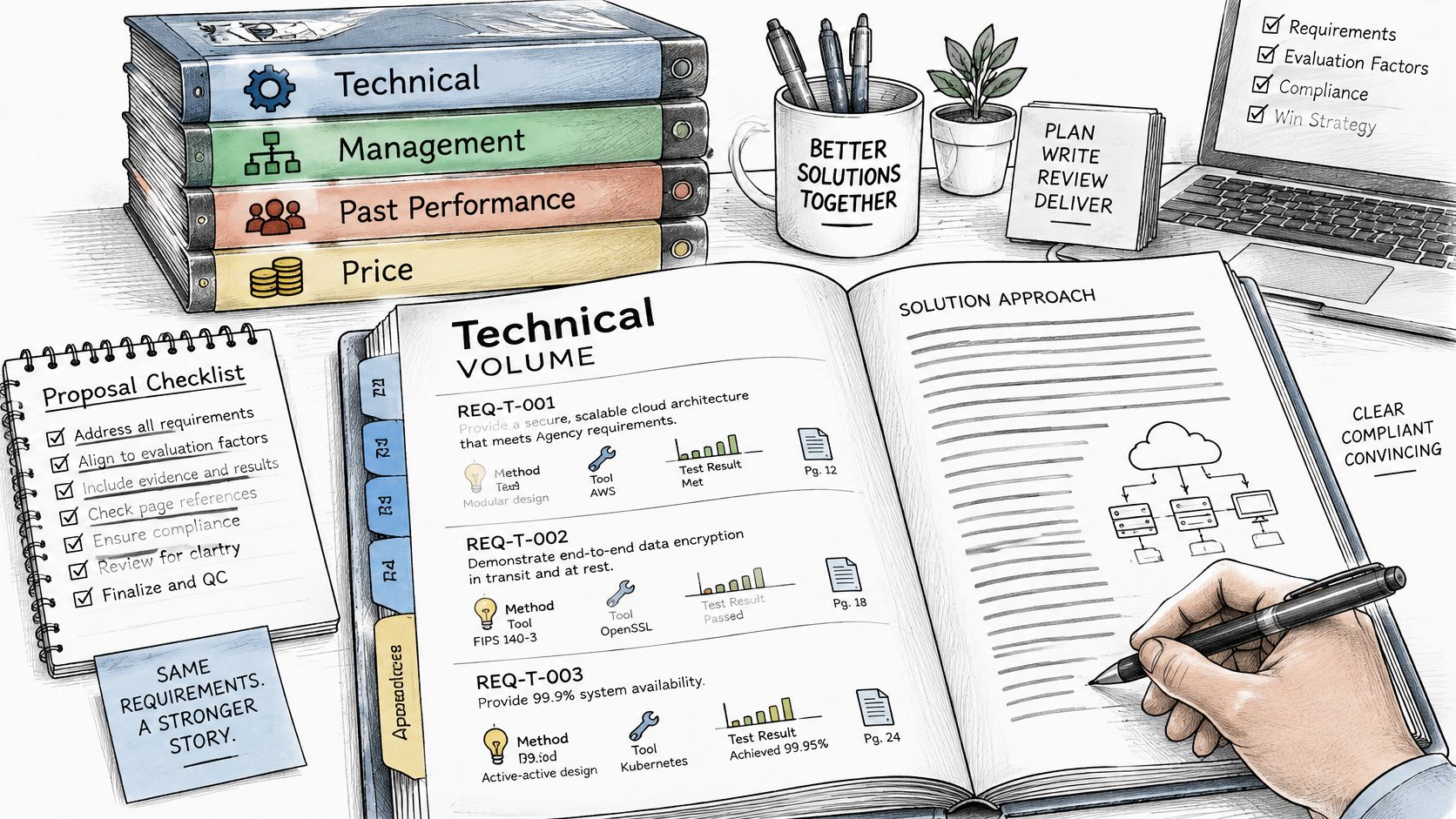
Technical volume
Write one subsection per requirement ID with the method, the tool, the test result and a page reference. A reviewer should be able to read a subsection, find the requirement number beside it, and know which part of the statement of work it answers.
Three questions before drafting:
- What must I demonstrate, phrased in the solicitation's own words rather than mine?
- What proves we've done it, whether that's a test result, a certificate, a sample or a past delivery?
- Which subfactor does this feed, and does the page limit leave room for the proof?
Management and staffing
Ask before you write: who is named, what are they doing, and what happens on day one if they aren't available? Resumes, an organization chart and staffing assumptions answer most of the management factor, and a transition plan with dates answers the rest.
Staffing assumptions carry more weight than their length suggests. They're where you state what the government has to provide for your approach to work, and where you protect yourself when the answer is "nothing yet."
Here's how the volume split and the drafting discipline look in practice on a services bid.
Past performance
Match examples on scope, customer type and the allowed year window. Record the contract number, a point of contact, and either a CPARS record or a reference letter. Where a gap exists, mark it; evaluators call references, and a contact who doesn't answer is worse than a stated shortfall. When the work you're citing is construction or modular building, framing the scope in the language the government uses to buy it, as in this overview of how the U.S. government uses modular construction, helps an evaluator recognize relevance fast.
Price volume
Build one worksheet per year or task, a subcontractor budget tab, a summary tab that reconciles to the worksheets, and an assumptions log covering labor rates and escalation. The summary is the only tab an evaluator reads closely, so it has to tie back to the detail without a footnote explaining the difference.
If your solicitation is a services buy, an IT consulting services RFP shows how the volumes and the pricing worksheets usually line up.
Then subtract. Remove any sentence that can't be traced to a Section M factor or a Section L instruction. What's left is shorter and scores better.
Adding an AI Compliance Module When Solicitations Require It
The common mistake is a persuasive AI narrative with nothing behind it: a page about model capability, a diagram, and no answer to what happens to government data. Recent federal guidance says solicitations and contracts for AI should address government-data protection, intellectual-property rights, transparency, explainability, portability, licensing, pricing transparency and, where applicable, authorization to operate, per the White House memo on driving efficient acquisition of artificial intelligence in government. The same guidance says agencies should test proposed systems to understand their capabilities and limitations.
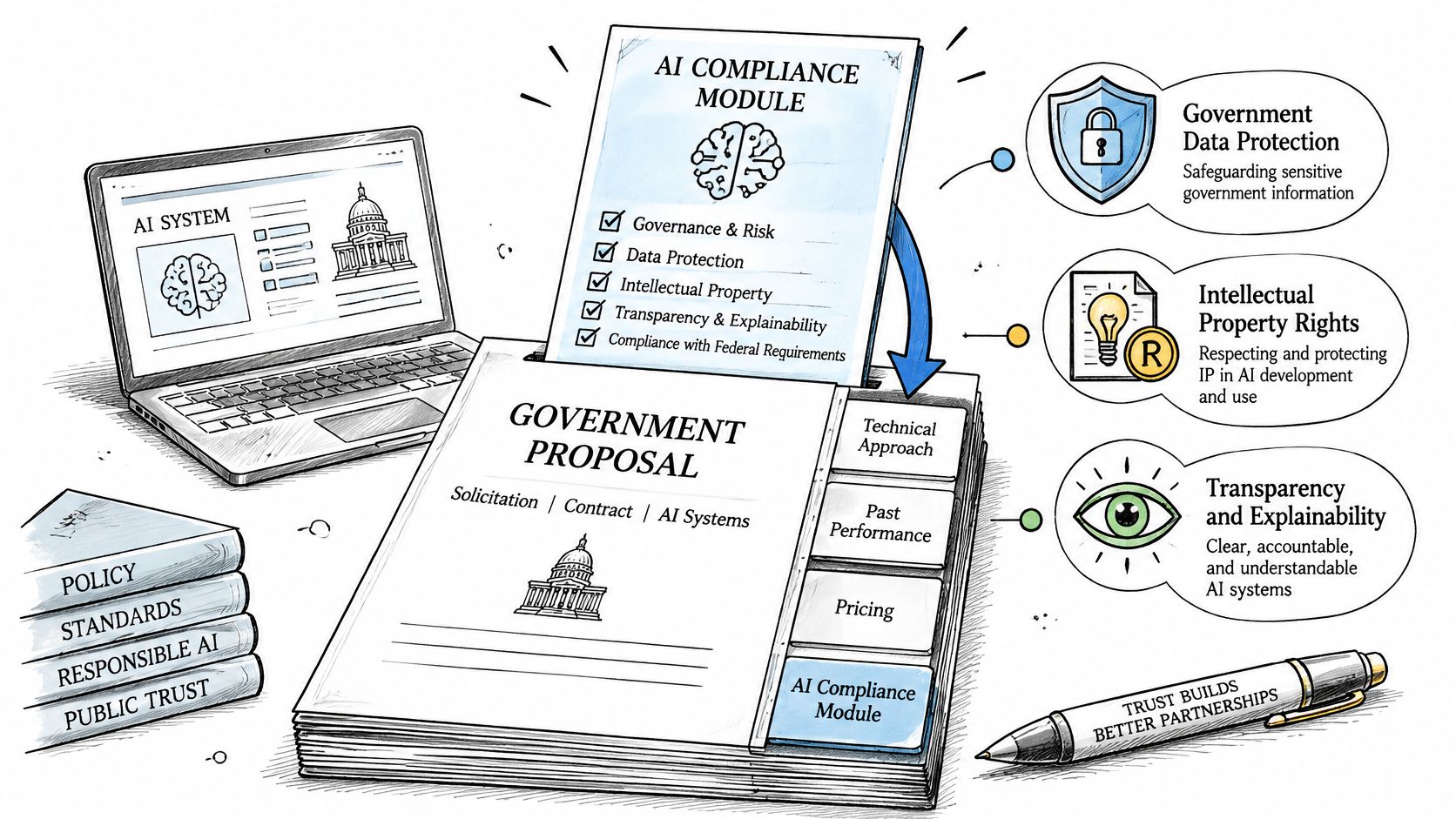
So the module isn't a section bolted on at the end. It's a set of prompts the template fires only when AI clauses appear, and it sits beside the technical approach rather than inside it.
The prompts to force
- Training-data provenance. Where the data came from, and whether the government's data is in it.
- Retention. Whether customer inputs or outputs are stored, and for how long.
- Human oversight. The specific points where a person reviews or approves output.
- Testing. Method, scope and who runs it.
- Limitations. What the system doesn't do well, stated before an evaluator finds it.
- Incident handling and deletion. Who is told, when, and how data gets removed.
- Subcontractor controls. Model providers and hosting count as subcontractors for this purpose.
- Portability. How the government gets its data and configuration out at the end.
The trade-off generic templates miss
A technically persuasive AI proposal can be commercially weak at the same time. Ignore lock-in, explainability or government-data restrictions and the evaluator sees a capability story with no governance answer, which makes the price hard to defend and the risk allocation worse for everyone.
Structure the module as one evidence row per requirement, each with a source document, an owner and a status. Where a test hasn't run, write not yet tested and name the date it will run. An invented certification or a borrowed performance history is the one error that turns a strong bid into a credibility problem.
Tie the module back to the test plan in the proposal. A prompt without a test plan is a promise; a prompt with a test plan and a date is evidence.
Accessibility Evidence Matrix for Section 508
Boilerplate is the default: one paragraph confirming Section 508 compliance, pasted into every bid. Federal acquisition guidance treats accessibility as something agencies evaluate and then validate throughout an ongoing period of performance, per Section 508's guidance on navigating federal acquisitions. A statement that starts as an answer becomes a continuing obligation, and that's what makes the boilerplate a liability rather than a shortcut.
Six columns that turn a claim into proof
- Applicable standard. The version and the specific requirements the solicitation names.
- Affected deliverable. The software, document, portal or workflow, named precisely.
- Testing method. Keyboard-only navigation, a screen reader, an automated scan plus a manual check, or a documented combination.
- Evidence owner. A person, not a department.
- Remediation timeline. What happens when testing finds a defect, and by when.
- Assumptions needing government clarification. The questions you need answered before you commit.
One row, written out
Say the statement of work names two user workflows in a public-facing portal. The row reads: the standard cited in the solicitation, applied to the intake and case-status workflows, tested with keyboard-only navigation and a screen reader, owned by the quality lead, with any defect fixed within 30 days of a finding, plus an assumption asking the government to confirm which standard governs the legacy back office. That's a commitment someone can retest after award.
Product accessibility is not an accessible proposal
Your submission files are deliverables too. Alternative text on images, captions on video, tagged documents, headings that don't skip levels and a working table of contents all belong in the matrix, along with procurement documentation and subcontractor deliverables, because the obligation follows what you hand over, not just what you build.
Copy a compliance statement and you create an apparent answer without usable proof. Accessibility language also touches technical design, schedule, pricing and acceptance criteria, so an untestable commitment becomes a change order later.
Keep the matrix alive after award. Add re-test dates to the contract plan and treat a failed check as a schedule item rather than a surprise.
The question isn't where to mention accessibility. It's how you'll prove it for the exact workflows you're proposing.
Pre-Submission Compliance Checks and Where to Fix Them
Run these eight checks after drafting and before submission. Each one has a timing rule and a pass condition, and the pass condition is the part people skip.
Pre-submission checks, timing and pass test
| Check | When to run it | Pass test |
|---|---|---|
| Section L and M validation | Before the first full review | Every Section L instruction and Section M factor has a response location |
| Page and format limits | Before assembly | Each volume is within its page count and file format |
| Compliance matrix status | Before final review | No Partly or Not found row without an owner and a plan |
| Forms and certifications | Before signature | Every Section K form is signed and dated |
| Past-performance dates and counts | Before selection | Each example is inside the allowed window and within the count limit |
| Accessibility evidence | Before pricing is locked | Each deliverable has a test method and an evidence owner |
| AI disclosures | When AI clauses exist | Provenance, retention, oversight and portability are each answered |
| Pricing reconciliation | Before submission | Worksheets match the summary tab and the assumptions log |
Every row carries one of three statuses: Covered, Partly or Not found. A Partly or Not found row needs a named owner and a plan before the file leaves the building. A sentence of hope in the cover letter isn't a plan, and an evaluator can't score one.
The Section L and M validation reads the crosswalk in both directions one last time, checking that every requirement has an answer and every answer has a requirement. Page and format checks come second, because a page count that shifts when fonts render is a real failure mode. If a volume has to be trimmed or split to fit a portal's upload cap, this guide to splitting a PDF by size covers the mechanics without breaking the page numbering the instructions require.
Forms and certifications come before anyone signs, not after. Past-performance dates and counts get checked at selection, which occurs earlier than usual, because a rejected example changes the volume's structure. Accessibility evidence belongs before pricing is locked, since a testing commitment carries cost. AI disclosures apply only where the clauses exist. Pricing reconciliation is the last gate: worksheets match the summary tab, and the summary tab matches the assumptions log.
Checks also travel between bid types. A janitorial services RFP, for instance, runs the same matrix but weights staffing and quality control far more heavily than software testing.
Finish with a read by someone who didn't write the volume. Their only job is confirming volume names, page numbers and the table of contents against the instructions, exactly.
Confirm the Template Fits Your Next Solicitation
One question decides the bid: does this solicitation fit the team's capacity between now and the deadline? Work through it in this order.
- Read Section M first. Pick one open solicitation and confirm the evaluation factors before anything else.
- Build the crosswalk and count the gaps. Rows needing evidence you don't yet have are the actual bid/no-bid number.
- Decide to bid, partner or pass. Base it on those gaps and the deadline, not on how interesting the work sounds.
- Copy the master into a new bid folder. Set the evidence limits, and open the AI and accessibility modules only where the solicitation triggers them.
- Schedule one validation review. Put it on the calendar before the deadline, not on the day.
BidFunnels supports that work as a research and drafting tool. It helps small contractors find public opportunities, judge which are worth bidding on, organize solicitation requirements, draft sections from their own files, and run a Covered, Partly or Not found proposal check. Drafts need review and editing by your team, which stays responsible for what gets submitted, and the tool doesn't submit bids for you.
A government contract proposal template only pays off when the requirements behind it are organized before the writing starts. BidFunnels reads a solicitation and its attachments into a requirements table with section and page references, drafts sections from your own past proposals, CPARS records, capability statements and résumés, then rates every requirement Covered, Partly or Not found so you find the gaps before an evaluator does. Take the free RFP checker to one live solicitation and see what your current template has been missing at BidFunnels.