

Capability Statement Template: How to Fill and Tailor It
Nov 10, 2026 · 11 min read

Six days before a sources-sought response is due, you open the capability statement you used last spring. The file name still says 2024. A certification on the front page lapsed in March. Your NAICS list runs to seven codes because someone once told you more was better, and the agency you're writing to buys under exactly one of them.
You can send it and hope the contracting officer skims past the stale parts. Or you can build the document properly once, so every version after it takes fifteen minutes instead of a weekend.
That's the argument for a disciplined capability statement template. Not a prettier brochure, but a file where every field is evidence a reviewer will try to verify, and anything you can't back up gets cut before it costs you a shortlist spot.
Table of Contents
- Sections Every Capability Statement Template Needs
- How to Fill In Company Details and Certifications
- Writing Differentiators an Evaluator Can Verify
- Presenting Past Performance as Usable Records
- Tailoring the Template to Each Solicitation
- Template Mistakes and How to Fix Them
- Review Your Draft Before You Send It
Sections Every Capability Statement Template Needs
A contracting officer opens your statement with a requirement in hand and a shortlist to fill. A prime contractor's small business liaison opens it with forty vendor files already sitting in a folder. Neither is reading for tone, and neither has time to hunt for your registration number.
That's the job the template does. It puts fit, identity and proof where a reviewer already expects them. Department of Health and Human Services guidance on capability statements recommends company identification, core capabilities, major services, federal and state certifications, contract vehicles, government and commercial customers, staff clearances and registration identifiers. That sets the floor. The order below is built for the scan.
| Section | What the reviewer checks | Evidence to attach |
|---|---|---|
| Company snapshot | Legal identity, size and location | Registration identifiers and address |
| Core capabilities | Fit to the statement of work | Service list mapped to contract scope |
| Differentiators | Why you stand apart from similar firms | Metric, result or method with a source file |
| NAICS and certifications | Eligibility for set-asides | Current certificates and codes |
| Past performance | Comparable recent work | Three to five contract records |
| Contract vehicles | Access to buying channels | Vehicle names and contract numbers |
| Personnel and clearances | Staff qualifications | Résumés and clearance status |
| Facilities and quality controls | Operational capacity | Quality certifications and site list |
| Cybersecurity or CUI posture | Handling of sensitive data | Security controls summary |
| Primary contact | Who responds to questions | Named contact with phone and email |
Every row asks the same kind of question. Not what you believe about your firm, but what a reviewer can check in under a minute.
A finished capability block looks like this:
Capability: wastewater sampling for a state utility. Measured result: 98% of samples reported within 48 hours across 24 months. Reference: contract number plus a contracting officer's representative who will take the call. Personnel: the named certified lab analyst and the credential held. Proof location: the dated quality report saved as file 2024-QA-03.
Those values are illustrative, and yours come from your own records. The block is finished only when a reviewer could request every file behind it and receive one.
Build this as a single master file with modular sections, one block per capability, one record per contract. Customized versions then add or remove blocks instead of forcing a rewrite of the whole page.
How to Fill In Company Details and Certifications
These are the fields that fail verification first, and they're the cheapest to fix. Work through them in this order every time the master file is refreshed.
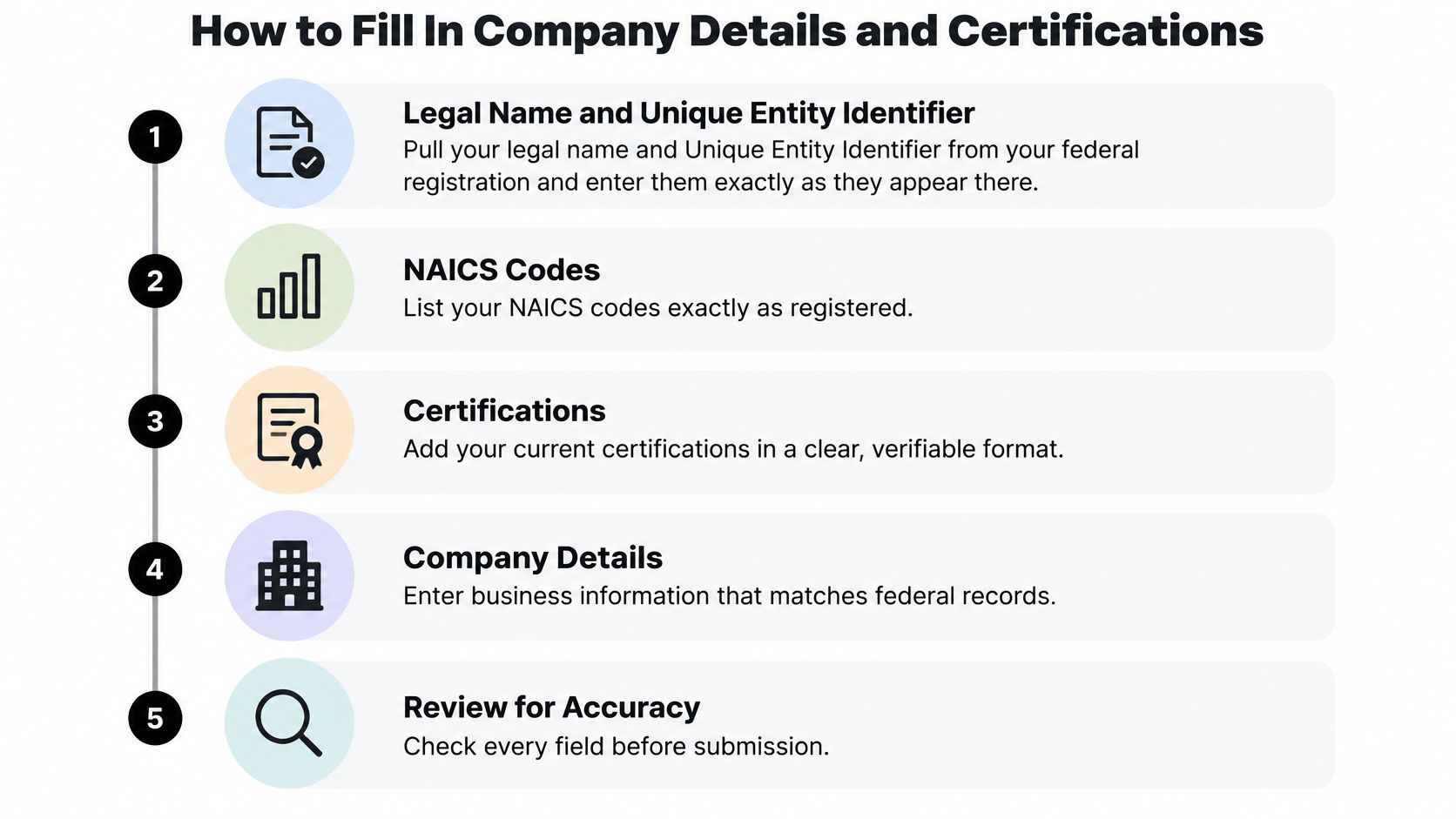
- Legal name and Unique Entity Identifier. Pull both from your federal registration and type them exactly as they appear there. A trade name in place of the legal name sends a reviewer to a lookup that fails.
- NAICS codes in bid order. Put your primary code first, then the rest by how often you bid them. Confirm your size status for each code, because size is determined per code, not once for the company.
- Certifications with status and expiration. List women-owned, HUBZone, service-disabled veteran-owned, 8(a) or any other program you hold, with the expiration date visible on the page.
- Delete anything lapsed. An expired claim costs more credibility than a missing one, because it tells the reviewer the document wasn't checked before it was sent.
- Locations that matter to the work. Show the facilities a contract would use, not every address on your registration.
- A last field-by-field check against the registration. Do this before the file leaves your desk, not after the reviewer replies.
The certifications carry real weight because the money is allocated around them. The SBA's capability statement guidance identifies core competencies, differentiators, past performance and qualifications as central to the document, and sets federal prime-contracting goals of 23% overall for small businesses, 5% for women-owned small businesses, 5% for small disadvantaged businesses, 3% for HUBZone firms and 5% for service-disabled veteran-owned small businesses.
| Goal category | SBA federal target | Certification to list |
|---|---|---|
| All small businesses | 23% of prime contract dollars | Size status for each NAICS code |
| Women-owned small businesses | 5% | Women-owned small business status |
| Small disadvantaged businesses | 5% | Small disadvantaged business status |
| HUBZone firms | 3% | HUBZone certification |
| Service-disabled veteran-owned small businesses | 5% | Service-disabled veteran-owned status |
Agencies are scored against those numbers, so a verified certification isn't decoration. It's a direct reason for a buyer to pull your file into a set-aside competition. The overall goal is also one agencies beat: GovConferences reports the federal government awarded $773.68 billion in contracts in fiscal year 2024, including $183.0 billion to small businesses, or 28.8% of total federal awards (GovConferences). When the broad category is oversubscribed, the narrower certifications do more work for you, which is exactly why the specific status has to be current and easy to find.
Writing Differentiators an Evaluator Can Verify
"Responsive customer support" is a slogan. A four-hour on-site response written into every task order, honored across two named contracts, is a differentiator. The difference isn't length. It's that the second one has a number, a scope and a file behind it.
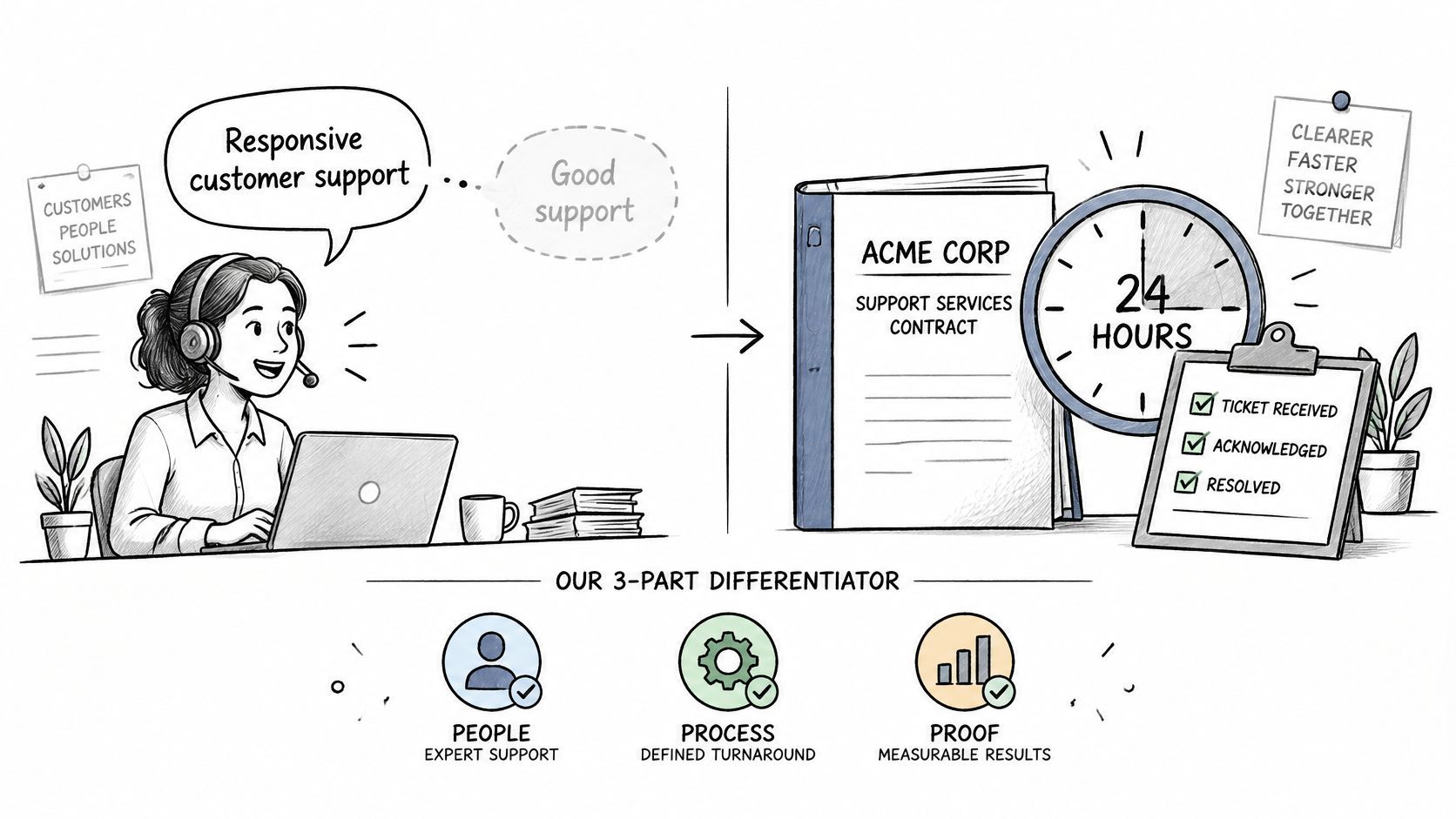
Put every claim through three tests before it earns a line:
- A number or a dated result. Some measurable outcome, even a simple one, that a reviewer could compare against a competitor's page.
- A named scope. The type of work or NAICS code the claim applies to, so it reads as a fact about a contract rather than a personality trait.
- A file a reviewer could request. A quality report, a customer letter, a performance evaluation. If you can't name the file, the claim isn't ready.
Take a line off your current page: quality service delivered on time. Strip it back. What's the actual metric, on what kind of work, supported by what document? Rewritten with a claim you can defend, it becomes something like: punch-list items closed within five business days on 14 school renovation projects between 2022 and 2025, tracked in the QC log for each contract. Every element there is checkable.
Pick three to five differentiators from your real history, not from a list of adjectives. Strong sources are a specialized method your team uses, a clearance your staff holds, a measured result on comparable work, or a facility you operate that competitors would have to rent.
Words like best-in-class and trusted partner cost you more than they earn. A reviewer discounts them on sight, and once one claim reads as puffery, the verified claims next to it get read with suspicion too.
Same fact, different proof: a federal health agency wants to see HIPAA-adjacent handling and uptime numbers. A state transportation office wants geographic coverage and mobilization time. Rewrite the same underlying achievement for the audience, and never let one generic version stand in for both.
Before the file goes out, remove any differentiator your team can't back with a document it can upload that day. Rewrite the survivors so each one points at its source.
Presenting Past Performance as Usable Records
Past performance is where templates lose credibility fastest, and it's rarely because the work was weak. It's because the record was incomplete. A sample capability statement template published by Contractology specifies three recent contracts as the recommended amount of past performance to include (Contractology). Treat that as the floor and work up to five, choosing the contracts that most closely match the work you want next.
The largest contract isn't automatically the best evidence. A modest project for the same agency, in near-identical scope, beats a much bigger one for a buyer with nothing to do with the notice.
Dollar values in a record aren't decoration either. The SBA's contracting data shows small businesses receiving 26.01% of federal contract dollars in fiscal year 2020, totaling $145.7 billion, a market counted in contract values. A record with no number reads as incomplete to anyone used to reading them.
| Record field | What to enter |
|---|---|
| Customer | Agency or prime contractor name |
| Contract number | Exact federal or subcontract number |
| Period of performance | Start and end dates |
| Dollar value | Total contract value |
| Scope similarity | Which target requirement the work matches |
| Outcome | Measured result, stated with a figure where possible |
| Your role | Prime, subcontractor or teaming partner, spelled out |
| Point of contact | Name, phone and email of a reference who has agreed to be contacted |
Gaps are where people start guessing, and guessing is what gets caught. If a record is missing a dollar value, or the contact has left the agency, mark the gap and chase it down before you send. Don't round up, don't estimate, and don't put a colleague's name where a reference hasn't agreed to answer.
Subcontract work counts and belongs on the page. Present it as subcontract work, name the prime, and state your role in one line, because a subcontract dressed up as prime experience invites a question you don't want asked in an evaluation. A closed contract still counts if it falls inside the solicitation's recency window.
How the work was rated matters as much as whether it existed, and those evaluations follow you into later bids. How CPARS ratings affect future bids explains how the ratings are recorded and what a reviewer sees when they check. Sort your records by relevance first and recency second, so the strongest match sits at the top of the list. When the response grows beyond the statement, the same evidence discipline carries into the volume, and this walkthrough of an RFP for IT consulting services shows how that handoff works.
Tailoring the Template to Each Solicitation
- Keep one master file. Every capability, certification and past-performance record lives there, in modular blocks.
- Build a requirement-to-evidence matrix from the notice. Columns for solicitation section, obligation, response language, supporting artifact, page reference, owner and verification status.
- Mark each requirement Covered, Partly supported or Not found. A "Not found" is information. Never fill it with an inferred claim or a plausible-sounding example.
- Check format limits before you write a word. One SAM.gov notice limits capability statements to 15 pages and requires a font size of at least 10 points, while another asks for only one or two paragraphs each on technical, management and corporate-experience approaches. Build a two-page marketing version and a longer sources-sought annex from the same modules, and never shrink the type to force a fit.
- Run three passes. A compliance pass for every mandatory instruction, an evidence pass for traceability and citations, a presentation pass for legibility, branding, contact accuracy and file naming.
Name each file with the solicitation number and the date, so every version on your drive announces its target and its vintage without anyone opening it.
The matrix you build here is the skeleton a full response needs anyway; how to write a government contract proposal covers what changes once the page limit lifts and the technical volume starts.
Template Mistakes and How to Fix Them
Most broken capability statements aren't badly written. They're stale, generic or overreaching, and every one of those failures has a fix that takes less than an hour.
| Mistake | Why it hurts | Fix |
|---|---|---|
| Outdated identifiers | Signals a stale file and fails verification | Check UEI, NAICS and certifications against current registration before each send |
| Irrelevant customer examples | Buries the records that match the target work | Replace them with the most comparable recent contracts |
| Unsupported differentiators | Reviewers discount claims they cannot trace | Attach a source file or remove the claim |
| Omitted subcontractor roles | Hides teaming experience or looks like overstated prime work | Name each partner and state the role in one line |
| Missing security or quality answers | Leaves mandatory questions unanswered | Add a short CUI and quality-controls section tied to the notice |
| Generic capability language | Could describe any firm | Tie each capability to a line in the statement of work |
The first row does the most damage. An identifier that no longer matches your registration turns a five-second verification into a failed lookup, and the reviewer's next assumption is that other fields are stale too. The third row is quieter: a claim nobody can trace doesn't just get ignored, it lowers the credibility of the verified claims sitting beside it.
Treat the table as a checklist, not an article. Run it during final review on every tailored version, in order, with the notice open beside you. It takes ten minutes and it catches the failures that repeated reuse creates.
Validation is a habit, not a step. Check every numeric assertion, certification, contract vehicle, employee qualification, clearance and customer reference against an internal source before the file goes anywhere.
Make personnel qualifications, contract value, contract number and recent prime-contract experience mandatory fields in the master template rather than optional ones. Agencies ask for them directly, so a version that omits them answers the wrong question. And when the page needs to serve an invitation with a different format, the invitation for bids guide explains where a sealed-bid process asks for something else.
Review Your Draft Before You Send It
Three checks, in this order, on the customized version and never on the master file.
Confirm what's active on the day you send. Certifications, registration identifiers, NAICS codes and vehicle numbers, all against the source. A status that changed since you last looked is the single most common cause of a document that was accurate last quarter.
Run the three passes. Compliance first, so every mandatory instruction is answered. Then evidence, so each claim traces to a file. Then presentation, so the contact details are right, the type is legible and the file name identifies the solicitation.
Save a dated copy of the verified version. Next quarter's bid then starts from proof instead of memory.
Export the finished page as a text-searchable PDF, not a flattened image, because buyers and primes search saved files by keyword and an image returns nothing. If a portal rejects the upload or you need to re-save the file, Upfling's guide to uploading PDFs walks through the steps.
Teams that already find notices and draft from their own files can put BidFunnels behind part of this. On Pro, drafts are built only from the files you upload, such as past proposals, CPARS records, capability statements and résumés, and each paragraph shows the file and page it came from, with anything your files don't cover marked so you can fill it in. That keeps the reviewer's question, "can I verify this," answerable at the source.
Pick one open notice this week and run the requirement matrix against it before you write anything. Ten minutes of mapping tells you which blocks you need.
BidFunnels is a subscription platform for finding, evaluating and managing U.S. federal and state contracting opportunities, and it connects the documents you already have to the bids you decide to chase. Company details, NAICS codes and certifications populate from a Unique Entity Identifier or a website, and on Pro the drafting draws only on your uploaded past proposals, CPARS records, capability statements and résumés, with sources cited paragraph by paragraph. Visit BidFunnels to see how the fit score and requirement matrix work on a live notice.