

How to Find SDVOSB Government Contracts in 2026
Nov 16, 2026 · 11 min read
Your SDVOSB certificate is current. Your SAM.gov alerts arrive, but most notices are outside your capabilities, already tied to a contract vehicle you don't hold, or too close to the deadline to pursue responsibly. You've narrowed the competition on paper without finding much work you can win.
Learning how to find SDVOSB government contracts starts with changing the search. Search for what agencies buy, verify how you can enter the procurement, and treat the SDVOSB designation as a result to confirm, not just a keyword to type.
Table of Contents
- Search Steps That Surface SDVOSB Set-Asides
- Early Signals Before a Set-Aside Is Published
- Qualification Gates That Decide Whether to Bid
- Reading the Solicitation for Deadlines and Requirements
- Pitfalls That Waste Bids and How to Fix Them
- Build a Weekly Routine and Decide Your Next Bid
Search Steps That Surface SDVOSB Set-Asides
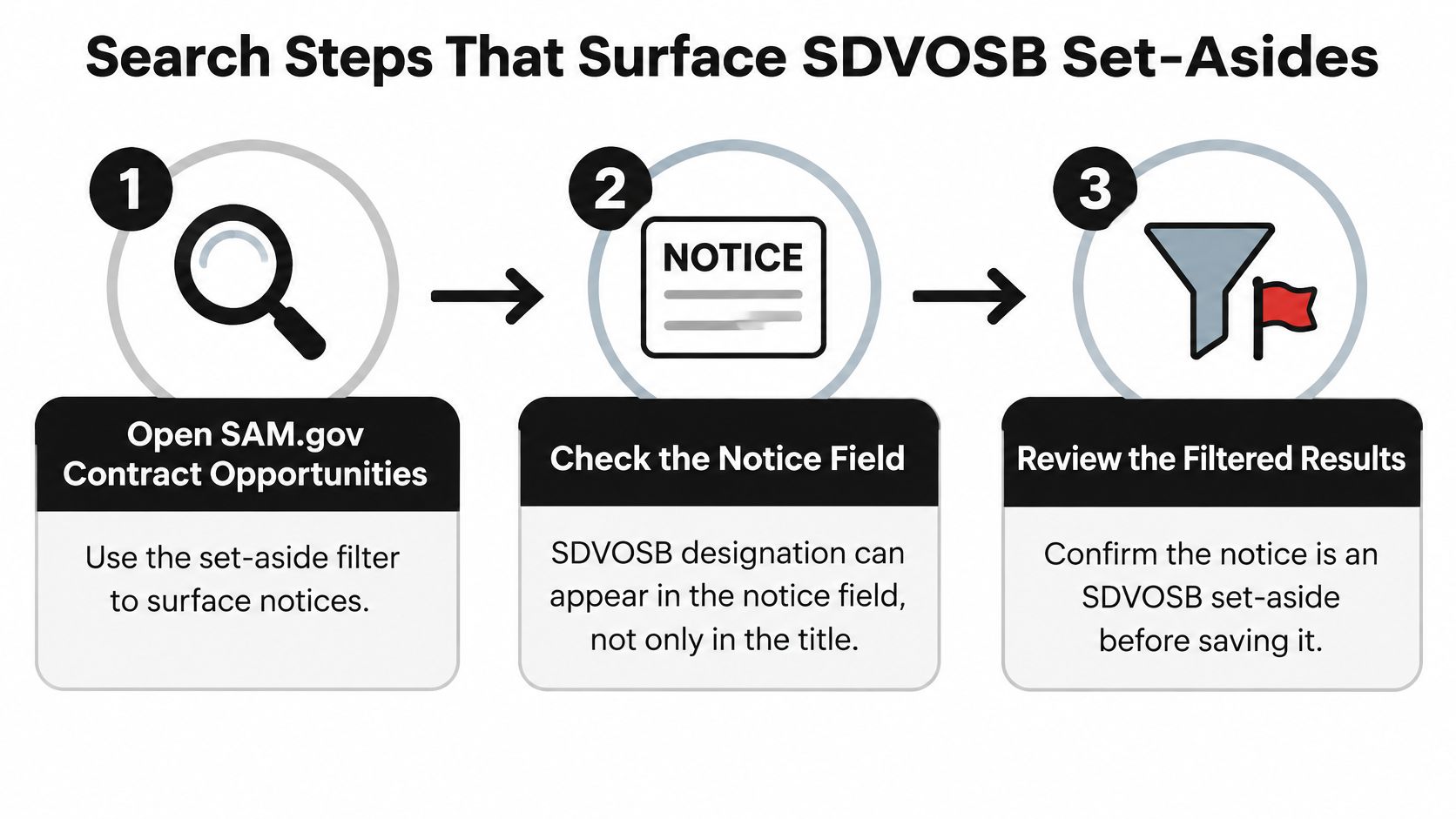
Start with SAM.gov Contract Opportunities and its set-aside filter. The designation sits in a notice field, so a keyword search for SDVOSB can miss relevant notices when the title and description don't repeat it. The SBA's contracting guidance states that agencies must advertise federal contracts valued above $25,000 on SAM.gov, making it the primary discovery feed.
Don't confuse discovery with qualification. A search result tells you a notice matches selected fields. It doesn't establish that you have the staffing, past performance, vehicle access, or pricing to compete.
Build Separate Searches for Separate Decisions
- Check your registration first. Confirm that your SAM.gov registration is active and your NAICS codes describe the work you deliver. Adding unrelated codes won't create a competitive advantage and can make your alerts harder to review.
- Apply the SDVOSB set-aside filter without a keyword. Leave the text search empty initially. Review the notice's set-aside field rather than relying on its title.
- Save a separate search for each relevant NAICS code. This makes it easier to identify which business line produces useful notices. Add place-of-performance restrictions only where your delivery model requires them.
- Enable email notifications. For every notice you pursue, record the response deadline and its stated time zone. Distinguish a solicitation deadline from a sources-sought response date or a question deadline.
- Run a broader weekly search without the set-aside restriction. Review general small-business and unrestricted opportunities that match your capabilities. An unrestricted procurement may offer a subcontracting route even when competing as prime isn't realistic.
Separate Opportunity Discovery From Award Research
Say a landscaping firm uses NAICS 561730. It could maintain a saved search restricted to SDVOSB set-asides and another without that restriction, reviewing unrestricted results for scopes it could deliver under a prime contractor. The broader search isn't an instruction to bid everything. It's a way to see demand that the narrow search excludes.
Use USAspending.gov and FPDS-NG to investigate awarded work, rather than expecting SAM.gov's active notices to explain the whole market. Search by agency, service description, incumbent, and relevant classification fields. Record the buyer, scope, vehicle, and award history alongside the live notice.
Historical value helps you understand the procurement's scale, but it isn't a target price. The current requirement may have different quantities, labor obligations, delivery conditions, or options.
Search checkpoint: If a saved search stays empty for months, inspect the filters before concluding that agencies don't buy your work.
Remove unnecessary keywords, test adjacent classifications that accurately describe your services, and check whether agencies use different terminology. Keep the search broad enough to discover work, then make the bid decision with the documents.
Early Signals Before a Set-Aside Is Published
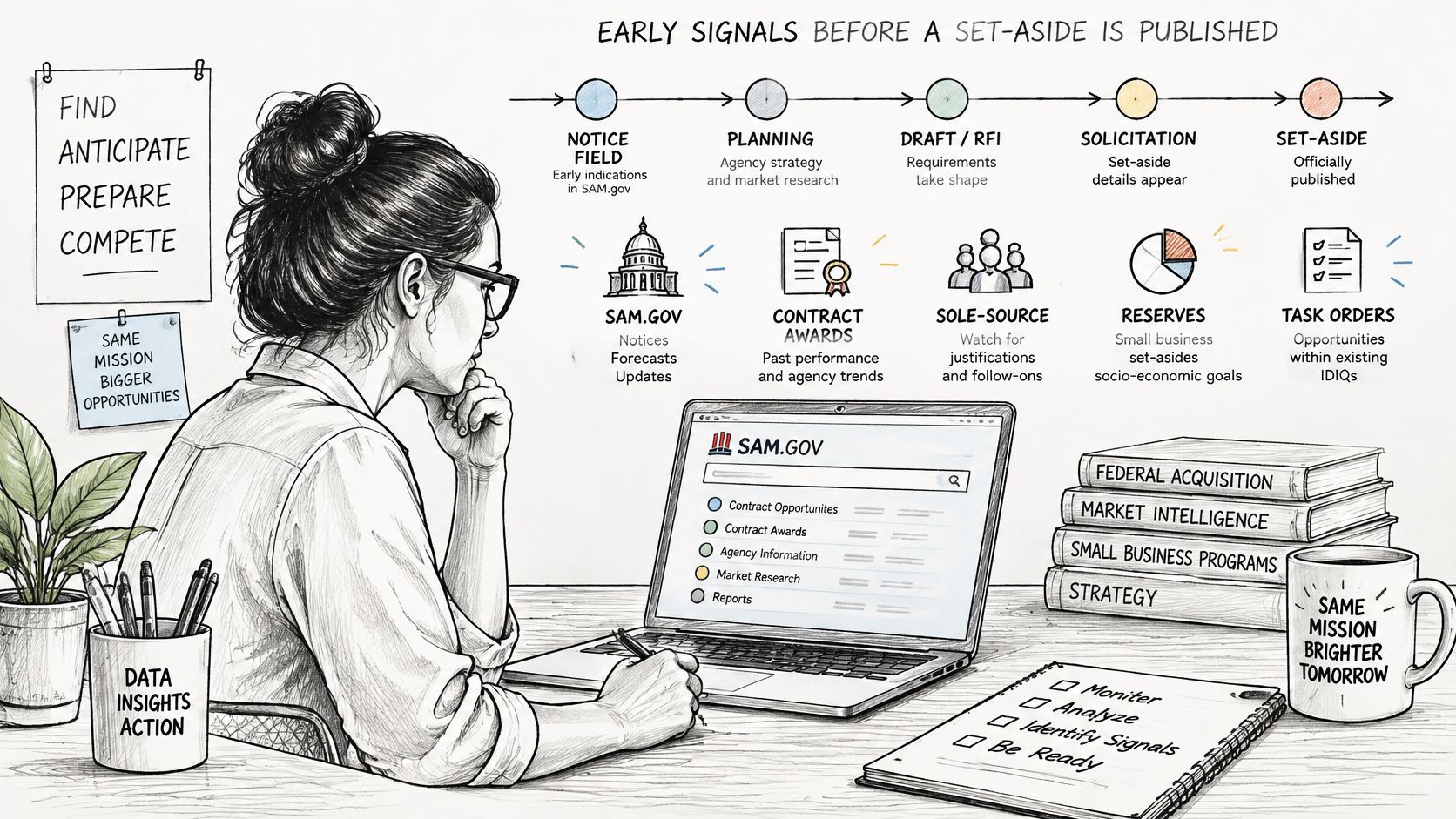
A labeled solicitation is a late signal, not the beginning of the buying process. Under the federal SDVOSB contracting rules, opportunities can involve competitive set-asides, sole-source awards, reserves, and task orders under multiple-award contracts. Competitive set-asides require a reasonable expectation of at least two eligible SDVOSBs and an award at a fair market price.
Agencies test that expectation during market research. Your job is to make your capability visible while the contracting officer is still deciding how to structure the purchase.
Early signals that point to an SDVOSB set-aside
| Signal | Where to find it | What it suggests | Next action |
|---|---|---|---|
| Procurement forecast | Agency forecasts published under SBA guidance | Planned demand before a formal solicitation | Map each item to your NAICS codes and note the expected timing |
| Sources-sought notice | SAM.gov notice type | Agency testing the market for two or more qualified SDVOSBs | Reply with a specific capability statement and comparable past performance |
| Recent award history | USAspending.gov and FPDS-NG | Incumbent, contract value and likely recompete | Review the incumbent vehicle and its period of performance |
| Market research survey | SAM.gov notice and agency small-business office | Agency deciding whether a set-aside is viable | Respond with capability evidence and ask structuring questions |
| Task order under a multiple-award contract | Vehicle holder listings and ordering terms | Set-aside possible within orders under the vehicle | Confirm vehicle holders and how orders are competed |
Give the Buyer Evidence They Can Use
A sources-sought response should explain how you would perform the actual scope. Name comparable work, staffing capacity, geographic reach, and relevant credentials. Use a capability statement template as a framework, not a substitute for a requirement-specific response.
Ask the agency's small-business specialist precise questions about the anticipated vehicle and market-research process. Don't ask them to produce a list of contracts for your company.
Keep a subcontracting path open, too. Unrestricted procurements can include subcontracting plans with small-business goals. Identify relevant vehicle holders and approach them with a defined work package you can deliver.
Search Dynamic Small Business Search (DSBS) and the VA veteran-business database by NAICS to identify potential teaming partners. Listings provide an initial view of the supplier pool, not proof that those firms have capacity or intend to bid. A signal identifying multiple capable peers deserves more attention than a vague forecast entry.
Qualification Gates That Decide Whether to Bid
A notice earns proposal time only when its structural gates pass. Certification gets you considered for eligible work. It doesn't make every SDVOSB notice accessible or commercially sensible.
The SBA's legacy SDVOSB administration guidance described a historical 3% annual goal for prime and subcontracting dollars and generally automatic small-business set-asides for contracts at or below $250,000, with further socioeconomic targeting possible. Those historical benchmarks aren't a substitute for checking the current solicitation and applicable acquisition rules.
Verify the Entity, Not Just the Certificate
Since January 1, 2024, contracting officers generally must verify SDVOSB status through SBA certification reflected in SAM.gov, under the federal SDVOSB set-aside provisions. Check that the certified entity, identifiers, representations, and proposed bidding entity agree.
The SBA's veteran-business guidance requires at least 51% ownership and control by service-disabled veterans, and VA set-aside and sole-source participation requires SBA certification rather than self-certification. Small-business eligibility must match the NAICS code assigned to the solicitation, not merely another code in your profile.
Qualification gates for an SDVOSB set-aside
| Gate | What passes | Where to check | If it fails |
|---|---|---|---|
| Certification | Current SBA certification matching your profile | DSBS and your SAM.gov entity profile | Fix stale or inconsistent records before bidding |
| NAICS size standard | Firm is small under the notice's NAICS code | Notice NAICS field and SBA size standards | Too large for this code: skip |
| Rule of Two | Sufficient capable SDVOSBs likely to offer at a fair price | Market research, sources-sought replies and VA veteran-business listings | Don't assume a set-aside; follow the published procurement method |
| Set-aside type | Total, partial, sole-source or vehicle order you can enter | Notice set-aside field and vehicle terms | Inaccessible vehicle: skip; partial set-aside: assess the eligible scope |
| Value and VA ceiling | Applicable small-business acquisition basis, or a VA sole-source award within its ceiling including options | Estimated value, governing authority and any justification | No applicable award basis: skip that route |
| Ownership and control | Required service-disabled-veteran ownership and control | Corporate records and SBA certification file | Not met: skip; self-certification won't cure VA ineligibility |
The Rule of Two is the contracting officer's determination, not a requirement that you obtain competitors' commitments. Likewise, failing a sole-source value test doesn't necessarily eliminate a competitive set-aside route.
Bid decision: A structural failure means Skip. An unresolved interpretation means Maybe, with a named question and a deadline for resolving it.
Use a broader small-business government contracting workflow to assess financing, staffing, and delivery capacity alongside eligibility. Don't send a vague question about whether you qualify. Identify the exact clause, entity issue, or vehicle restriction that needs clarification.
Reading the Solicitation for Deadlines and Requirements
Read the solicitation as a set of obligations you must prove you can meet. The VA's acquisition guidance ties veteran-business participation to certification and capability, including relevant performance, capacity, and reasonable pricing. A matching set-aside label doesn't resolve those questions.
Build a Submission-Control Record
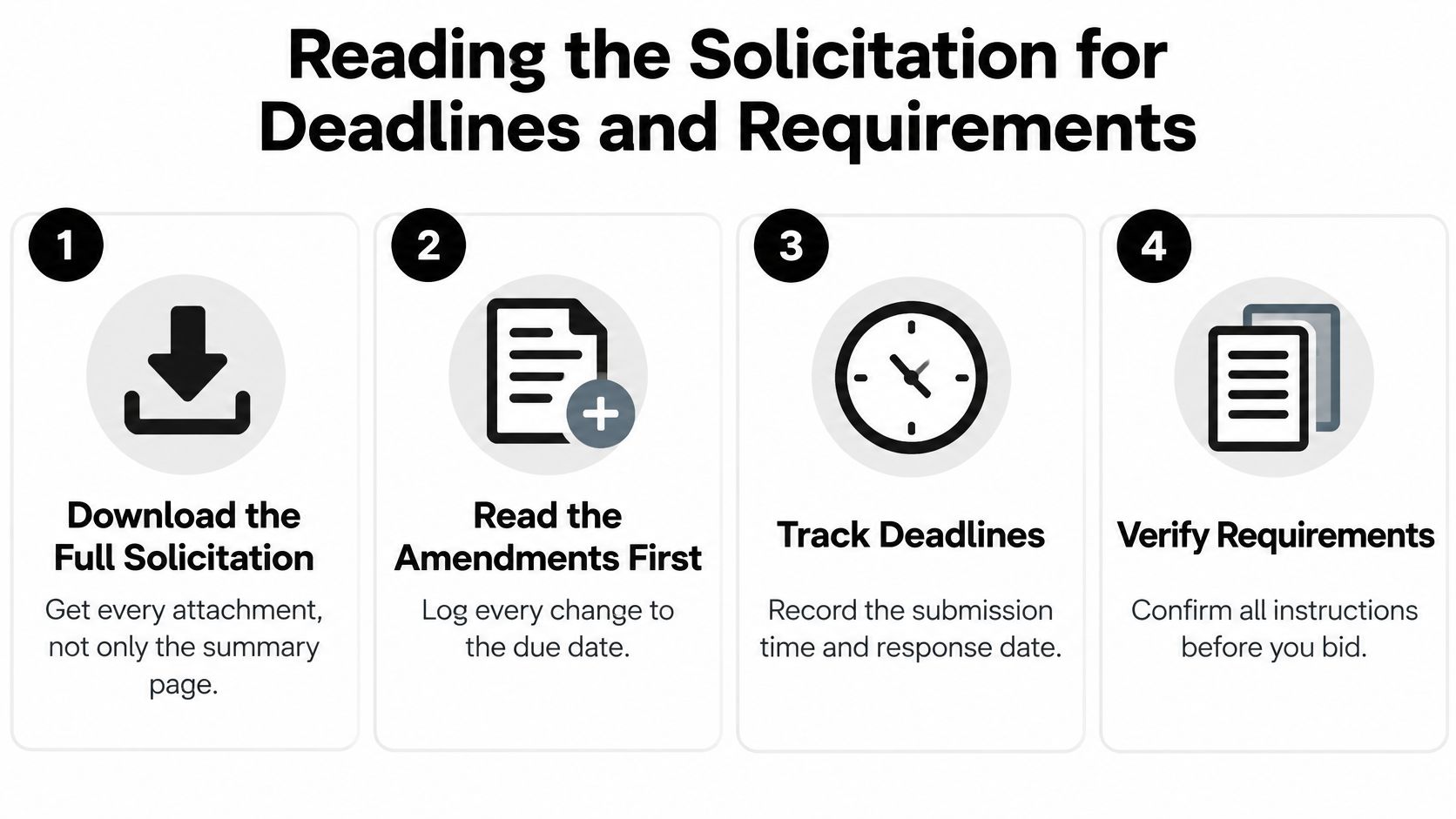
- Download the complete package. Save the solicitation, attachments, exhibits, and incorporated instructions. The summary page isn't your compliance checklist.
- Read amendments first. Log changes to the due date, submission time, question deadline, scope, and pricing instructions. Retain the superseded documents so you can trace what changed.
- Create a requirements table. Extract clauses, labor categories, security obligations, delivery terms, and subcontracting requirements. Give each entry its document, section, page, evidence owner, and completion status.
- Match evaluation factors to evidence. Identify the contract records, performance evaluations, résumés, and technical material that support each response. Mark missing evidence before anyone starts drafting around it.
- Investigate the incumbent. Review prior awards and available performance information. Separate documented facts from assumptions about customer satisfaction or an incumbent's pricing advantage.
- Ask precise questions. Cite the conflicting instruction or unclear requirement when contacting the contracting officer. Preserve written replies and check whether clarification appears in a formal amendment.
- Set an earlier internal deadline. I recommend finishing at least a business day before submission. Convert the agency's deadline to your working time zone, verify the delivery method, and leave time to resolve upload or access problems.
Say a firm preparing a VA services task-order response overlooks an amendment moving submission earlier in the day. Its technical response may be ready, but its deadline record is wrong. A shared log with amendment ownership would expose the change before submission.
Use a government contract proposal template only after identifying the solicitation's required organization. Don't force the agency's instructions into your preferred outline.
Your day-one record should show the due date, time zone, unresolved amendments, and the requirements most likely to cause rejection.
Record certification status from DSBS, the official system of record for that check, rather than relying on a retired VetCert record. Include mandatory acknowledgments, security conditions, and submission mechanics in the final review.
Pitfalls That Waste Bids and How to Fix Them
Symptoms, causes and fixes in SDVOSB bidding
| Symptom | Likely cause | Fix |
|---|---|---|
| Many set-aside notices pursued, few awards | Pursuing labels without a fit check | Score each notice on NAICS, past performance and capacity before bidding |
| Eligibility challenged or certification questioned | Stale or inconsistent DSBS or SAM.gov record | Recheck certification and profile before each bid and after any change |
| Compliant-looking bids rejected on technicalities | Missed amendments or clauses | Log every amendment and re-verify the requirements table against it |
| Strong capability statement, weak evaluation score | Capability statement used as proof of past performance | Attach contract records, performance evaluations and references |
| High pipeline volume, low award count | Reading program totals as a personal success rate | Track stage conversion by agency, NAICS, vehicle and incumbent status |
| Owner assumes eligibility from military service | Veteran status treated as sufficient | Confirm SBA certification, required ownership and control, and NAICS size eligibility |
A label-driven pipeline creates writing work before establishing competitive fit. Screen each notice for comparable scope and available capacity, then resolve certification discrepancies before committing proposal resources. Treat an unresolved registration question as an eligibility risk. If the DSBS record and the SAM.gov profile disagree, fix the record first and bid second.
A capability statement has a built-in weakness: it summarizes what you offer, while evaluators score what you performed and how well. Pair it with contract records, performance evaluations and named references that match the solicitation's scope.
Use Program Spending to Choose a Market
The VA's veteran-business program update reported more than $8.4 billion, or 19.54% of its awards, through SDVOSB set-asides in one cited update, and referenced another report with more than 2,200 SDVOSB awardees and $10.1 billion, about 21.7% of prime-contract dollars, for its reporting period. Totals like these show addressable demand. They say nothing about your proposal's probability of winning.
For VA sole-source possibilities, check the current award-price ceiling in the applicable VA rules before assuming a sole-source route, since responsibility and fair-and-reasonable pricing still apply. A possible sole-source path is an option to pursue, not an award waiting to happen.
Military service alone doesn't settle the bidding entity's eligibility. Apply the qualification gates to the actual firm submitting the offer, including any joint-venture arrangement, before the pursuit decision.
Track stage conversion, not just raw award count. Keep a line per notice showing whether it reached qualification, a bid decision, compliant submission, discussions, or award, and why it moved or stopped. That record separates a weak search from an evidence gap, an inaccessible vehicle, or a pricing problem.
Build a Weekly Routine and Decide Your Next Bid
Make opportunity review a scheduled operating task, not something you do between customer emergencies. Keep research separate from the decision to spend money on a proposal.
- Review new notices each morning. Work from saved searches rather than rebuilding the same query.
- Record Go, Maybe or Skip. Check NAICS fit, certification, market-research evidence, and capacity. Add a short reason that someone else could understand.
- Resolve each Maybe. Open the full solicitation and identify the missing fact before deciding.
- Recheck entity records regularly. Review DSBS and SAM.gov monthly and before every bid.
- Update notice stages. Record what changed and why, so your conversion history stays useful.
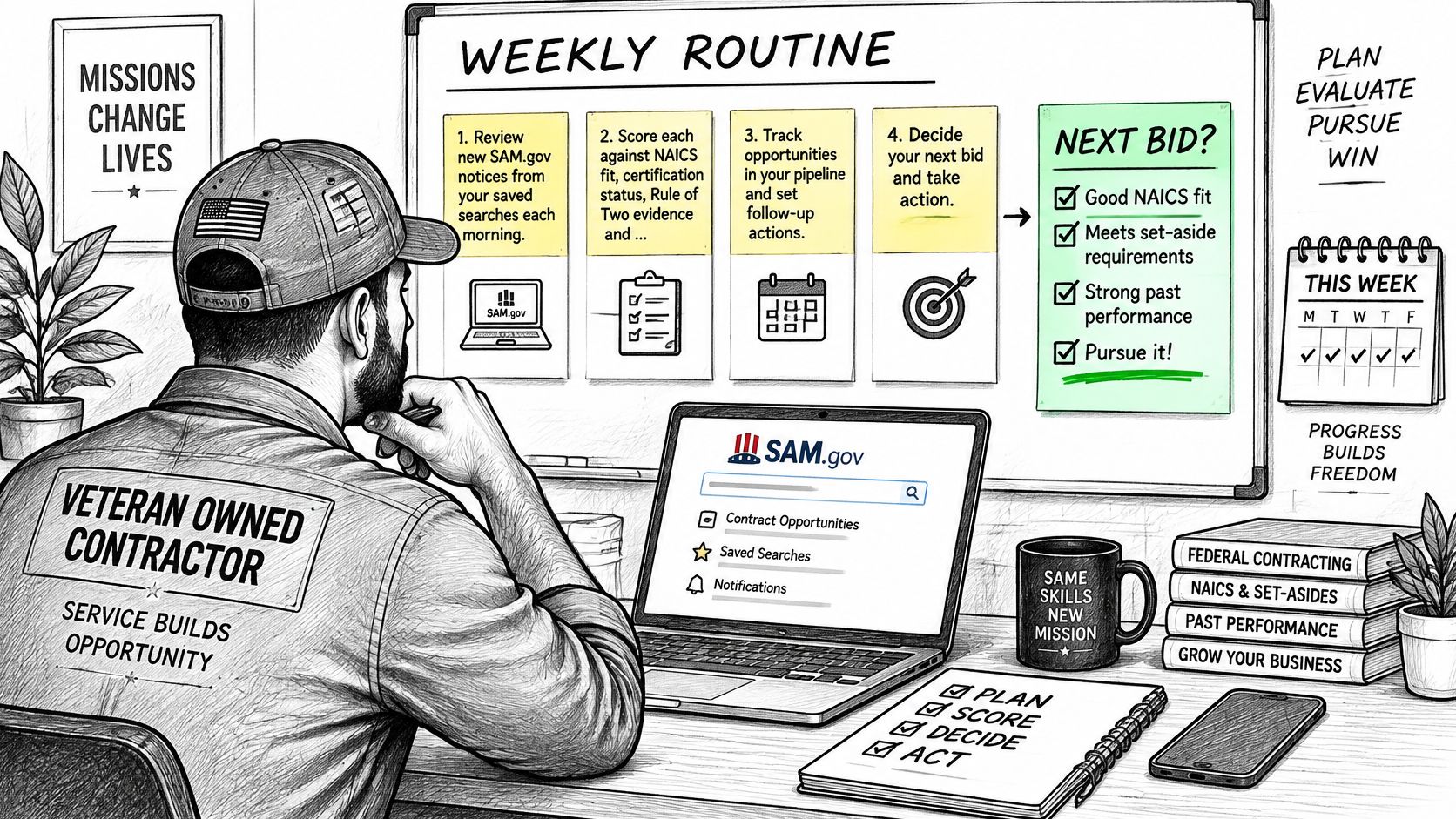
Use Tools Without Outsourcing the Decision
BidFunnels is a research and drafting tool that checks federal SAM.gov notices several times a day and scores them against your company profile. Its Go / Maybe / Skip Fit score uses rules, not AI, and is a quick read, not a promise. Drafts come from your own files; we don't submit bids or proposals or act as your agent before any government body.
Starter is $79 per month without AI features; Pro is $199 per month, with a 7-day Pro trial and no card required. Monthly billing isn't unique, so compare features and fit.
This week, run the SDVOSB-filtered search and the broader unrestricted search. Open the first three relevant notices and apply the qualification gates before drafting anything.
BidFunnels helps you compare federal notices with your company profile, organize solicitation requirements, and prepare editable proposal drafts from your own evidence. Visit BidFunnels to evaluate your next SDVOSB opportunity, then confirm the fit against the official solicitation before committing to a bid.