How to Get Government Contracts for Small Business in 2026
Nov 11, 2026 · 14 min read
In fiscal year 2019, small businesses received $132.9 billion in federal prime-contract dollars, representing 26.50% of the total, according to the Small Business Administration announcement on federal small business procurement goals. That money didn't go to the firms with the slickest writing. It went to firms that proved eligibility, picked notices they could perform, and had the cash to survive until the first payment arrived.
If you're learning how to get government contracts for small business buyers, I would put those three gates in that order. Proposal skill matters, but it matters last.
Table of Contents
- Register in SAM.gov and Prove Your Eligibility First
- Where to Find Notices Worth Your Time
- Qualify Each Bid Before You Write a Word
- Check Whether Your Cash Can Carry the Work
- How to Write and Submit a Compliant Proposal
- Pick Your First Three Notices This Week
Register in SAM.gov and Prove Your Eligibility First
In fiscal year 2023, small businesses received 28% of U.S. federal prime contracts, representing a $178.6 billion investment, as reported in the SBA announcement highlighting record federal contracting certifications in FY24. That share looks encouraging until you ask who was eligible to receive it. Firms that hadn't registered, hadn't checked their size status, or claimed a set-aside they didn't qualify for weren't in the running at all.
Eligibility isn't paperwork you clean up after you find a good notice. It's the condition that decides whether a contracting officer can award to you. Do this sequence first, in order, and you'll save yourself from spending weeks on bids you were never allowed to win.
Step 1 Pick NAICS Codes That Match What You Deliver
Start with your NAICS codes, the industry classifications buyers attach to notices. List what you deliver today, not what you hope to sell next year and not just your best known product. A firm that does IT help desk work, network installation, and cybersecurity assessments may need several codes, because each service can sit in a different classification.
Don't inflate the list. Every code you claim invites notices, questions, and size checks tied to that industry. A short, accurate set gives you cleaner matches and fewer embarrassing clarification calls where you have to admit you don't really do that work.
The codes you register are the codes buyers use to tag notices, so a mismatch doesn't just create noise. It silently hides work you could have won.
Step 2 Check Your Size Against Each Code
Next, compare your average annual receipts or employee count with the SBA size standard for each code. The SBA guidance on getting started with contracting explains that size standards determine whether a company is small enough for particular programs and that those standards vary by NAICS code, so a business can qualify as small under one classification but not another.
Say a 40 person IT services firm clears the standard for one code and fails another. That firm isn't universally small or universally large. It's small for some competitions and other than small for others, and it must bid accordingly.
Write the result down code by code. You'll need that sheet every time a solicitation lists its assigned NAICS code, because that assigned code, not your preferred code, controls the size check for that procurement.
Step 3 Register Directly in SAM.gov
Register in the System for Award Management, called SAM.gov, which is the government's primary vendor database. You don't need a paid intermediary to create the registration. Agencies search that database, and your registration lets you represent your eligibility for contracts reserved for small businesses.
Complete your representations carefully, matching size and ownership claims to your actual records. Then set a calendar reminder well before renewal is due. An expired or inconsistent registration can stall an award even when your proposal scored well, and fixing entity information under deadline pressure is a miserable way to spend a submission week.
For clarity on my own position, BidFunnels is not affiliated with, endorsed by, or acting for SAM.gov, the General Services Administration, the Universal Service Administrative Company (E-Rate), or any federal, state or local agency. You register yourself, directly with the government.
Step 4 Confirm Certifications Before You Chase Set-Asides
Certifications can expand the pool you're allowed to enter, but only if you qualify and complete the process. Federal contracting goals include 5% for women-owned small businesses and 5% for service-disabled veteran-owned small businesses, and the 8(a) program can make eligible firms competitive for sole-source and competitive set-aside contracts, as noted in the SBA guidance linked above.
Check, in plain language, which categories fit your ownership and location:
- Women-owned or economically disadvantaged women-owned: Ownership and control documentation drives eligibility, so don't rely on a marketing label.
- Service-disabled veteran-owned: Verify status through the proper certification channel before you claim it on a bid.
- 8(a): This is a development program with its own application, not a box you tick in SAM.gov.
- HUBZone: Location and employee residency both matter, so a mailing address alone won't carry you.
I would not delay all bidding until every certification is finished if you're eligible for unrestricted or general small business work now. But I also wouldn't build a pipeline around a set-aside category you haven't secured. Pursue the certification and pursue eligible open work in parallel.
Step 5 Put Your Proof in One Place
Create a one page eligibility sheet with your legal name, Unique Entity Identifier, NAICS codes, size status per code, SAM.gov renewal date, and certifications held or pending. Add the supporting files a reviewer may ask for, such as capability material. If you need a starting structure, a capability statement template can help you organize core competencies, past performance, and codes without turning it into a brochure.
Keep that sheet current. When ownership, address, banking, or size status changes, update SAM.gov and your internal sheet together. Mismatches between your proposal, your registration, and your certification records create questions you don't want during evaluation.
| Step | What you do | What it unlocks |
|---|---|---|
| 1. Set NAICS codes | Choose the industry codes that match what you actually deliver | Size standard checks and notice matching |
| 2. Check size standard | Compare average annual receipts or headcount with the SBA limit for each code | Eligibility for set-aside contracts |
| 3. Register in SAM.gov | Create the registration and complete your representations | Discoverability and award eligibility |
| 4. Pursue certifications | Apply for programs such as 8(a), HUBZone or veteran status where you qualify | Access to reserved contracts |
| 5. Find and qualify notices | Search portals and test each notice against capacity and cash | A short list of winnable bids |
| 6. Prepare and submit | Build the compliance matrix, draft, red-team and submit before the deadline | A compliant, on-time proposal |
Before you open any solicitation, fill in your own version of that sequence. If you can't state your codes, size status, and certifications in two minutes, you're not ready to judge opportunities yet.
Where to Find Notices Worth Your Time
Federal and state work don't live in the same place, and searching the wrong portal wastes your week. Federal notices appear on SAM.gov, and each open notice has its own public page you can bookmark and recheck for amendments. State and local buyers post on their own systems, with their own registration rules and submission quirks.
We cover federal contract notices from SAM.gov and state opportunities from Texas (ESBD), Florida (MyFloridaMarketPlace), California (Cal eProcure) and Pennsylvania (PA eMarketplace), which gives you a practical starting map. Check each state or city site directly for its current rules before you rely on any summary.
| Buyer level | Where to search |
|---|---|
| Federal agencies | SAM.gov |
| Texas state agencies | Texas ESBD |
| Florida state agencies | MyFloridaMarketPlace |
| California state agencies | Cal eProcure |
| Pennsylvania state agencies | PA eMarketplace |
| Other states and cities | Each state or city procurement site |
Read the Notice Type Before the Scope
A sources sought notice or request for information isn't a bid you can win today. It's market research, and it's your chance to show capability early, influence how requirements get written, and learn whether the buyer plans a set-aside. Respond briefly and specifically, with relevant work and your codes.
A solicitation is different. It has instructions, evaluation factors, required forms, and a hard deadline. A combined synopsis or solicitation, an invitation for bids, and a request for proposals each reward a different approach, so don't treat price-only work and best-value work as the same exercise.
Set-aside labels tell you whether you may compete. If a notice is reserved for a category you don't hold, move on unless you're pursuing it as a subcontractor. Hoping the buyer will waive eligibility isn't a strategy.
Check Who Won Before You
Look at past winners on USAspending for similar work over the last five years. You'll see award sizes, incumbent names, and whether small firms win that type of requirement from that buyer. A history of awards far above your delivery and cash capacity is useful information, not discouragement for its own sake.
While you're building that shortlist, it's worth evaluating tools before your next procurement so your search, tracking, and alerts don't depend on scattered bookmarks and memory.
Red flag screen: A notice that names an incumbent, is sole-source, or gives you fewer days than you need to draft and review should be questioned before anyone opens a writing document.
Say a notice allows ten days to respond, but assembling staffing proof, pricing, forms, and a compliant technical volume realistically takes your team three weeks. That's not a challenge to heroically overcome. That's a no-go signal, unless you already have most of the material ready and verified.
Qualify Each Bid Before You Write a Word
Bid qualification is a go or no-go decision, not a warmup for writing. Split every notice into three buckets before you draft. If the first bucket fails, the other two don't rescue it.
- Hard gates: Eligibility under the assigned code, set-aside status, mandatory licenses, required forms, place of performance, and clauses you cannot accept.
- Scored variables: Technical approach, past performance, staffing depth, geographic coverage, management plan, and price.
- Risk deductions: Short deadline, strong incumbent, security requirements you don't meet, unclear specifications, and heavy amendment activity.
Score accurately. A technically attractive opportunity with an unresolved mandatory license is still a no-go until you can close that item or get a formal clarification that changes it.
Test Self-Performance Early
Many first-time primes plan to win the work and subcontract most of it. Set-aside rules limit that approach. According to the SBA guidance on governing rules and responsibilities for contracting, for set-aside service contracts the small-business prime generally must perform at least 50% of the personnel cost, for supplies at least 50% of manufacturing cost excluding materials, for general construction at least 15% of contract cost excluding materials, and for specialty construction at least 25% with its own employees.
| Contract type | Minimum share performed by the prime | Measured against |
|---|---|---|
| Set-aside services | 50% | Personnel cost |
| Supplies | 50% | Manufacturing cost, excluding materials |
| General construction | 15% | Contract cost, excluding materials |
| Specialty construction | 25% | Work performed with the firm's own employees |
Run your staffing plan against that table before pricing. Say a services bid needs ten people and you can only supply three with your own employees, while a partner would supply seven. You likely fail the self-performance test, and no amount of persuasive writing fixes the arithmetic. Restructure the team compliantly, pursue a subcontractor role, or decline.
Understanding the buying format helps here too. If you're unsure how sealed bidding differs from negotiated procurement, review what an invitation for bids requires before you assume you can explain away a gap after opening.
Treat Goals as Direction, Not Odds
The government's small-business prime-contracting goal is 23%, while socioeconomic goals include 5% each for women-owned, small-disadvantaged, and service-disabled-veteran-owned businesses and 3% for HUBZone firms, as stated in the SBA guidance linked above. Use those goals to prioritize eligible set-asides where agencies need qualified suppliers. Don't use them to forecast your win probability, because a policy target isn't your personal success rate.
Apply one strict benchmark. Aim for 100% closure of mandatory compliance items before submission. Any unresolved mandatory item should trigger a no-bid decision or a formal clarification question submitted through the channel the solicitation specifies.
Don't invent past performance or capabilities to fill a weak score. Mark the evidence gap in writing. Then obtain substantiation, propose a compliant subcontractor with real proof, or walk away. Reviewers, competitors, and auditors can all test claims you made casually.
Finish with a one page decision sheet for each notice. Record gate results, scores, risks, cash exposure, and the reason for go, maybe, or no-go. A documented no-bid protects your team from relitigating the same weak opportunity next week based on optimism and forgetfulness.
Check Whether Your Cash Can Carry the Work
Winning can make your cash position worse before it makes it better. In a 2025 Small Business Majority survey submitted to Congress, 29% of small businesses could not cover expenses before receiving their first contract payment, while another 34% were unsure they could do so. That's the risk beginner guides skip.
Payroll starts when work starts. Materials, insurance, bonding, travel, software, and subcontractor invoices also arrive before the government pays you. If acceptance takes time or an invoice gets rejected for a formatting error, your runway shrinks again.
Run a Pre-Bid Cash Test
Estimate each cost category by week, not by contract total. Add labor burden, materials, insurance, bonding, subcontractor payments, and overhead you'll carry during performance. Then add invoicing delay, inspection and acceptance time, and the payment terms stated in the solicitation. Compare the peak negative cash position with cash on hand plus credit you have secured.
If you don't already forecast this way, learning to build rolling forecasts for your business gives you a simple discipline for updating that peak exposure as prices and start dates move.
Inspect these terms before you submit:
- Payment structure: Milestone billing and progress payments reduce exposure, while payment only on final acceptance increases it.
- Retainage and holdbacks: Money withheld until closeout isn't available for payroll, however profitable the job looks on paper.
- Reimbursement limits: Cost-type work can still leave you carrying costs that fall outside allowable or capped categories.
- Contract type: Firm-fixed-price work puts overrun risk on you, so estimating errors come straight out of margin.
For example, a $400,000 award with 10% retainage holds $40,000 until closeout, using that percentage as a hypothetical illustration. If that $40,000 is the difference between staffing the job and missing payroll, the award is too big for you right now.
Financing can help, but it isn't free. Purchase-order financing, lines of credit, progress payments, subcontracting, and teaming each shift cost or risk somewhere. Price the financing cost into your decision, because an attractive contract can become unprofitable once interest, fees, and partner margins are included.
Sometimes the right first win isn't a prime contract. A smaller subcontract, purchase order, or fixed-scope pilot can build past performance and cash with far less exposure.
I would rather see a firm take that smaller step and survive to prime later than win a headline award it cannot fund. Cash is a bid gate. Treat it that way.
How to Write and Submit a Compliant Proposal
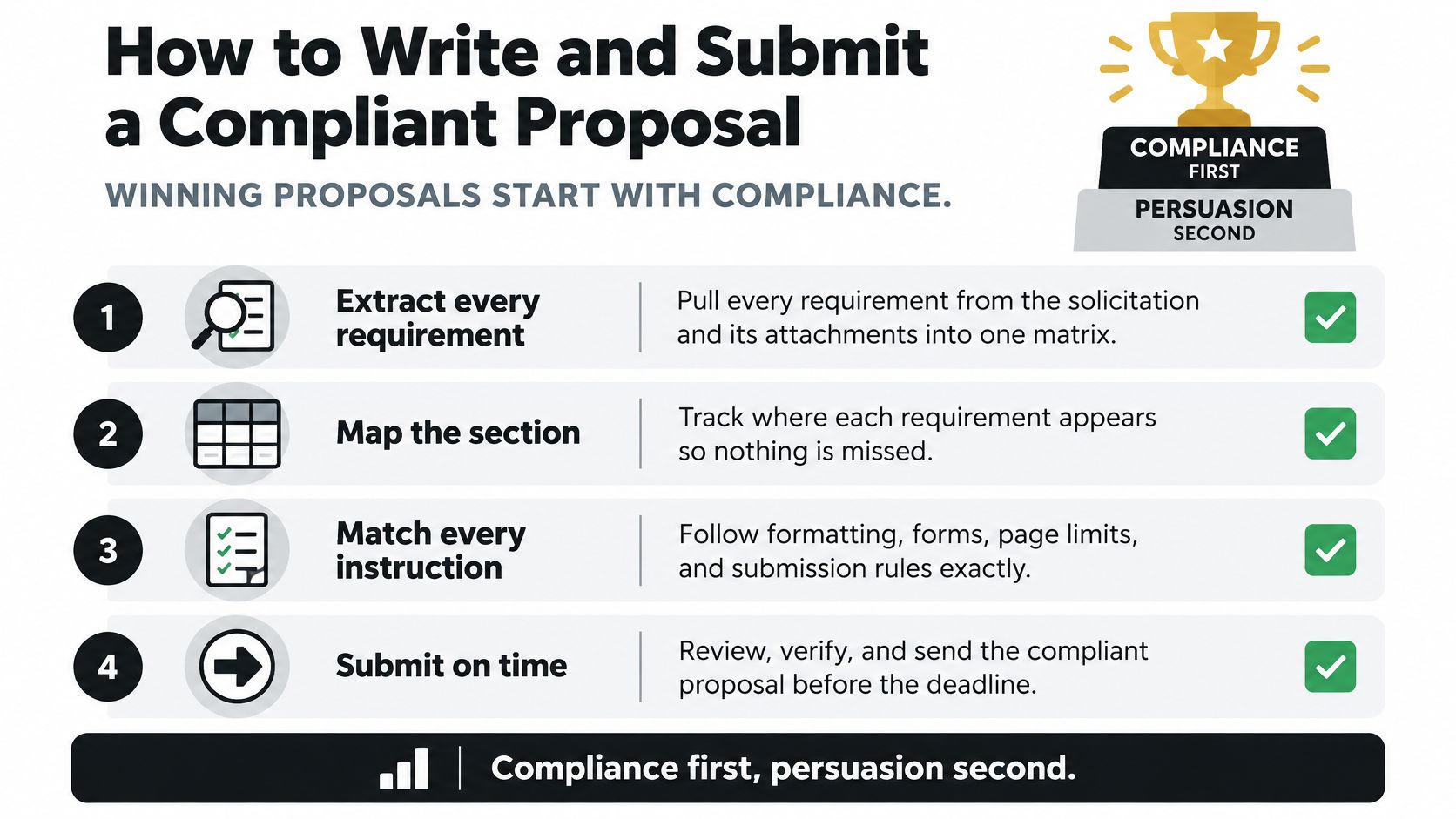
A proposal is won by compliance first and persuasion second. Reviewers score what they can find, mapped to instructions and evaluation factors. A brilliant approach buried in the wrong section, over the page limit, or missing a required form earns less than a solid approach presented exactly where the solicitation asked for it.
The visual below summarizes the compliance sequence before the detailed steps.
Build the Matrix Before You Draft
1. Extract every requirement. Read the solicitation and every attachment, amendment, exhibit, and form. Put each requirement into one matrix with the section and page it came from, including formatting rules, page limits, file naming, and submission instructions.
2. Map each requirement to an owner. Assign a proposal section and a named person for every row. If a requirement has no owner, it has no reliable chance of being answered. If two people think the other owns pricing assumptions, you'll discover that during final assembly.
3. Draft from evidence you own. Use your past proposals, CPARS records, capability statements, résumés, and contract references. Mark any gap instead of inventing experience. If you need to organize drafting support, you can find tools for creating business proposals and compare them against your actual compliance workflow, not just their editing features.
For a deeper walkthrough of structure and evidence, see this guide on how to write a government contract proposal. Use it to strengthen your draft, but let the current solicitation, not any general guide, control section order and content.
Check, Red-Team, Then Submit Early
4. Classify coverage. Check each requirement as covered, partly covered, or not found. Fix every partial and missing item before polishing language. Reviewers don't award points for elegant prose that omits a required staffing table.
5. Run a red-team review. Give the draft and matrix to a second person who didn't write it. That reviewer checks every requirement against the submitted volume, page, attachment, and citation, and tries to find reasons to mark you noncompliant or weak. Solo operators can swap reviews with a trusted peer or use a checklist after a break, but fresh eyes matter.
6. Close mandatory items and submit early. Confirm every mandatory form, signature, representation, and pricing file is complete. Verify the deadline time and time zone, test portal access, and submit with time to recover from an upload failure. Save the confirmation exactly as the system issues it.
The short video below is a useful refresher to watch before your final quality check, especially if your team tends to rush assembly.
Handle Thin Past Performance Honestly
If you have no federal past performance, use relevant commercial references or subcontract work you delivered. Label it accurately, explain your role, contract size, and results, and connect it to the current requirement. Don't present a prime contractor's entire project as if your firm performed all of it.
Common failure points are mundane. Teams work from an outdated amendment, exceed page limits hoping no one counts, forget a required form, or price options the instructions didn't ask for. Your matrix prevents most of that, but only if someone updates it every time an amendment lands.
Remember the boundary of any support tool you use. BidFunnels is a research and drafting tool that does not submit bids or proposals for the customer and does not act as the customer's agent before any government body. You review the final files, you press submit through the government system, and you own every representation in that proposal.
Pick Your First Three Notices This Week
Stop asking how to win every bid. Start asking which three notices you can perform, afford, and document well. That shift turns government contracting from a scrolling habit into a managed pipeline.
First, pull a focused list. Search SAM.gov for notices matching your NAICS codes, then check one state portal you chose earlier. Don't open five states and every federal agency at once. A narrow list you evaluate beats a huge list you skim.
Second, score each notice on one page. Record the notice number, deadline, hard gate results, self-performance test, and cash exposure in one line, with a short reason for go, maybe, or no-go. If a notice fails any hard gate, mark it no-go and move on without drafting anything. That discipline is where small teams recover the most time.
Third, keep only three active bids. Set deadline and amendment alerts for each, assign owners, and record why you dropped the rest. BidFunnels helps small government contractors find public contract opportunities, judge which are worth bidding on, organize solicitation requirements, and draft proposal sections from their own files and saved answers, and the RFP checker is free and can be used to check one RFP without signing up.
Your next review should start from facts on the decision sheet, not from memory, enthusiasm, or whoever argues loudest that morning.
Schedule the first review session on your calendar before the end of this week. Bring your eligibility sheet, your cash test, and no more than three candidate notices. Leave that session with written decisions, not a longer list of maybes.
When you're ready to put this sequence into practice, BidFunnels can help you find matched federal and state notices, score them against your eligibility and deadlines, and organize each solicitation into a compliance-ready drafting workflow. Start with your first three qualified notices this week and build a pipeline based on work you can perform, fund, and prove.