

Snow Plowing Contracts: How to Find and Win Public Bids
Nov 20, 2026 · 12 min read
You've found a public snow-removal notice that looks close enough to serve with your existing trucks. Then you open the attachments: sidewalk work, overnight dispatch, dedicated equipment, insurance endorsements, and pricing that could hold you to the same assumptions through several winters. The question isn't just whether you can plow the property. It's whether you can reserve the capacity, meet the service clock, and make money under the agency's terms.
Government snow plowing contracts reward careful qualification before estimating. Start with reachable sites, separate standby costs from storm work, and treat every submission requirement as part of the job.
Table of Contents
- Where to Find Snow Plowing Solicitations
- Seasonal Calendar and Deadlines for Snow Contracts
- Registration and Eligibility Requirements
- How to Read the Scope and Service Levels
- Pricing Standby Capacity Against Storm Work
- How to Submit a Compliant Bid
- Choose Go Maybe or Skip This Week
Where to Find Snow Plowing Solicitations
Start with SAM.gov Contract Opportunities, the federal government's central public search point, which anyone interested in federal work can search. Its notice types include pre-solicitation, solicitation, award, and sole-source notices. Those labels matter: an upcoming requirement is not an open bid, an award notice is not available work, and a sole-source notice signals an intended award without open competition.
Search for snow removal, snow and ice control, plowing, de-icing, winter maintenance, and sidewalk clearing. Add NAICS 561730, Landscaping Services, which includes snow removal, and avoid making that code your only filter. Check adjacent classifications when a buyer groups winter work with broader grounds or facilities services.

Where snow plowing notices are posted
Our coverage includes federal notices from SAM.gov, state opportunities from Texas, Florida, California, and Pennsylvania, and city and county procurement sites. We check SAM.gov for new and changed notices several times a day; state opportunities load from each portal's own list.
| Source | Where it is posted | What you will see | How often to check |
|---|---|---|---|
| Federal | SAM.gov Contract Opportunities | Pre-solicitation, solicitation, award, and sole-source notices | Several times a day in season |
| Statewide | State procurement portals in Texas, Florida, California, and Pennsylvania | Buyer-posted snow and winter-maintenance notices | Each covered portal as notices post |
| City and county | City and county procurement sites | Local plowing, sidewalk, and lot contracts | Each covered site as notices post |
| Other local buyers | School districts, housing authorities, and transit agencies | Separate plowing schedules on the buyer's own board | Weekly from summer onward |
A consolidated search does not replace checking a buyer's own board when that source falls outside covered portals. School districts and transit authorities in particular often post plowing schedules on their own pages, so add any buyer in your service area to your weekly round. For a concrete state-level lookup process, use our guide to finding government RFPs in Pennsylvania.
Keep a weekly search routine
- Monday search: Run saved searches from summer onward, organized by your actual service radius.
- Amendment check: Open changes the day you receive them, rather than waiting until bid preparation.
- Notice log: Record the source, notice number, closing date, time zone, and site-visit date.
Rank opportunities by the roads, lots, and sidewalks your crews can reach during a regional storm. Distance measured on a clear afternoon is the wrong test for a contract that prices standby capacity through the whole season.
Seasonal Calendar and Deadlines for Snow Contracts
The Wisconsin Army Reserve snow-removal solicitation listed a scheduled performance period of November 1, 2026, through October 31, 2027, with four additional 12-month option periods and a possible six-month extension. That structure is the deadline story. You are committing to hold trucks, operators, and materials in reserve for a full year, then up to four more if the buyer exercises each option. A contractor aiming at a planned start should have paperwork ready by late summer, not when snow enters the forecast.
Use a seasonal planning calendar, but don't mistake it for the agency's procurement schedule. Buyers can advertise outside the usual window, and the solicitation controls every actual deadline.
Contract calendar by phase
| Phase | Typical timing | What to do |
|---|---|---|
| Pre-solicitation watch | Spring through summer | Confirm registration is active, review insurance certificates, estimate what standby coverage would cost |
| Solicitation window | Late summer to early fall | Read the scope, submit questions by the stated date, bid before the closing time |
| Award and mobilization | Fall, before the first storm | Confirm insurance endorsements, stage equipment, set up a 24/7 contact line |
| Active season | Typically November through March | Respond to event triggers, log service times, record inspections |
| Option renewal | Before each option year | Review performance records and confirm the standby price still covers the equipment you hold |
The active-season window is a planning shorthand, not a promise about local weather or contract coverage. Some requirements include readiness, cleanup, or administrative obligations outside the months when crews expect snow, which means you may carry standby costs while no revenue-generating events occur. Once a period like November 1 begins, that obligation starts on the calendar date, not on the first snowfall.
Put preparation dates in your planner
- April: Identify agencies with sites inside your operating area and note when their current contracts expire.
- July: Review insurance renewal dates with your broker so coverage won't lapse during performance.
- Before closing: Aim to finish the bid at least a week early, leaving room for missing signatures or upload problems.
- October: Run equipment inspections, confirm driver availability, and test dispatch arrangements.
Deadline rule: Use the closing time and time zone in the current notice. An amendment can change either the work or the calendar.
Before the first freezing-rain forecast, have approved materials, staged equipment, a backup operator, site access instructions, and an escalation contact ready. An award letter alone doesn't make a crew operational.
Registration and Eligibility Requirements
For federal bidding, you need an active SAM.gov registration and Unique Entity Identifier, and the notice itself controls any timing exceptions or special instructions. State and municipal buyers run their own vendor systems. Appearing in a federal database does not finish a city's vendor paperwork.
Check the NAICS designation and any set-aside before you price the work. A small-business, veteran-owned, woman-owned, 8(a), or HUBZone restriction can put an otherwise profitable site out of reach, and our guide to NAICS codes and size standards shows how to test the classification against your business.
Insurance is a site-specific review
Limits are set solicitation by solicitation, so never carry last season's numbers into a new bid. Cleveland's 2025 specification required $1 million in general liability, $1 million in automobile liability, and workers' compensation. Other solicitations split bodily-injury limits per person and per occurrence, or pair a per-occurrence limit with a higher aggregate. Higher limits and extra endorsements raise your premium for the whole season, whether it snows twice or twenty times, so that cost belongs in the standby capacity you price, not only in the per-push rate.
Requirements by contract level
| Contract level | Registration | Insurance to confirm | Other requirement |
|---|---|---|---|
| Federal notice | Active SAM.gov registration and UEI | Solicitation limits, vehicle coverage, and required endorsements | Line-item pricing and certifications |
| State contract | State vendor registration | State-specified limits and coverage forms | State forms and any local business documents |
| Cleveland 2025 specification | Buyer's vendor and bid-submission requirements | $1 million general liability, $1 million automobile liability, workers' compensation | Certificates must match the solicitation before award |
| Utah 2025–26 solicitation | Solicitation's vendor-registration process | Split bodily-injury limits stated in the insurance clause | Additional-insured status and indemnification |
| Cass County, Minnesota | County's stated bidder-registration process | Per-occurrence and aggregate limits stated in the solicitation | Confirm endorsements against that solicitation |
Send the full insurance and indemnification section to your broker. Ask for a clause-by-clause response covering aggregate limits, hired and non-owned vehicles, additional-insured endorsements, contractual liability, and snow-and-ice completed operations.
A certificate alone does not prove the contract is covered. Pedestrian exposure, subcontracted sidewalk crews, rented equipment, salting responsibility, and refreezing each deserve an answer before you accept the risk.
Assemble the award file
- Coverage documents: Certificates plus the actual required endorsements.
- Performance evidence: References describing comparable sites and service obligations.
- Operating documents: Equipment inventory, licenses, tax forms, and required local permits.
Fix gaps before award. A low plowing price cannot absorb an uninsured obligation you failed to notice.
How to Read the Scope and Service Levels
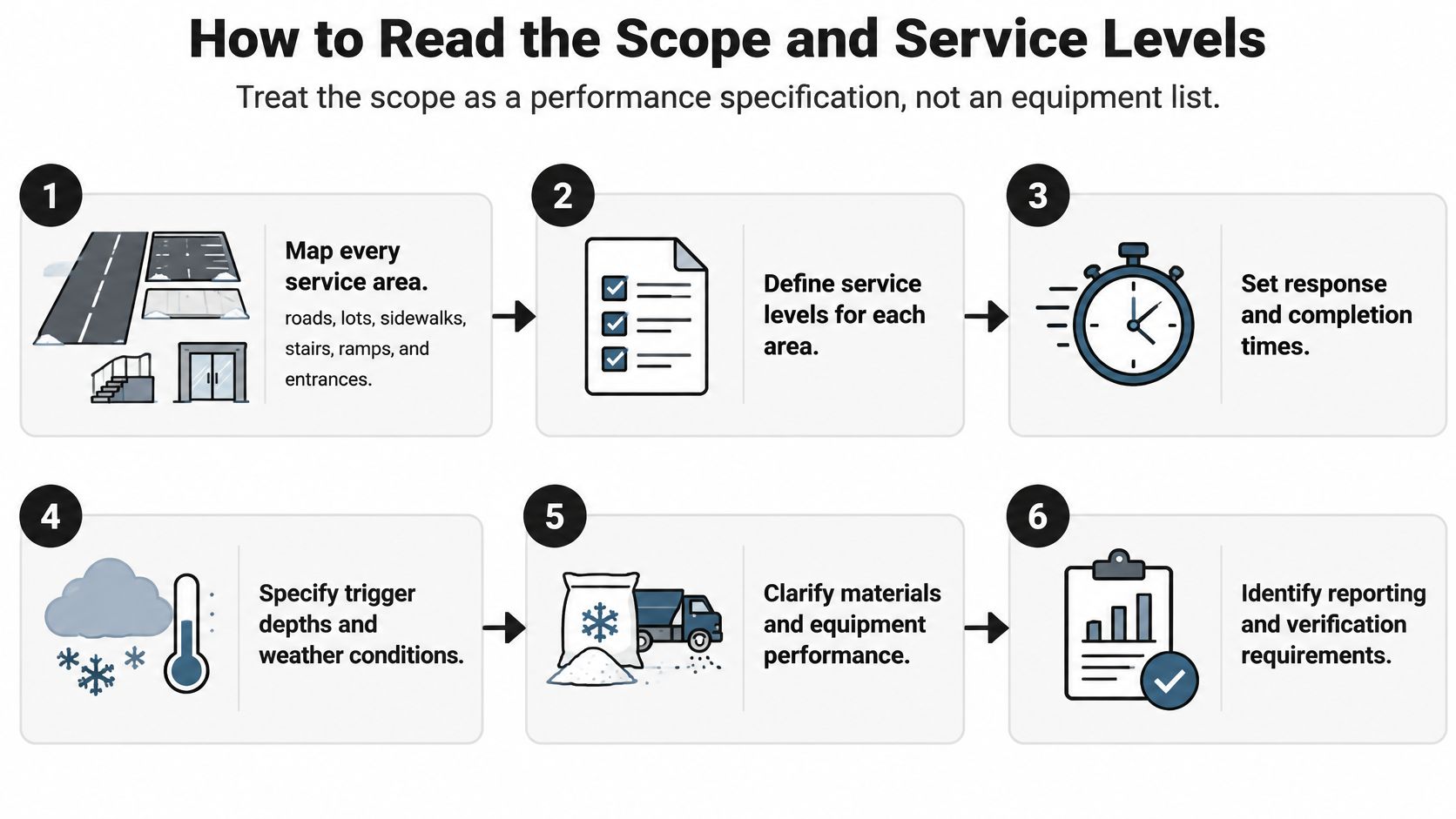
Read the scope as a performance specification, not a truck shopping list. Use this sequence to turn the attachments into an operating plan:
- Map every service area. Include roads, lots, sidewalks, stairs, ramps, entrances, accessible routes, and snow-storage zones.
- Rank priorities by traffic, pedestrian exposure, and opening times. An entrance may need attention before an otherwise empty lot.
- Identify event triggers. Separate accumulation, icing, forecast conditions, and the end of precipitation.
- Extract the clocks: response, completion, inspection, and re-treatment.
- Check the operating plan for equipment, personnel, approved de-icers, coordination, and escalation.
- Find the inspection method. Determine who verifies compliance and what evidence they use.
The General Services Administration's custodial specification identifies snow-service planning elements and connects evaluation to measurable performance standards and a Quality Assurance Surveillance Plan. Translate those obligations into dispatch instructions your supervisor can use.
Separate the storm phases
Pretreatment happens before freezing precipitation. During the event, crews may need continuous treatment and access maintenance; primary plowing follows the accumulation trigger, and final cleanup follows precipitation cessation. Don't price those as interchangeable visits.
A District of Columbia contract requires priority work to begin at 0.5-inch accumulation or within one hour after precipitation stops. That's a measurable dispatch requirement, unlike an undefined instruction to keep the site cleared.
The Army Corps' Franklin Falls Dam notice includes snow plowing, shoveling, sanding, and snowbank clearing. Those tasks require their own labor, materials, and equipment assumptions; they aren't optional extras attached to truck time.
Build a one-page scope checklist
| Scope field | What to record |
|---|---|
| Dispatch | Around-the-clock contact, authorization, maximum mobilization time |
| Access | Priority routes, clear widths, accessible paths, opening deadlines |
| Treatment | Approved materials, application controls, refreeze inspections |
| Snow storage | Stacking locations and the point when hauling becomes necessary |
| Damage | Pre-work condition photographs and post-work inspections |
| Verification | Service times, areas treated, materials, weather, inspection results |
A scope is not price-ready when the buyer defines the outcome but leaves mobilization, access, materials, and damage responsibility unresolved.
Submit questions about missing sidewalks, hauling rules, standby equipment, or owner-controlled obstructions before the question deadline. Don't assume they're excluded.
Pricing Standby Capacity Against Storm Work
A seasonal retainer pays for reserved equipment and crews even when little snow arrives. Per-event pricing leaves the buyer with a weather-sensitive total, while the contractor risks reserving capacity without enough billable work. Neither model automatically offers better value.
You'll also encounter per-push, per-inch, hourly, and hybrid standby-plus-use pricing. Define the billable unit carefully: a push, a complete storm response, and an hour of hauling are different services.
Toronto's 2025 winter-maintenance review found that fully dedicated resources provided the fastest and most reliable cleanup but carried substantial standby costs, with options reaching an estimated C$130 million. The review found that separating hauling or using existing agreements reduced costs while maintaining similar completion times, and the city rejected dedicated models because major storms don't occur every winter.
Compare equal service promises
Use this worksheet before choosing a seasonal number:
- Total guaranteed standby cost. Include reserved equipment, crew availability, storage, insurance allocation, maintenance, and dispatch readiness.
- Estimate qualifying events from local records using the solicitation's trigger, not days with snowfall.
- Divide standby by expected events to expose the capacity cost assigned to each expected response.
- Add actual storm-work costs: labor, fuel, wear, de-icer, loading, hauling, and disposal.
- Compare equivalent bids. Match response windows, reserved resources, inspection duties, and event definitions.
Expected seasonal cost = guaranteed standby + expected qualifying events × variable event cost.
Dividing standby by events does not produce the complete per-event price. It only shows how much reserved capacity you're asking each expected event to support.
Test light and severe winters
Run separate light, expected, and severe-weather cases. A shared-resource arrangement may work for a flexible lot but fail where the buyer requires immediate access during a widespread storm. Conversely, the fastest cleanup promise may be poor value when the buyer funds dormant equipment every season.
- Disclose capacity assumptions: Guaranteed trucks, operators, standby hours, hauling availability, and mobilization time.
- Define service tiers: Trigger thresholds, response windows, and authorized emergency work.
- Price the full term: Extend the worksheet across the base and potential option periods without treating unexercised options as guaranteed revenue.
- Separate extra work: Show materials, shoveling, sanding, and hauling distinctly wherever the bid schedule permits.
Don't change the agency's pricing structure to fit your preferred model. Ask questions before closing if its schedule prevents a clear allocation of standby and usage costs.
How to Submit a Compliant Bid
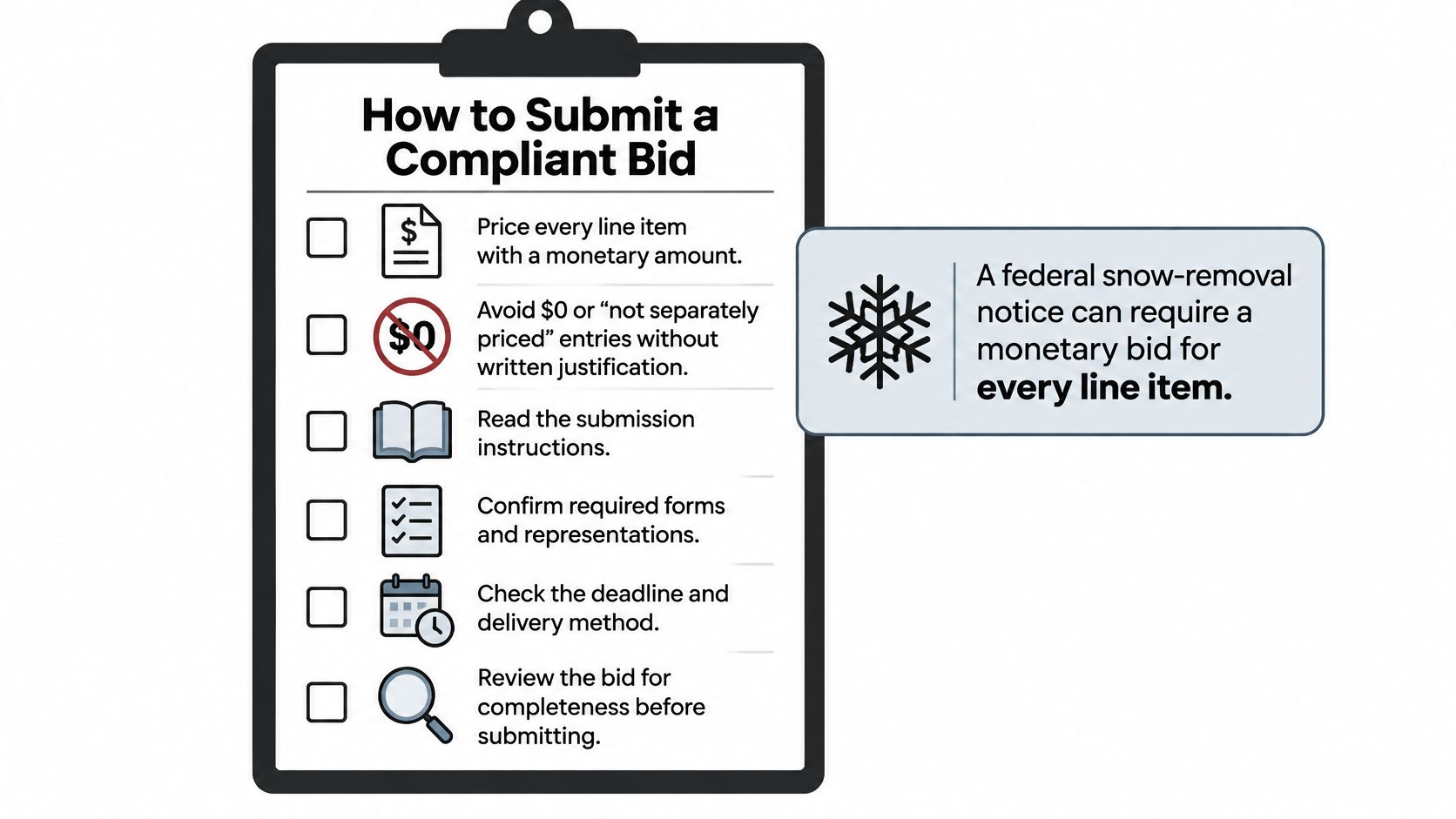
An unexplained zero-dollar line can put an otherwise competitive offer at risk. The Brockton Army Reserve Center snow-and-ice-removal notice required a monetary bid for every line item and warned that zero-dollar or not-separately-priced entries without written justification could be rejected; it sought a single firm-fixed-price contract with a 12-month base period and four 12-month option periods.
That notice also required offerors to incorporate amended plans, drawings, and specifications. Unapproved deviations or added conditions could cause rejection, so don't attach your standard commercial estimate terms without checking the instructions.
Follow a controlled submission routine
- Read every amendment and record acknowledgment. Check whether it changes quantities, maps, dates, or the pricing schedule.
- Price every required line and option period. Reconcile extensions and totals against the exact units the buyer requests.
- Remove unauthorized conditions. Don't qualify your obligation with weather exclusions or minimum charges the solicitation doesn't allow.
- Complete representations and certifications. Verify names, identifiers, signatures, and the authority of the signer.
- Confirm delivery instructions. Check the destination, file format, size limits, closing time, and time zone.
- Submit early and retain proof. Save the receipt, uploaded files, and the final version delivered.
Build a requirement-by-requirement review using a government RFP compliance matrix. Give each obligation an owner, a response location, and a completion status so missing evidence is visible before submission.
Review terms without rewriting the offer
GetBill's explanation of change order and cancellation clauses is useful for recognizing where scope changes and cancellation can affect an estimate. For public bids, use that understanding to identify questions for the agency, not to append conflicting terms after the question period closes.
Final review: Compare the completed offer with the solicitation's requirements list, not just with your estimator's worksheet.
Have someone other than the drafter check the submission when possible. Ask them to locate each required document rather than merely confirm that the package looks complete.
Drafting assistance doesn't transfer responsibility. Any draft built from your own files still needs your review and editing; you're responsible for the factual claims, prices, and commitments submitted. We don't submit bids or proposals for customers or act as their agent before a government body.
Choose Go Maybe or Skip This Week
Pick a live notice and make a documented decision before assigning proposal work. Don't keep an opportunity open merely because you own the right plow truck. A workable public contract also needs eligible registration, insurable obligations, reachable sites, and enough cash to support the promised readiness.
BidFunnels assigns a Go / Maybe / Skip Fit score using rules applied to your company profile: NAICS codes, set-asides, location, and time left to respond. It isn't an AI judgment, a promise of winning, or confirmation that every clause suits your firm. Read the solicitation itself.
Apply the decision tests
| Decision | Conditions | Immediate action |
|---|---|---|
| Go | Registration is active, eligibility fits, mapped sites match existing crews and equipment, and required endorsements can be issued before award | Assign the estimator and submission owner |
| Maybe | Operational fit is good, but standby funding, option pricing, or missing additional-insured language remains unresolved | Name the blocker and a decision deadline |
| Skip | The notice is sole-source, the set-aside excludes your firm, or required pricing can't be completed without an unjustified zero entry | Record the reason and stop drafting |
A Maybe needs a specific answer, not more optimism. Ask whether the broker can issue the endorsement, whether the agency will clarify the standby obligation, or whether your cash plan survives a light winter under the proposed payment schedule.
Close the week with a decision
- Copy the next three closing dates and time zones into the person responsible for submission's calendar.
- Name the certificate owner. Give that person the insurance clauses and a deadline for resolving exceptions.
- Book the first Monday search. Keep prospecting separate from the work of finishing an active bid.
You can use our free RFP checker for one RFP without signing up. Treat its output as a review aid, not authorization to bid or a substitute for reading attachments.
Finish with a written decision on the notice in front of you: Go, with an assigned owner; Maybe, with a dated blocker; or Skip, with a reason. That's more useful than a long watchlist nobody has qualified.
BidFunnels helps you find public snow-removal opportunities, evaluate fit, organize requirements, and draft responses from your own files. Visit BidFunnels to assess a notice against your service area and bidding capacity, then review the solicitation before committing your crews.