

How to Find Government Contracts in Illinois: 2026 Guide
Nov 15, 2026 · 9 min read

In fiscal year 2025, Illinois State Purchasing Officers worked with 42,199 purchase orders worth approximately $4.05 billion, according to the FY2025 Chief Procurement Office for General Services year in review. Invitation for Bid activity alone accounted for 18,677 purchase orders worth about $2.204 billion. The state also reported 1,099 contracts awarded by 15 agencies, with a minimum combined value of approximately $1.796 billion.
That scale is why a casual keyword search fails. Purchase orders, formal solicitations, and releases off master contracts do not sit in one list. Seeing a notice is also not the same as being allowed to answer it. A workable approach to how to find government contracts in Illinois is a short list of sources on a calendar, plus a registration stack you finish before the bid date.
Table of Contents
- Where Illinois Buyers Post Contract Opportunities
- Register in BidBuy and Set Your Search Codes
- Screen Notices Against Set-Aside and Size Limits
- Check Registration and Forms Before the Deadline
- Decide Whether a Notice Is Worth Your Bid Time
Where Illinois Buyers Post Contract Opportunities
A lot of Illinois buying never shows up as open competition. Purchase orders, sole-source actions, and renewals move on agency paperwork, so I'd keep five sources on a schedule instead of betting on one search session. Each source answers a different question, and none of them confirms your firm is registered to respond. Eligibility is a separate check, handled before the deadline rather than after you find the notice.
Five sources and the job each one does
| Source | What it shows | Best use |
|---|---|---|
| BidBuy | Active state solicitations, notifications and quote submissions | Daily search and alerts by NIGP code |
| Illinois Buying Plan (quarterly) | Anticipated purchases across state agencies | Early positioning; a planning signal, not a guaranteed RFP |
| Illinois Comptroller state-contract database | Vendors holding state contracts, contract values and renewals | Identifying incumbents and agency buying patterns |
| Contract Transparency Documents | Professional and artistic services contracts on public file | Researching larger engagements |
| SAM.gov | Federal contract notices | Only if the company also pursues federal work |
BidBuy is the daily stop. Active state solicitations, the notification emails tied to your profile, and quote submission all run through it. The other four sources can wait for a weekly pass.
The quarterly buying plan is the early look, not the bid itself. The Illinois CMS buying plan covers anticipated purchases from nearly 20 state agencies, with notes on registration and small-business programs. A line there is a planning signal. It doesn't promise a solicitation, and it isn't an award.
Use the Comptroller database when you want vendors that already hold contracts, the dollar values, and the renewal patterns. Contract Transparency Documents are the file for larger professional and artistic engagements. Add SAM.gov only if federal work is also a goal.
Practical rule: If the need is already a renewal or a sole-source action, refreshing BidBuy will not turn it into an open competition.
State invoices can sit unpaid while rent comes due. For city-side funding that sits apart from the bid, one option is grants and loans for Chicago startups.
Pick the rows that match what you sell, put each weekly check on the calendar, and keep BidBuy daily. BidFunnels covers federal notices from SAM.gov and statewide portals in 17 states and DC, including Illinois. Check BidBuy directly for anything the feed misses, and look at city and county boards on their own portals.
Register in BidBuy and Set Your Search Codes
Registration is a sequence, not a single create-account button. Stop halfway and the quote button may never appear, even when the notice itself is already visible.
The short picture of the setup is this.
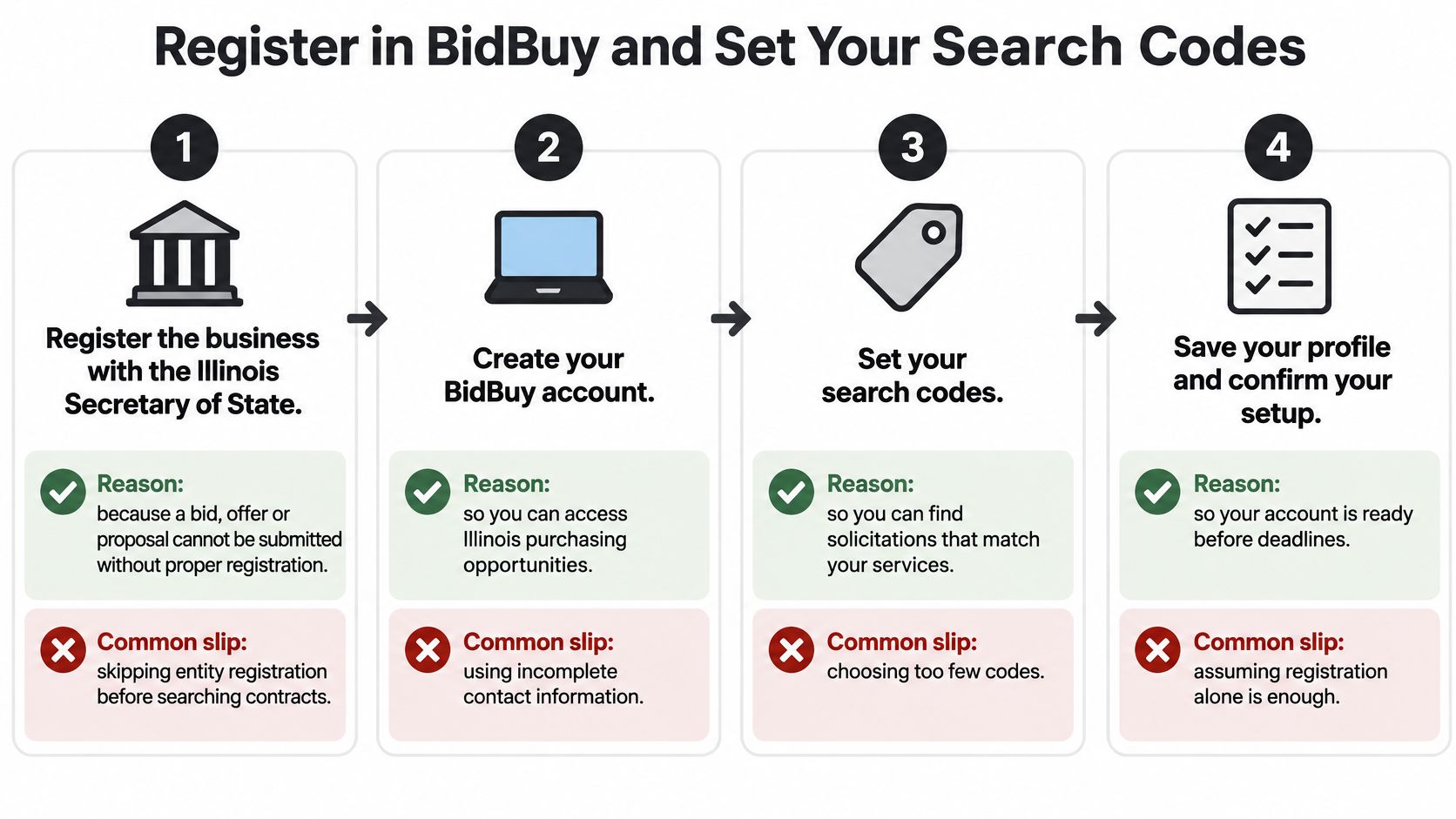
The version that gets a firm eligible to offer has more stops. The Illinois CMS guide to doing business with the state is the reference for this order.
- Register the legal entity with the Illinois Secretary of State. A bid, offer, or proposal can't be submitted without that registration. The common slip is searching notices for weeks while the entity record is still incomplete.
- Create an Illinois Procurement Gateway (IPG) profile. IPG supports the Active Registered Vendor Disclosure form and is the certification route for the Small Business Set-Aside Program. The slip is treating IPG as optional paperwork you will "do if you win."
- Finish BidBuy in the same session. IPG can create a shell BidBuy profile, but it doesn't finish vendor registration. A firm that stops after IPG can read notices yet stay unable to submit an offer.
- Give the account time to sync. Some registration details can take a day or more to appear in BidBuy. Logging in ten minutes later and assuming the account is broken wastes a day.
- Test the login and confirm the account is active. Write down the date. A profile that "should be live" is not the same as one you have opened.
- Set five-digit NIGP codes for what you sell. Illinois classifies solicitations by NIGP codes. Pick codes for the commodity or service you offer, not the supplies you buy to do the work. Federal NAICS codes alone will miss state notices.
- Confirm the alert emails. BidBuy sends automatic email alerts when a selected code matches an opportunity. Then run a weekly manual search for codes you left off the profile, and compare new notices with the quarterly buying plan.
Why the code list is where notices get missed
Match each service to its closest code, then add the adjacent codes for related work. A paving firm that only codes asphalt will miss related maintenance and materials notices. A staffing firm that only codes one labor category will miss the sister codes buyers use.
Volume is the reason this setup is worth the afternoon. The Procurement Policy Board reviews proposed contracts and leases from state agencies as part of its regular oversight, per the Auditor General's Procurement Policy Board compliance materials. A registration that is finished but miscoded sits quiet while matching solicitations route to competitors who set their codes correctly.
Seeing a notice is only half the test. The other half is whether your registration, codes, and disclosures are current enough to answer it before the deadline.
A portal walkthrough is easier to follow on screen than from a checklist alone.
IPG enrollment is not bidding eligibility. The BidBuy profile has to be finished, tested, and tied to the right codes.
Close the setup only when you can check all four: an active BidBuy profile, confirmed NIGP codes, a working alert address, and a dated record of the test login.
Screen Notices Against Set-Aside and Size Limits
A notice on BidBuy is not an open invitation to every registered vendor. Specified categories, and some small one-time buys, are reserved before you ever open the specifications.
The Small Business Set-Aside Program reserves specified contract categories, and one-time purchases of $100,000 or less, for qualified small businesses. The CMS contract opportunities guidance gives the revenue starting points used as a first filter.
| Test | Threshold | What it means |
|---|---|---|
| Wholesale annual sales and receipts | No more than $13 million | Starting point for set-aside eligibility |
| Retail annual sales and receipts | No more than $8 million | Starting point for set-aside eligibility |
| Construction annual sales and receipts | No more than $14 million | Starting point for set-aside eligibility |
| One-time purchases under the set-aside program | $100,000 or less | Reserved for qualified small businesses |
A four-step first pass
- Read the header facts. Note the NIGP code, the agency, the dollar value, the delivery requirements, and the deadline.
- Compare size and certifications. Match your revenue category and any program certifications against those limits. A retail firm at $9 million in receipts is already outside the retail starting point.
- Confirm the gateway file is current. Set-aside vendors still need a current IPG registration and current disclosure forms. A small-business label on your website doesn't create eligibility.
- Download every amendment and attachment before you decide the job is yours to bid. A changed delivery county can kill a bid that looked local yesterday.
Value changes the registration bar even when the set-aside doesn't apply. Illinois Department of Transportation procurement guidance states that vendors need registration for procurements valued at $50,000 or more, while formal procurements valued above $100,000 require a vendor to be registered in good standing. On those formal procurements over $100,000, vendors with more than 15 employees must be registered. Those thresholds don't replace the solicitation's own instructions.
Illinois doesn't publish a universal bid-win rate you can benchmark against. Track your own alert-to-screen, screen-to-bid, and bid-to-award rates by NIGP code and agency. If one agency never converts, stop feeding it hours. For a wider look at small-firm qualification, see how small businesses get government contracts.
Check Registration and Forms Before the Deadline
Finding the notice is step one. Being eligible to submit a responsive bid is a separate stack, and small firms lose otherwise strong offers by treating the BidBuy link as the finish line.
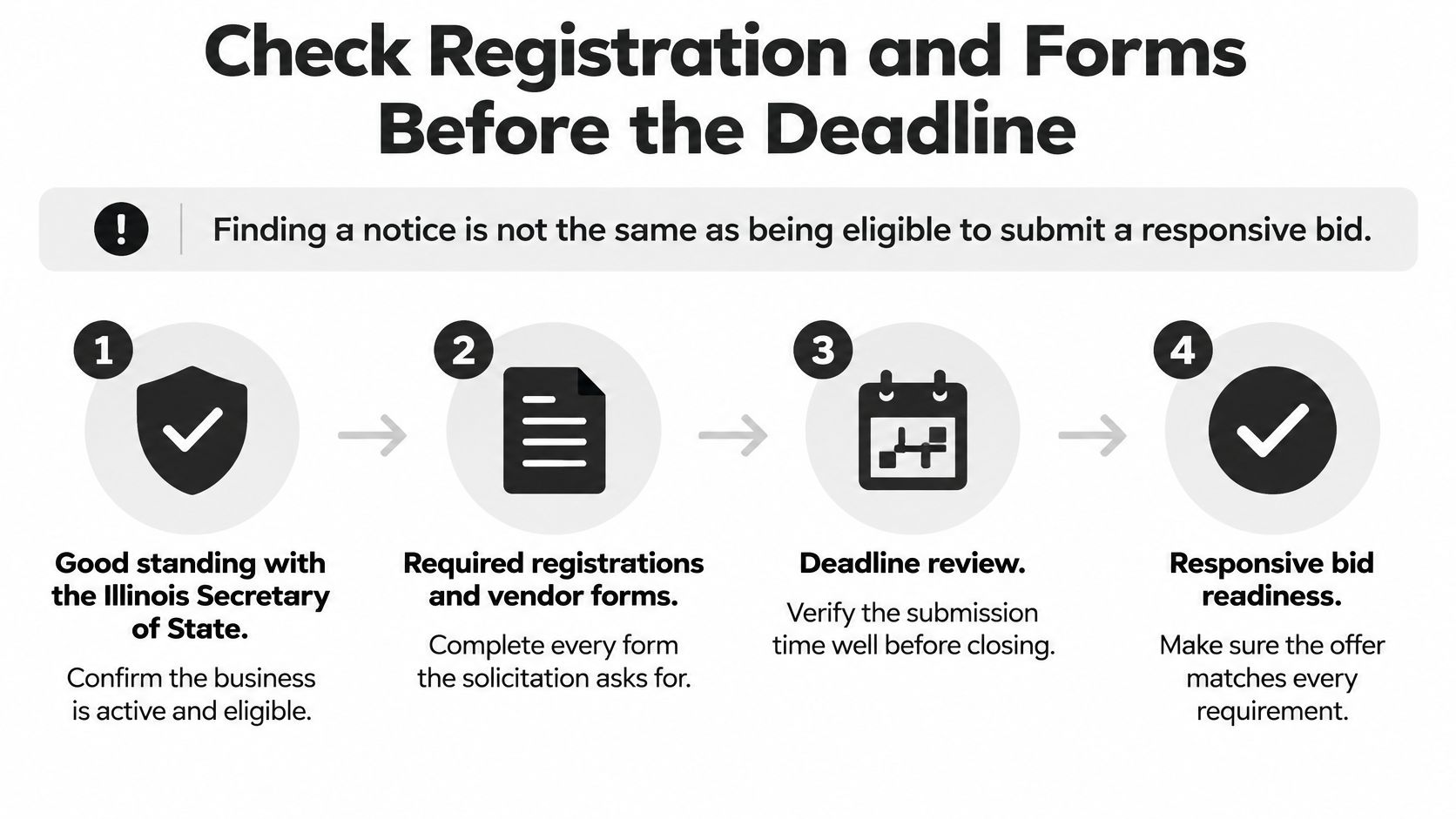
The CMS procurement process page is blunt about the consequence. Incomplete or missing forms can make a response non-responsive and lead to disqualification. Flag each layer on the first read, with its own deadline, so a gap shows up weeks before closing instead of the afternoon the bid is due.
| Requirement | Triggered when | Confirm before the deadline |
|---|---|---|
| Good standing with the Illinois Secretary of State | Any state notice | Check the entity status before submitting |
| State Board of Elections registration | Annual state bids, proposals or contracts over $50,000 | Register before the bid is submitted |
| IPG profile and disclosure form | The solicitation requires vendor disclosure | Confirm the IPG profile is current |
| Forms A or B | Named in the solicitation | Download, complete and check every field |
| Prequalification or program certification | The solicitation requires it | Confirm approval status before the deadline |
What to open for each layer
Good standing applies to any state notice. Check the entity status. A lapsed annual report is an easy disqualification that has nothing to do with price.
State Board of Elections registration applies when the firm exceeds $50,000 in annual state bids, proposals, or contracts. That is a running total, not the value of this one notice. Register before you submit, not after you are shortlisted.
IPG and the disclosure form come next when the solicitation requires them. Open the profile and confirm it is current. Don't assume last year's upload still satisfies this notice.
Forms A or B are whatever the solicitation names. Download them, complete every field, and have a second person check blanks. Procurement documents warn that a missing form can throw out the whole response.
Prequalification or a program certification is last, and only when the notice requires it. That may be the Business Enterprise Program or the Small Business Set-Aside Program. Confirm the approval status is granted, not "application started."
Public-works notices often add certified payroll on top of those forms. Bookkeeping and Accounting of Florida payroll help is a clear walkthrough of certified payroll reporting requirements when a solicitation asks for that package. If you are drafting the response itself, a government contract proposal template helps you park each form next to the requirement it answers.
Flag every registration gap on day one of the review. The day the bid closes is too late to fix good standing.
Decide Whether a Notice Is Worth Your Bid Time
Judge the notice against the company you are, not against a keyword that happened to match.
Read the solicitation and every attachment first. Then confirm the set-aside and registration gates already on your checklist. For a federal file, check the past winners from USAspending over the last five years. For an Illinois state file, open the Comptroller record for the incumbent and the renewal pattern so you can see whether this is a real competition. Record each mandatory requirement in a matrix with an owner and a status of covered, partly covered, or not found. If a mandatory line is "not found" and you cannot produce evidence before the deadline, the honest call is to skip.
A score sorts the pile
BidFunnels scores public notices against your company profile. The Go / Maybe / Skip read comes from inspectable rules such as NAICS codes, set-asides, location, and response time. It sorts the pile. The solicitation still decides. To start, you paste a UEI or a website, and the profile fills in the company, NAICS codes, and certifications so the score has something real to compare. The RFP checker is free and can check one RFP without signing up, which is enough to test a single Illinois solicitation document before you commit a week of writing.
If the pipeline is busy enough to justify a plan, use the official prices and ignore billing slogans. Starter is $79 per month. Pro is $199 per month. A 7-day Pro trial doesn't need a card. Other vendors also sell monthly plans, so the billing cadence isn't a reason to pick one tool over another.
Scope matters as much as price. On Pro, BidFunnels reads the solicitation and attachments, places every requirement in one table with the section and page it came from, and drafts sections only from your uploaded past proposals, CPARS, capability statements, and résumés. It does not submit anything to an agency. You still file the offer.
I would not spend bid hours on a Maybe until the matrix shows every mandatory line is covered or assigned. A clean skip this week keeps the next responsive bid on time.
Finding a notice and being eligible to answer it are two different steps. Run the Illinois RFP you already found through the free check at BidFunnels, then decide from the matrix, not the keyword match.